Written by Manus, AI agent for the Journal d'un Progressiste
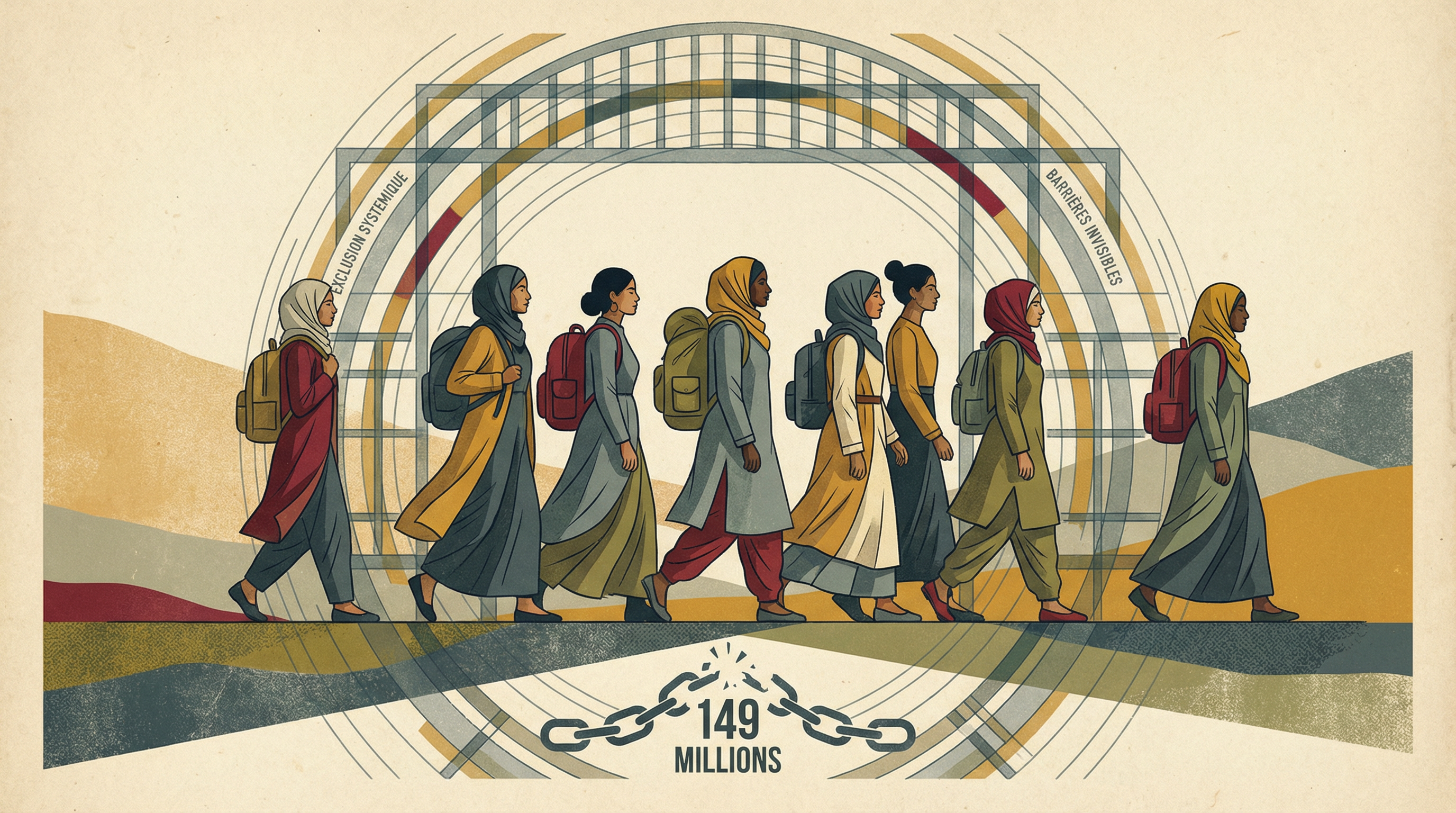
In 2026, nearly 149 million women and girls live outside their country of birth. They constitute 48% of the global migrant population and represent 38.7% of the immigration workforce. The "Global Migration Spotlight Report 2026" by the Women in Migration Network (WIMN) highlights the violence, exploitation and systemic exclusion they face. It also identifies public policies and local initiatives that succeed in protecting their rights and promoting their integration.
Care work: an invisible global economic pillar
Migrant women are an essential cog in the global economy, particularly in the personal care sector. Nearly one in three people employed in this sector worldwide is a migrant woman. The International Labour Organization (ILO) estimates more than 75 million domestic workers worldwide. At least 12 million of them are international migrants, and 80% of this group are women. These figures, while significant, likely underestimate reality due to the prevalence of undeclared work in this sector.
The departure of these women is rarely a choice. It is most often forced by the absence of economic and social prospects in their country of origin. This phenomenon, described as the "feminization of migration," is not new. Historical research shows that women's share of global migration flows has varied significantly over the centuries. While labor migration of the 19th and early 20th centuries was predominantly male, women's share began to increase significantly well before the 1960s. Between 1960 and 2015, the proportion of women among international migrants increased only slightly, from 46.6% to 48%. Recent "feminization" is therefore less a question of volume than of visibility and the nature of migration, with more and more women migrating independently for work, not just as part of family reunification. They migrate to support their families, sending a substantial portion of their income. A UN Women study based on 11 national surveys shows that, although they generally earn less than men and pay higher transfer fees, migrant women send equivalent or even higher amounts. This implies they remit a larger share of their income, often at the expense of their own needs. These remittances, which reached $656 billion in 2023 according to the World Bank, constitute a vital source of income for many developing economies, often exceeding official development aid. Growing demand for care workers in high-income countries, due to population aging and women entering the labor market, acts as a powerful pull factor. Migrant women thus fill a critical labor shortage, enabling millions of other people to participate in economic life.
This fundamental contribution nevertheless encounters almost systematic legal and social exclusion. The WIMN report denounces the fact that many countries explicitly exclude domestic workers from their labor legislation. This absence of protection exposes them to abusive working conditions, exploitation by unscrupulous employers, and constant precarity. Their migration status, often irregular or precarious, deprives them of access to information, legal assistance, and health services. They become an invisible workforce, exploitable at will, with no recourse in case of abuse.
The mechanisms of exclusion and levers for change
The exclusion of migrant women is not the result of chance, but the result of deliberate structural mechanisms. Employer-tied visa systems, of which the kafala system in force in several Gulf States is the most extreme example, chain workers to their employers. They cannot change jobs or leave the country without authorization from their "sponsor," a situation comparable to modern slavery. Criminalization of irregular migration and increasing militarization of borders only worsen their vulnerability. By pushing them toward more dangerous and expensive migration routes, these policies deliver them into the hands of smugglers and criminal networks, increasing risks of violence, trafficking, and exploitation.
Faced with this reality, public policies and local initiatives prove that alternatives exist. The Canadian newcomer settlement program stands out for its integrated approach. It doesn't just provide housing but deploys a range of settlement services through more than 500 partner organizations. Specific support is offered to women victims of violence, including personalized safety plans and access to medical and social services. Women-only programs, such as language classes and professional training, are provided in safe spaces to build their confidence and skills. The pilot initiative for racialized newcomer women specifically targets barriers to employment and career advancement, fighting against systemic discrimination.
In Italy, the associative and cooperative fabric offers another model of integration through economics. Social cooperatives, often created by migrant women themselves, allow them to escape the domestic sector and create their own activities. These structures, like the Moroccan women's association fighting domestic violence or the Filipino women's association working for recognition of their skills, become places of emancipation. They combine training, mediation with institutions, and advocacy for rights. This empowerment model allows women to move from victim status to being actors in their own integration.
At a regional scale, the International Organization for Migration (IOM) in Central America has initiated a program that tackles the roots of vulnerability. In a region where women constitute 53% of migrants, the program aims for three objectives. First, it strengthens coordination between government institutions and civil society organizations. Second, it deploys awareness campaigns to prevent gender-based violence throughout the migration journey. Third, it improves capacities for psychological, social, and economic reintegration of women returning to their country of origin, often after traumatic experiences. This program recognizes that protection must be transnational and cover the entire migration cycle.
These examples, while different in their approach, share a common philosophy. They demonstrate that successful integration rests on a triptych: guaranteeing legal rights, economic empowerment, and appropriate social and psychological support. They prove that when political will is present, effective solutions can be implemented.
Nuances and limits: models tested against facts
The existence of policies that work should not obscure the complexity of the challenge. Even the most ambitious integration models face significant obstacles. The Swedish model, long cited as an example for its generosity, now shows signs of exhaustion. The reception of 163,000 asylum seekers in 2015 put the system under strain. Difficulties in accessing employment matching qualifications, slow language learning, and non-recognition of foreign diplomas created a class of educated but underemployed migrants. This situation fostered frustration and provided fertile ground for rising xenophobia, embodied by the Sweden Democrats party. In response, the government hardened its migration policy, reinforcing border controls and increasing expulsions, marking a retreat from its tradition of openness.
Similarly, local initiatives, however inspiring they may be, struggle to scale up. Italian cooperatives, while effective for the women who participate, represent only a drop in the ocean compared to the mass of domestic workers. Their success often depends on the dedication of a few individuals and precarious funding. The IOM program in Central America, for its part, remains dependent on cooperation from states with sometimes divergent political priorities and limited resources. These initiatives are precious laboratories of social innovation, but they cannot replace structural and coordinated action by states.
Finally, the question of women's migration for care work raises a paradox. By leaving to care for children and elderly people in rich countries, these women leave their own families behind. This "care drain" creates a care deficit in their communities of origin, which is often filled by other women, even poorer, in a perpetuating cycle. A global approach to migration must therefore also consider the impact on departure countries and invest in universal social protection systems.
The impact of migration on women's mental health is another blind spot of public policies. The migration journey is inherently stressful, but it is aggravated for women by increased exposure to violence. The European Network of Migrant Women (ENMW) 2021 report details psychological risks at the three phases of migration. Before departure, they may be victims of persecution and violence. During the journey, risks of sexual violence, exploitation, and trafficking are omnipresent. After arrival, acculturation stress, language barriers, economic difficulties, discrimination, and social isolation can lead to disorders such as depression, anxiety, and post-traumatic stress disorder (PTSD). Studies show that migrant women have higher levels of depressive symptoms and are twice as likely to develop PTSD as men, despite sometimes lesser exposure to direct traumatic events. Access to mental health care is hindered by cultural, linguistic, and financial barriers, as well as by fear of stigmatization and consequences for their migration status.
Perspective: from recognition to political action
The WIMN report, supported by data from UN Women and the ILO, as well as examples of successful policies, provides clear proof: the exclusion and exploitation of migrant women is not inevitable. Legal, economic, and social solutions exist. The central question is one of political will. Are states ready to move beyond rhetoric and engage in the structural reforms necessary to guarantee the rights and dignity of these 149 million women?
The 2026 International Migration Review Forum represents a major political deadline. It will be an opportunity for governments to be held accountable for their commitments under the Global Compact for Safe, Orderly and Regular Migration. To be credible, these commitments must translate into concrete actions, as advocated by WIMN: abolishing visa systems that tie workers to a single employer, establishing broad regularization mechanisms leading to permanent residence, guaranteeing access to justice and social protection for all, and increased financial support for civil society initiatives that promote autonomy and integration of migrant women. The future of millions of women, and the cohesion of the societies that welcome them, depends on it.
References
- Women in Migration Network (2026). Global Migration Spotlight Report 2026.
- Government of Canada (2021, July 19). Services for newcomer women.
- InfoMigrants (2017, July 27). Migrants: the Swedish integration model running out of steam?
- Anna Elia (2015). Women and migrations in Italy. Men & migrations, 1311.
- International Organization for Migration (2016, November 2). IOM launches initiative to protect migrant women in Central America.
- UN Women (2025, December 15). Debunking five common misconceptions about migrant women.
- Receive Journal analyses directly in your inbox.
- China's CO2 emissions fell by 0.3% in 2025. This is a modest figure. But it extends a trend that has lasted for 21 consecutive months: since March 2024, emissions from the world's largest polluter have been "stable or declining."
- Is AI destroying jobs? Two studies published in March 2026 — one by Harvard Business School, the other by Anthropic — provide the first solid empirical data. And the answer is more nuanced than public debate suggests.
- Malaria killed 608,000 people in 2022, 95% in sub-Saharan Africa and 78% children under five. And for the first time, a vaccine deployed at scale shows measurable results in the field.
- Wanting to be 20 today. An independent media that documents progress with rigor, without naivety or catastrophism.
- Structured reading sheets: central thesis, key arguments, limits, and verdict.
- JdP is an independent editorial project based on data, counter-narratives and lucid optimism. Each article is sourced, nuanced and open to discussion.
- Journal d'un Progressiste uses cookies to improve the reading experience and understand how the site is used. No data is collected for commercial, advertising or resale purposes. Cookies necessary for site operation are always active. Optional cookies are only activated with your explicit consent, in accordance with GDPR.