2.1 billion informal jobs: the global labor market in 2026
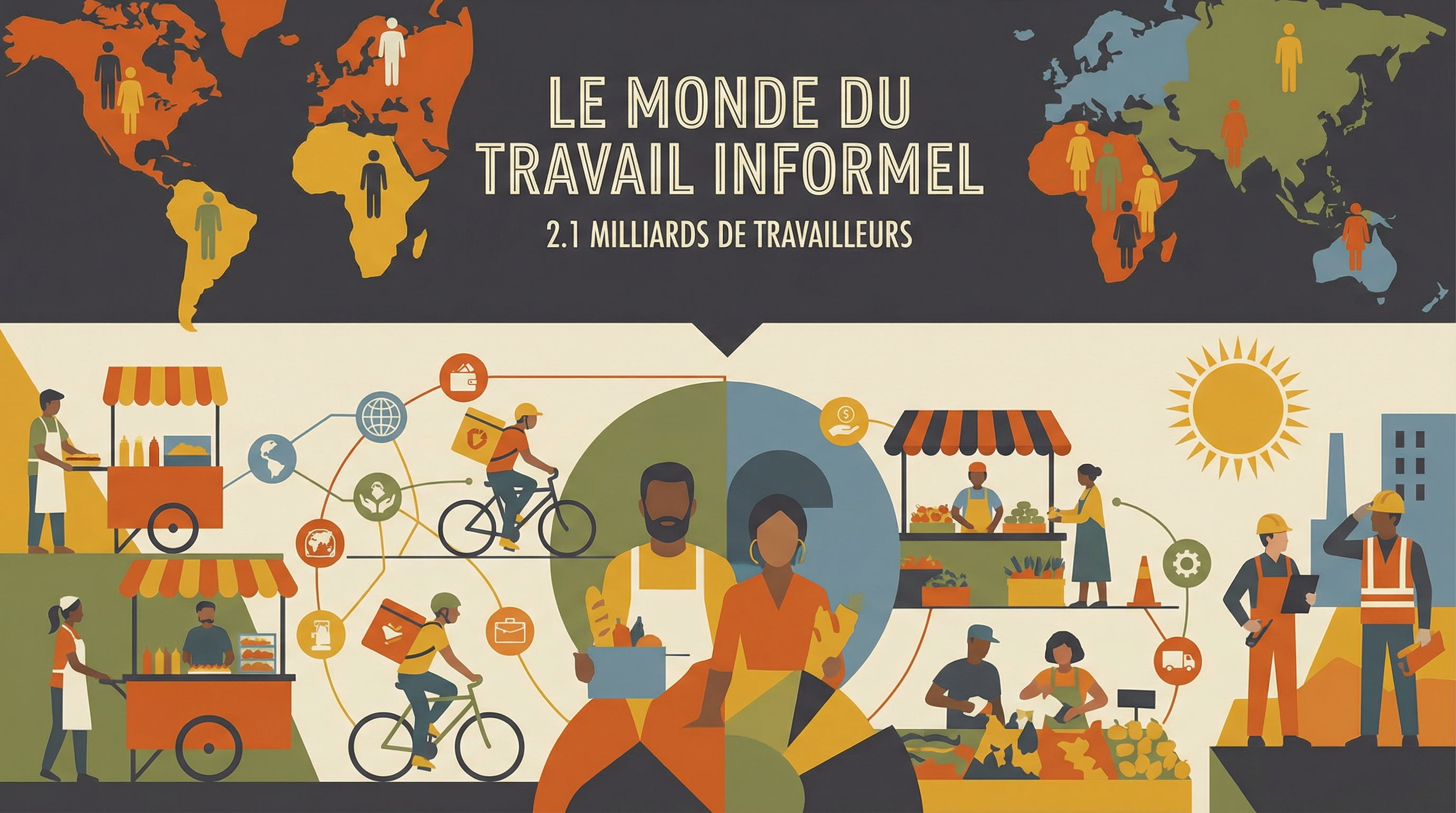
In 2026, 2.1 billion workers worldwide are expected to hold informal employment [1]. This figure, from the latest International Labour Organization (ILO) report, reveals the hidden face of a global labor market in full transformation. Behind a global unemployment rate that remains stable at 4.9% lies a continuous deterioration in job quality and rising inequalities, sketching a two-speed future of work. An in-depth analysis of ILO data highlights a complex and often contradictory reality, where the apparent stability of major macroeconomic aggregates conceals increasingly deep social and economic fractures. This situation challenges policymakers, social partners, and civil society to rethink development models to ensure a more just and inclusive future of work for all.
4.9% unemployment: a misleading stability
The main indicator of the global labor market, the unemployment rate, is expected to remain stable at 4.9% in 2026, corresponding to 186 million people without jobs [1]. While this figure may seem to indicate some resilience in the global economy, it masks much darker realities. The ILO introduces a broader measure, the "global employment gap," which includes people wanting to work but without access to employment. This indicator is expected to reach 408 million people in 2026, showing much greater unmet labor demand than the unemployment rate alone suggests [2]. This gap highlights that a significant portion of the global population is excluded from the labor market, not by choice, but due to lack of opportunities. This exclusion has major economic and social consequences in terms of lost production, poverty, and inequality.
Beyond access to employment, it is the quality of work that is deteriorating. Nearly 284 million workers live in extreme poverty, with less than $3 per day [2]. The global informal employment rate, after a decade of decline, increased by 0.3 percentage points between 2015 and 2025. These workers, deprived of access to social protection, fundamental rights, and job security, constitute the silent majority of a globalized economy that struggles to produce decent work for all.
Real wage and labor income growth has failed to compensate for recent inflationary shocks, limiting gains in living standards. The global share of labor income in GDP, at 52.6% in 2025, remains below its 2019 level (53.0%), indicating a decoupling between productivity growth and labor compensation [2].
2.1 billion workers in the shadows
The increase in informal employment is one of the most concerning symptoms of labor market deterioration. In 2026, 2.1 billion people, or 57.7% of global workers, will be employed informally [1]. This increase is mainly driven by countries with high demographic growth in Africa and South Asia, where economic structures struggle to absorb the massive influx of young people into the labor market. The slowdown in structural transformation of economies—the transition from an agricultural economy to industrial and then service economies—is a key factor in this persistent informality. In many developing countries, the informal agricultural sector remains a major employer, while the rapidly expanding service sector often creates low-skilled and precarious jobs.
The informal economy is not a homogeneous phenomenon. It covers a multitude of situations, from street vendors to digital platform workers, including undeclared agricultural workers. What these situations have in common is the absence of protection and rights. In low-income countries, self-employment, often out of necessity, increased again between 2015 and 2025, illustrating the lack of quality wage employment opportunities.
This precarization is not limited to developing countries. In developed economies, new forms of precarious work are emerging, notably through the "gig economy." While these jobs are not always informal in the statistical sense, they share many characteristics with traditional precarious employment: income instability, absence of social protection, and weak bargaining power for workers.
A widening North-South divide
The ILO report highlights a growing divergence between high-income and low-income countries. In wealthy countries, population aging and slowing growth of the working-age population help stabilize unemployment. Conversely, low-income countries experience strong demographic growth, with employment growth estimated at 3.1% in 2026. However, this employment growth is not accompanied by improved quality. Weak productivity gains and slow structural transformation of economies mean that many new jobs are created in the informal and low-productivity sector. This North-South divide is also visible in job quality indicators. While high-income countries have made significant progress in reducing working poverty and informality, these scourges remain endemic in low-income countries. The ILO report emphasizes that both extreme and moderate working poverty rates increased in low-income countries between 2015 and 2025, affecting nearly 68% of workers in 2025 [2].
This divergence risks canceling out the potential "demographic dividend" for many Southern countries. While their working-age population is rapidly increasing, the inability to create decent jobs could translate into increased poverty and social instability. Inequalities also persist, particularly for women and young people. Women represent only two-fifths of global employment and are 24.2% less likely than men to participate in the labor market [2]. Youth unemployment stands at 12.4%, and 20% of young people are neither in employment, education, nor training (NEET) [2].
Solutions exist: three inspiring models
Faced with this dark picture, solutions are emerging to promote decent work and reduce precariousness. Three national examples illustrate promising approaches.
1. Progressive formalization in Rwanda
Rwanda has made formalizing its economy a national priority. Aware that the informal economy represents a significant share of its GDP and employment, the country has implemented a progressive formalization strategy. Rather than opting for a repressive approach, the Rwandan government has emphasized incentives to encourage businesses and workers to join the formal sector. This includes simplified registration procedures, tax incentives, and facilitated access to credit and public markets for businesses that formalize [3]. The country is also working to extend social protection to make it a pathway to formalization [3].
2. Universal social protection in India with PM-JAY
India launched the Ayushman Bharat Pradhan Mantri Jan Arogya Yojana (PM-JAY) program in 2018, the world's largest state-funded health insurance program [4]. It aims to provide free health coverage of up to 500,000 rupees (about €5,500) per family per year for secondary and tertiary hospital care to more than 100 million poor and vulnerable families [5]. By decoupling social protection from formal employment, this type of program offers an essential safety net for informal economy workers and can reduce the vulnerability associated with employment precariousness.
3. Dual vocational training in Germany
Germany's dual vocational training system is globally recognized for its effectiveness in integrating young people into the labor market. This system combines theoretical training in vocational schools with practical training in companies. Apprentices acquire skills directly relevant to the labor market, facilitating their transition to stable and skilled employment [6]. This model, by ensuring a highly skilled workforce, contributes to German economic competitiveness and low youth unemployment. It represents a proven path to improve human capital quality and avoid the trap of low-skill jobs.
Nuances and risks: the uncertain future of work
While these solutions are hopeful, their generalization faces numerous obstacles. Measuring the informal economy remains a statistical challenge, making precise evaluation of public policies difficult. Moreover, the ILO report highlights several major risks that could further darken labor market prospects. Uncertainty related to trade policies, growing sovereign debt, and disruptions induced by artificial intelligence (AI) are all threats to global employment stability [1]. Implementing structural reforms, such as those undertaken in Rwanda, requires strong political will and administrative capacity that are often lacking in the poorest countries. Similarly, extending universal social protection, as in India, faces significant budget constraints. As for vocational training, its effectiveness depends on the education system's ability to rapidly adapt to the economy's changing needs.
The impact of AI on youth employment is particularly concerning. Preliminary data for high-income countries suggest that young graduates entering the labor market could face increased difficulties due to automation of certain skilled tasks [2]. Young people with high education levels face a greater risk of automation than their less educated counterparts, which could question the return on investment of higher education.
Perspective: toward a new social contract
The deterioration of job quality and rising precariousness are not inevitable. They call for determined political action, both nationally and internationally. The ILO report emphasizes that in a context of sluggish global growth, progress will increasingly depend on national political choices. Strengthening quality job creation, investing in skills, expanding social protection, and strengthening labor market institutions are essential levers. This requires better coordination of economic, social, and employment policies, as well as strengthened social dialogue between governments, employers, and workers. Promoting transition to the formal economy, fighting discrimination in the labor market, and establishing social protection floors are priorities for building a more just future of work.
Beyond specific policies, the need for a new social contract emerges. A social contract adapted to 21st-century realities that recognizes the diversity of employment forms and guarantees rights and protection to all workers, regardless of their status. The question is no longer just how to create more jobs, but how to create decent jobs that allow everyone to live with dignity and contribute to a more just and sustainable society.
References
- [1] ILO. (2026). World Social and Employment Trends 2026. International Labour Organization. https://www.ilo.org/fr/publications/flagship-reports/tendances-sociales-et-de-lemploi-2026
- [2] ILO. (2026). Employment and Social Trends 2026. International Labour Organization. https://researchrepository.ilo.org/view/pdfCoverPage?instCode=41ILO_INST&filePid=13147301370002676&download=true
- [3] Global Accelerator on Jobs and Social Protection for Just Transitions. (2025). Rwanda identifies key actions to support the transition to formality, with social protection as a key pathway. https://www.unglobalaccelerator.org/rwanda-identifies-key-actions-support-transition-formality-social-protection-key-pathway
- [4] National Health Authority, Government of India. (n.d.). About Pradhan Mantri Jan Arogya Yojana (PM-JAY). http://nha.gov.in/PM-JAY
- [5] MyScheme, Government of India. (n.d.). Ayushman Bharat - Pradhan Mantri Jan Arogya Yojana. https://www.myscheme.gov.in/schemes/ab-pmjay
- [6] Make it in Germany. (n.d.). How to find vocational training?. https://www.make-it-in-germany.com/fr/etudes-formations/formation-en-allemagne/comment-trouver
- Receive Journal analyses directly in your inbox.
- China's CO2 emissions fell by 0.3% in 2025. It's a modest figure. But it extends a trend that has lasted for 21 consecutive months: since March 2024, the world's largest polluter's emissions have been "stable or declining."
- Does AI destroy jobs? Two studies published in March 2026—one by Harvard Business School, the other by Anthropic—provide the first solid empirical data. And the answer is more nuanced than public debate suggests.
- Malaria killed 608,000 people in 2022, 95% in sub-Saharan Africa and 78% children under five. And for the first time, a vaccine deployed at scale shows measurable results in the field.
- Wanting to be 20 today. An independent media that documents progress rigorously, without naivety or catastrophism.
- Structured reading sheets: central thesis, key arguments, limitations, and verdict.
- JdP is an independent editorial project based on data, counter-narratives, and lucid optimism. Each article is sourced, nuanced, and open to discussion.
- Le Journal d'un Progressiste uses cookies to improve the reading experience and understand how the site is used. No data is collected for commercial, advertising, or resale purposes. Cookies necessary for site operation are always active. Optional cookies are only activated with your explicit consent, in accordance with GDPR.