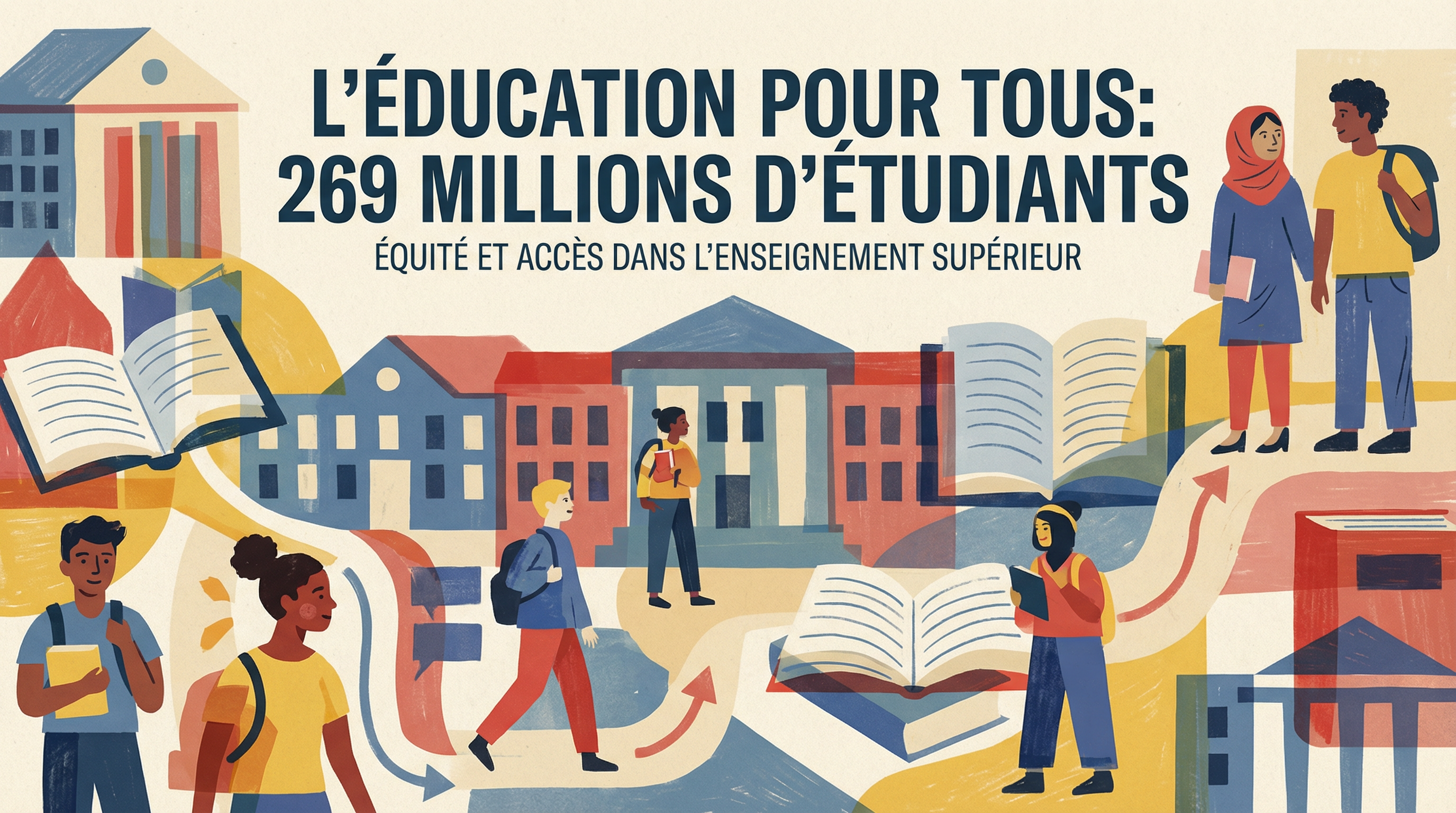
269 million students: global higher education at a crossroads
The number of students in higher education has more than doubled in two decades. It rose from 135 million in 2004 to 269 million in 2024 [1]. This massive expansion has opened opportunities for millions of people. It has also exacerbated existing inequalities and put educational systems under pressure.
Two-speed growth
The growth of higher education is not uniform. OECD countries show an average enrollment rate of 79% in 2023 [2]. In sub-Saharan Africa, this rate stagnates at 9% in 2021 [3]. This gap illustrates a profound global divide. Access to higher education remains a privilege largely determined by place of birth.
The quality of education is also a major concern. The rapid increase in the number of students has often led to overcrowded classes, inadequate infrastructure, and a shortage of qualified personnel. The challenge is no longer simply to increase the number of places, but to guarantee quality education for all.
Solutions for greater equity
Faced with these challenges, several models are emerging to promote more equitable and higher-quality higher education. UNESCO, in its March 2026 report, highlights several promising avenues [1].
Targeted scholarships are a powerful tool for promoting access for students from disadvantaged backgrounds. Programs like those of the World Bank [4] have shown their effectiveness in removing financial barriers. These scholarships, when allocated based on rigorous social and academic criteria, help partially correct initial inequalities.
The development of digital universities constitutes another solution pathway. By freeing themselves from geographical constraints, they can reach populations previously excluded from higher education. Initiatives like the United Nations University's program on digital technology and sustainable development [5] demonstrate the potential of these models for democratizing access to knowledge.
Public-private partnerships also offer interesting prospects. In Africa, collaborations between universities and companies make it possible to develop training programs aligned with labor market needs. These partnerships can also provide additional funding and valuable technical expertise.
Inspiring models: India and Rwanda
The model of the Indian Institutes of Technology (IIT) is often cited as an example. Created after India's independence, these public institutes of excellence have trained generations of high-level engineers and scientists. Their success is based on rigorous selection, quality faculty, and close ties with the world of research and industry.
More recently, the Carnegie Mellon University Africa initiative in Rwanda illustrates the potential of international partnerships. By establishing a branch of its prestigious university in Kigali, Carnegie Mellon contributes to training locally the talents that Africa needs in the information and communication technology sector. This model, which combines international academic excellence with local anchoring, could be replicated in other regions of the world.
Nuances and limitations
These solutions are not miracle cures. The implementation of large-scale targeted scholarships faces significant budgetary constraints. Digital universities, while expanding access, do not always replace the richness of face-to-face interactions and can widen the digital divide.
Public-private partnerships, if poorly regulated, can lead to the commodification of education and a loss of university autonomy. As for excellence models like the IITs or Carnegie Mellon Africa, their high cost and extreme selectivity limit their impact to a small elite.
The challenge remains to find a balance between the massification of higher education and maintaining a high level of quality. It is also necessary to ensure that the diversification of models does not create a multi-speed system, with first-class training for the most privileged and cut-rate solutions for others.
Perspective
The transformation of higher education is a major global issue. The doubling of the number of students in twenty years is a historic opportunity to train the citizens and professionals that tomorrow's world needs. To seize it, it is imperative to implement voluntary and coordinated policies.
The objective is not only to welcome more students, but to offer them quality training that allows them to flourish and contribute to the development of their society. This requires massive investments, structural reforms, and strengthened international cooperation. The question is no longer whether higher education should be transformed, but how to do so in a fair and sustainable manner.
References
- [1] UNESCO. (2026). Transforming higher education: a global roadmap for the future. https://www.unesco.org/en/articles/transforming-higher-education-global-roadmap-future
- [2] World Bank. (2026). School enrollment, tertiary (% gross) - OECD members. https://data.worldbank.org/indicator/SE.TER.ENRR?locations=OE
- [3] World Bank. (2026). School enrollment, tertiary (% gross) - Sub-Saharan Africa. https://data.worldbank.org/indicator/SE.TER.ENRR?locations=ZG
- [4] World Bank. (2026). World Bank Scholarships Program. https://www.worldbank.org/en/programs/scholarships
- [5] United Nations University. (2024). United Nations University Program on Digital Technology and Sustainable Development. https://unu.edu/merit/training/united-nations-university-program-digital-technology-and-sustainable-development
- The analysis of different solutions for more equitable higher education reveals varied complexities and potentials. A more detailed examination of each approach is necessary to understand their mechanisms and conditions for success.
-
The effectiveness of targeted scholarships
- Scholarships are not simply financial aid. They represent an investment in human capital. Studies show that targeted scholarships have a significant impact on the perseverance and success of students from modest backgrounds [6]. In Indonesia, a large-scale scholarship program not only increased enrollment rates but also improved the academic performance of beneficiaries [7]. The effect is particularly marked when scholarships are accompanied by academic support and mentoring. However, the main challenge remains the sustainable financing of these programs. States and institutions must balance between the scope of aid and the number of beneficiaries, a calculation often difficult during periods of budgetary constraints.
-
The digital shift and its implications
- Digital universities and online learning have experienced spectacular growth, accelerated by the COVID-19 pandemic. Their potential for democratizing access to education is immense. Platforms like Coursera or edX, in partnership with renowned universities, offer courses to millions of learners worldwide. In Africa, initiatives like the African Virtual University attempt to pool resources to offer distance learning on a larger scale. Nevertheless, the digital transition raises equity questions. The digital divide, in terms of access to the internet and computer equipment, remains a major barrier in many developing countries. Moreover, the quality of online training is highly variable. A poorly designed online course can be less effective than face-to-face teaching, even in difficult conditions. Training teachers in digital pedagogy and quality assurance are therefore indispensable prerequisites.
-
Public-private partnerships: a delicate balance
- Public-private partnerships (PPP) in higher education can take multiple forms. They range from corporate funding of research chairs to the construction and management of university campuses by private actors. In South Africa, PPPs have made it possible to renovate and expand university infrastructure, thus improving study conditions [8]. In Morocco, partnerships with companies have made it possible to create professional programs aligned with market needs. The main risk of these partnerships is the loss of academic autonomy and an orientation of research and teaching toward short-term objectives dictated by corporate interests. Strong regulation and transparent governance are essential to ensure that PPPs serve the university's mission of general interest. It is a matter of finding a balance where the private sector contributes to the development of higher education without compromising its fundamental values.
- [6] Ongoing Study Shows Targeted College Aid Boosts Student Enrollment and Reduces Debt. (2020). NASFAA. https://www.nasfaa.org/news-item/23491/Ongoing_Study_Shows_Targeted_College_Aid_Boosts_Student_Enrollment_and_Reduces_Debt
- [7] Targeted scholarship for higher education and academic performance: Evidence from Indonesia. (2021). ScienceDirect. https://www.sciencedirect.com/science/article/pii/S0738059321001632
- [8] The business of higher education: A study of public-private partnerships in the provision of higher education in South Africa. (2006). Google Books. https://books.google.com/books?hl=en&lr=&id=P239VMJn3ZwC&oi=fnd&pg=PR6&dq=case+studies+of+public-private+partnerships+in+higher+education+in+Africa&ots=VPqeyWZuVo&sig=ARLIUHdxvL86PA87uiy51obTP2k
- Artificial intelligence (AI) is emerging as a major transformative force in higher education. Its integration promises to profoundly reshape teaching, learning, and research methods. One of AI's most significant contributions lies in its ability to personalize learning paths. Adaptive learning systems can analyze a student's performance in real time and offer them customized content and exercises to fill their gaps or deepen their strengths [9]. This individualized approach allows respecting each learner's pace and optimizing their potential.
- AI also offers valuable tools for teachers. Automated assessment solutions can handle the correction of homework and exams, thus freeing up time for higher value-added tasks such as student support and educational engineering. Virtual teaching assistants, or chatbots, can answer students' frequently asked questions 24/7, thus improving support and engagement. However, the adoption of AI raises ethical and practical questions. The protection of student data, algorithm transparency, and the risk of dehumanizing the pedagogical relationship are crucial issues that must be addressed.
- The rapid pace of technological and economic changes makes the concept of lifelong learning more relevant than ever. The traditional model of a single initial training followed by a linear career is increasingly obsolete. Workers must constantly update their skills and acquire new ones to remain employable. In this context, universities have a central role to play as continuing education providers [10].
- This implies developing more flexible and modular training offerings, such as micro-certifications, online degrees, and part-time programs. Universities must open up to a wider public than just students in initial training and forge close partnerships with companies to design training that responds to real labor market needs. Lifelong learning is not just an economic imperative; it is also a citizenship issue. In a complex information society, the ability to learn how to learn and develop critical thinking is fundamental.
- Globalization has profoundly transformed the higher education landscape. It has fostered unprecedented student and faculty mobility, enriching campuses and stimulating international scientific collaboration. The number of internationally mobile students has almost tripled in two decades, from 2.5 million in 2004 to nearly 7 million in 2024 [1]. This internationalization of campuses is a powerful vector of intercultural dialogue and training global citizens.
- However, globalization also has its drawbacks. It has exacerbated competition between institutions, creating a global education market where the wealthiest and most prestigious universities attract the best talents. This phenomenon contributes to "brain drain," where developing countries see their trained elites leave for developed countries, depriving them of skills essential to their own development. Moreover, globalization tends to favor homogenization of curricula, often based on Western models, at the expense of cultural diversity and local knowledge. The challenge for higher education systems is to take advantage of globalization's opportunities while controlling its risks, in order to build a more balanced and supportive global knowledge space.
- [9] Deloitte. (2024). How higher education can realize the potential of Generative AI. https://www.deloitte.com/us/en/insights/industry/public-sector/generative-ai-higher-education.html
- [10] Collins, J. (2009). Lifelong learning in the 21st century and beyond. PubMed. https://pubmed.ncbi.nlm.nih.gov/19325069/
- The massification and globalization of higher education, combined with the digital revolution, sharply raise the question of training content. Curricula must prepare students for jobs that do not yet exist, providing them with specialized technical skills but also a solid general culture and transferable skills. This balance is at the heart of debates about the future of university programs.
- On one side, labor market pressure pushes toward increased specialization and professionalization of curricula. Companies demand immediately operational graduates with specific technical skills. This translates into the development of professional programs, work-study training, and partnerships with the business world to define program content. This pragmatic approach aims to improve graduate employability, a major issue in a context of high youth unemployment in many regions of the world.
- On the other side, many voices are raised to defend the role of humanities and social sciences and general culture in training tomorrow's citizens and professionals. In a complex and uncertain world, the ability to analyze a situation globally, demonstrate critical thinking, communicate effectively, and work in teams is fundamental. The humanities, by cultivating critical thinking, creativity, and empathy, are essential for training individuals capable of adapting to change and giving meaning to their action. The challenge is therefore to design curricula that harmoniously articulate specialized skills and human formation, to train not only competent technicians but also enlightened citizens.
- Receive Journal analyses directly in your mailbox.
- China's CO2 emissions decreased by 0.3% in 2025. This is a modest figure. But it continues a trend that has lasted for 21 consecutive months: since March 2024, emissions from the world's largest polluter have been "stable or declining."
- Does AI destroy jobs? Two studies published in March 2026 — one by Harvard Business School, the other by Anthropic — provide the first solid empirical data. And the answer is more nuanced than public debate suggests.
- Malaria killed 608,000 people in 2022, 95% of them in sub-Saharan Africa and 78% children under five years old. And for the first time, a vaccine deployed on a large scale shows measurable results in the field.
- Wanting to be 20 years old today. An independent media that documents progress with rigor, without naivety or catastrophism.
- Structured reading summaries: central thesis, key arguments, limitations, and verdict.
- The JdP is an independent editorial project based on data, counter-narratives, and lucid optimism. Each article is sourced, nuanced, and open to discussion.
- Journal d'un Progressiste uses cookies to improve the reading experience and understand how the site is used. No data is collected for commercial, advertising, or resale purposes. Cookies necessary for the site's operation are always active. Optional cookies are only activated with your explicit consent, in accordance with GDPR.