34 Times Annual Income: The Middle Class Faces a Global Housing Crisis
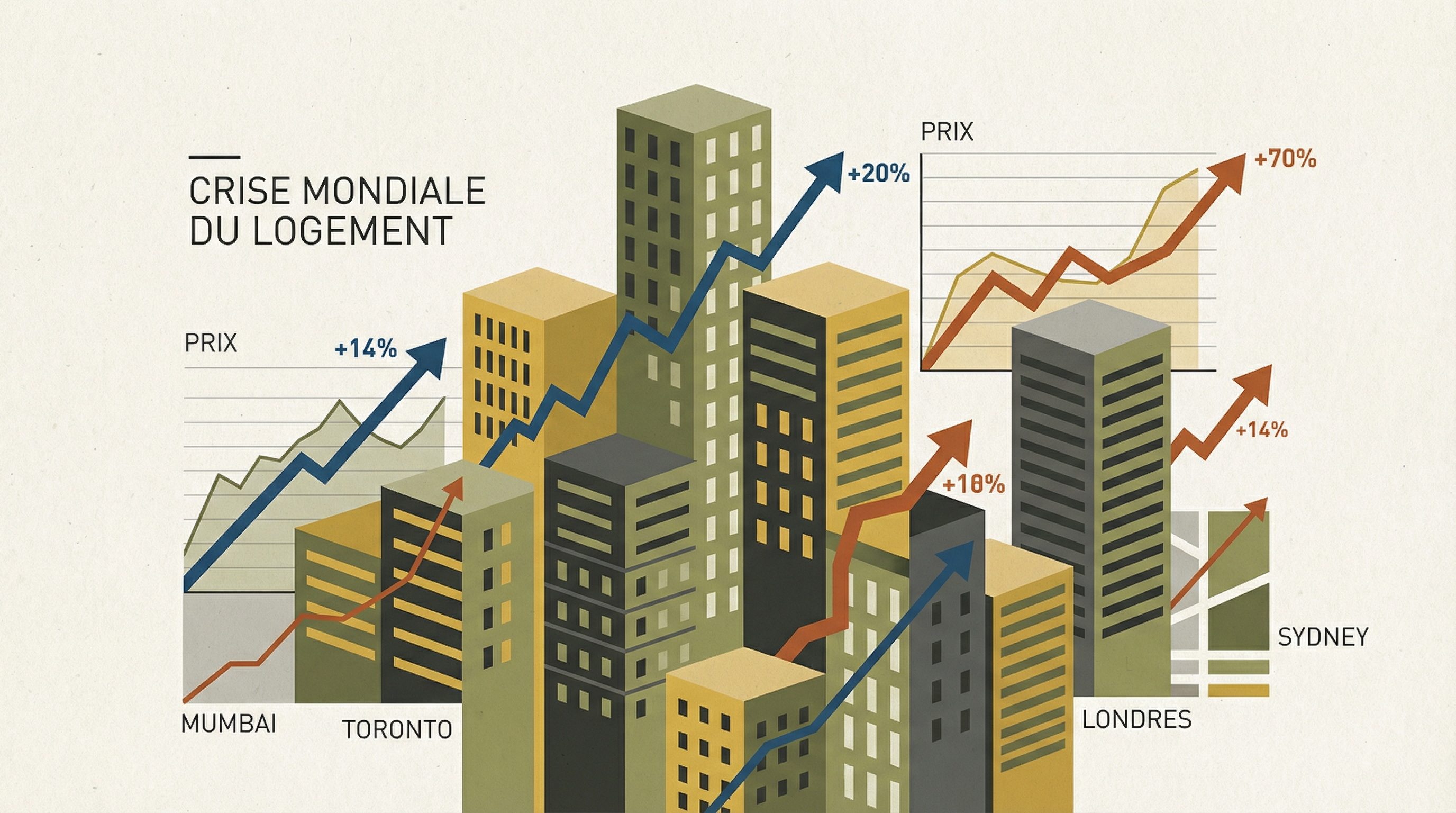
The average price of housing in Mumbai reached 34 times the average annual income of a typical buyer in 2025 [1]. This figure, which places India's financial capital at a level of unaffordability higher than New York, is not an anomaly. It is the symptom of a global crisis that is silently redefining the contours of our societies. From London to Lagos, from Toronto to Sydney, access to decent housing in urban areas has become a struggle for the middle class. Real estate prices are soaring, leaving wages far behind, and creating unsustainable financial pressure for millions of households. This dynamic does not merely weaken budgets; it redraws the social geography of metropolitan areas, erecting invisible barriers between those who can afford to live in the city and those who are excluded from it.
110% of Income for a Loan: The New Reality of Homeownership
The factual context of this crisis can be read in an accumulation of alarming data. A Brookings Institution report from March 2026 reveals that the real price of constant-quality housing in the United States is now 15% to 20% higher than during the peak of the housing bubble that preceded the 2008 financial crisis [2]. This inflation is not uniform, but it is widespread. Sunbelt cities like Miami have seen their prices increase by 189.4% in real terms since 2000, while historically more stable markets like Dallas are also experiencing rapid appreciation, with prices more than doubling over the same period [2].
The most telling indicator of this crisis is the price-to-income ratio. It measures the number of years of median household income needed to buy a home at the median price. A ratio above 4 is generally considered an affordability threshold, as it becomes very difficult for a household to obtain a mortgage [2]. If in 1970, no major American metropolitan area exceeded a ratio of 2.21, the situation has radically changed. In Toronto, in 2023, it took 42.9 months of median after-tax income to build up the 20% down payment for a typical home, compared to 26.4 months in 2014. Once this monumental obstacle was overcome, mortgage payments would swallow 110.2% of median after-tax income, a pure and simple financial impossibility, compared to 56% a decade earlier [10]. For renters, the situation is hardly better: median rent in Toronto represented 34.7% of median family after-tax income in 2023, making the city the most expensive in Canada for renters [10].
In Sydney, a household must now earn nearly 305,000 Australian dollars per year to buy an average house, whose price reached 1.7 million dollars in early 2026 [3]. In London, the situation is equally critical. The annual Housing in London 2025 report shows that despite a population that exceeded 9 million inhabitants in 2024, the construction of new housing struggles to keep up. The net supply of new housing even decreased by 6% in 2022-23 to 36,468 units, well below needs [11]. The number of homeless households in temporary accommodation reached a record 73,310 in March 2025, an increase of 12% in one year. The average monthly rent for housing in the private sector was £2,226 in August 2025, 60% more than the average in England. A one-bedroom home in London costs more to rent than a four-bedroom home in five of the eight other English regions [11].
In developing countries, the crisis takes another dimension, that of survival. In Lagos, Nigeria's largest city, the housing deficit is estimated at 3.4 million units. More than 70% of the population lives in informal housing or slums, without access to basic services [4]. For many formal tenants, the rent-to-income ratio exceeds 60%, double the 30% standard recommended by the United Nations, forcing them to make extreme sacrifices on other essential needs [5].
2 Years Waiting for a Permit: Supply Shortage as the Driver of the Crisis
Analysis of the data converges on a fundamental cause: a structural shortage of new housing supply. The Brookings Institution report is categorical: the problem does not come from excessive demand, but from markets' inability to produce enough housing to meet needs [2]. In many metropolitan areas, the number of building permits issued has drastically declined. In Boston, the construction peak of the 1980s has never been recovered. In Los Angeles, current construction levels represent only one-third of the 1980s peak [2]. In London, affordable housing starts funded by the city hall fell by 91% in 2023-24 compared to the previous year, reflecting a difficult economic context with rising material and borrowing costs [11].
Several mechanisms explain this supply contraction. First, restrictive zoning imposes strict rules on what can be built. In Toronto, municipal approval delays for a construction project exceed two years, three times more than in Vancouver and seven times more than in Edmonton. Moreover, municipal charges for new high-rise developments amount to $134,900 per unit, compared to $6,900 in Edmonton [10]. These regulatory and financial barriers make many projects unviable.
Second, chronic underinvestment in construction, particularly social housing, has worsened the shortage. After the 2008 crisis, the sector was durably weakened. In London, while the total stock of affordable rental housing slightly increased to reach 804,000 in 2024, this figure masks complex dynamics, notably the sale of social housing via the Right to Buy program which, since 2012, has only been replaced at a rate of 58% [11]. Third, financial speculation has transformed housing into a globalized investment asset. The injection of capital by investment funds and foreign buyers in cities like London, Toronto or Sydney has contributed to disconnecting real estate prices from local incomes. A University of Technology Sydney study revealed that 73% of Australians believe foreign investors have driven up prices [12]. In Toronto, studies show that financial landlords charge the highest rents, targeting the most vulnerable tenants [13].
False Good Ideas and the Limits of Solutions
Faced with this crisis, many solutions are proposed, but not all are effective. Policies focused on demand subsidies, such as 50-year mortgages or interest rate enhancements, are often counterproductive. Without an increase in supply, injecting more money into the system only fuels price increases [2]. Rent control, another popular measure, can offer short-term relief, but it discourages investment in maintenance and construction of new rental housing in the long term, thus reducing overall supply.
It is also important to recognize the limits of solutions that work. Vienna's social housing model, often praised for its ability to provide high-quality housing at affordable prices, is the fruit of a century of public investment and a specific political context of social democracy [6]. Its identical replication is complex. Similarly, the success of Singapore's HDB program, which enabled more than 80% of the population to become homeowners, relies on strong state intervention and centralized planning that are not politically acceptable in all societies [7].
Counter-arguments to massive deregulation also exist. Rapid and poorly planned densification can lead to infrastructure overload. The construction of millions of new homes also has an ecological footprint that must be managed. Uncertainty remains about markets' ability to self-regulate to produce truly affordable housing for the lowest incomes. The risk is that new supply concentrates on the luxury segment, as seen in many cities where new developments are predominantly high-end condominiums.
4 Ways to Make Cities More Affordable
The prospect of resolving the global housing crisis rests on concerted action focused on increasing supply. Several cities and countries are showing the way. Tokyo has managed to maintain relative price stability by adopting a much more flexible national zoning system. This system authorizes by default a mix of uses and higher densities, which allows the market to respond more quickly to demand [8]. The result is housing production per capita well above that of most Western cities.
Vienna's model offers another lesson: the need for a robust non-market housing sector. By owning or controlling a significant share of the rental stock, the city can influence prices across the entire market. In Singapore, the HDB's success shows the effectiveness of long-term planning and the state's commitment to housing its citizens. Finally, the example of Medellín, Colombia, highlights the importance of integrating housing policy with transportation policy. By building cable cars (Metrocable) to connect informal hillside neighborhoods to downtown and the metro network, the city improved access to employment and services for its poorest residents, reducing travel times and effectively increasing the attractiveness of these neighborhoods [9]. The open question remains how to adapt these lessons to the varied political, economic and cultural contexts of the thousands of cities that, around the world, are today confronted with the same crisis.
References
- [1] NDTV. (2025, December 22). India's Middle Class Priced Out: Mumbai Homes Cost 34 Years Of Salary And Rising. https://www.ndtv.com/business-news/indias-middle-class-priced-out-mumbai-homes-cost-34-years-of-salary-and-rising-9869258
- [2] Gyourko, J. (2026, March). Thinking about the growing housing affordability problem: A primer for sound policy. Brookings Institution. https://www.brookings.edu/wp-content/uploads/2026/03/20260318_ES_Gyourko_HousingAffordability.pdf
- [3] Devine, A. (2026, January 3). Sydney salary now required to afford house revealed in new data. realestate.com.au. https://www.realestate.com.au/news/sydney-salary-now-required-to-afford-house-revealed-in-new-data/
- [4] Adio, A. (2026, February 27). Lagos and the macroeconomic cost of unaffordable housing. Premium Times. https://www.premiumtimesng.com/opinion/860146-lagos-and-the-macroeconomic-cost-of-unaffordable-housing-by-ayodele-adio.html
- [5] Business Day. (2026, March 15). Buyers, tenants overstretched as rent-to-income ratio exceeds UN benchmark. https://businessday.ng/life/article/buyers-tenants-overstretched-as-rent-to-income-ratio-exceeds-un-benchmark/
- [6] The Guardian. (2024, January 10). The social housing secret: how Vienna became the world's most livable city. https://www.theguardian.com/lifeandstyle/2024/jan/10/the-social-housing-secret-how-vienna-became-the-worlds-most-livable-city
- [7] HDB. (2025, August 14). Public Housing – A Singapore Icon. https://www.hdb.gov.sg/about-us/our-role/public-housing-a-singapore-icon
- [8] HUD User. (2024, December 2). Global Cities and Affordable Housing: Tokyo. https://www.huduser.gov/archives/portal/pdredge/pdr-edge-international-philanthropic-120324.html
- [9] Centre for Public Impact. (2016, March 25). The Metrocable: transport by urban cable car in Medellín. https://www.centreforpublicimpact.org/public-impact-fundamentals/the-metrocable-transport-by-urban-cable-car-in-medellin/
- [10] Fuss, J., & Thompson, A. (2025, December 1). Recent price declines won't solve Toronto's housing affordability crisis. Fraser Institute. https://www.fraserinstitute.org/commentary/recent-price-declines-wont-solve-torontos-housing-affordability-crisis
- [11] Greater London Authority. (2026, January). Housing in London 2025. https://www.london.gov.uk/sites/default/files/2026-01/Housing%20in%20London%202025%20report%20%28002%29.pdf
- [12] University of Technology Sydney. (2023). Cited in The Impact Of Foreign Investors On Australia's Property Market. FN Arena. https://fnarena.com/index.php/2026/03/02/the-impact-of-foreign-investors-on-australias-property-market/
- [13] The Conversation. (2025, May 20). Financial firms are driving up rent in Toronto and targeting the most vulnerable tenants. https://theconversation.com/financial-firms-are-driving-up-rent-in-toronto-and-targeting-the-most-vulnerable-tenants-255935
- Receive Journal analyses directly in your inbox.
- China's CO2 emissions fell by 0.3% in 2025. This is a modest figure. But it extends a trend that has lasted for 21 consecutive months: since March 2024, emissions from the world's largest polluter have been "stable or declining."
- Does AI destroy jobs? Two studies published in March 2026 — one by Harvard Business School, the other by Anthropic — provide the first solid empirical data. And the answer is more nuanced than public debate suggests.
- Malaria killed 608,000 people in 2022, 95% of them in sub-Saharan Africa and 78% children under five. And for the first time, a vaccine deployed at scale is showing measurable results in the field.
- Wanting to be 20 today. An independent media that documents progress with rigor, without naivety or catastrophism.
- Structured reading sheets: central thesis, key arguments, limitations, and verdict.
- JdP is an independent editorial project based on data, counter-narratives and lucid optimism. Each article is sourced, nuanced and open to discussion.
- Le Journal d'un Progressiste uses cookies to improve the reading experience and understand how the site is used. No data is collected for commercial, advertising or resale purposes. Cookies necessary for site operation are always active. Optional cookies are only activated with your explicit consent, in accordance with GDPR.