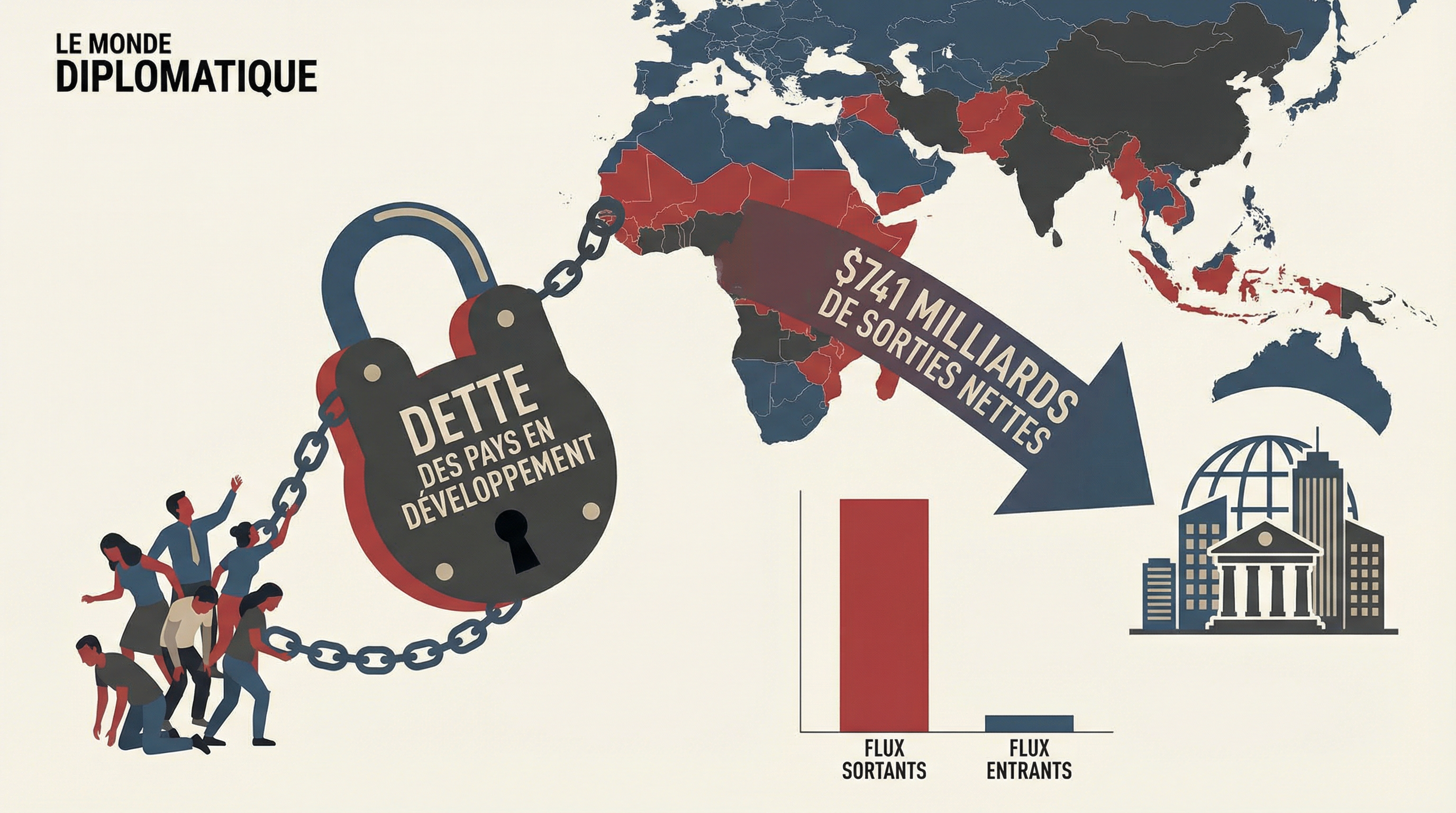
741 billion dollars. This is the net amount that developing countries paid to their external creditors between 2022 and 2024, an unprecedented wealth transfer in half a century [1]. This massive capital outflow, where principal and interest repayments far exceed new incoming loans and investments, illustrates a brutal reversal of financial flows. Far from receiving the capital necessary for their development, the most vulnerable economies are being drained of their resources, trapping them in a cycle of debt and underinvestment. This situation jeopardizes the Sustainable Development Goals (SDGs) and threatens the economic and social stability of dozens of countries.
8,900 billion dollars in external debt
The combined external debt of low- and middle-income countries reached a historic peak of 8,900 billion dollars in 2024 [1]. For the 78 poorest countries, eligible for International Development Association (IDA) loans, outstanding debt also reached a record 1,200 billion dollars [1]. This debt accumulation has been accompanied by a tightening of financing conditions. Average interest rates on new loans contracted in 2024 from public and private creditors reached their highest levels in 24 and 17 years, respectively [1].
Debt service weighs heavily on national budgets. In 2024, developing countries disbursed a record amount of 415 billion dollars in interest alone [1]. These sums are diverted from essential investments in education, health, and infrastructure. In the 22 most indebted countries, where external debt outstanding exceeds 200% of export revenues, more than half the population (56%) cannot afford healthy and nutritious food [1]. This forced trade-off between debt service and essential public services has direct and measurable human consequences. Reduced health budgets translate into increased infant and maternal mortality, while cuts in education compromise the future of an entire generation. The inability to invest in climate-resilient infrastructure increases these countries' vulnerability to future shocks, thus perpetuating the debt cycle.
Faced with this pressure, debt actors are diversifying. Public bilateral creditors, such as states, have seen their relative share decline after waves of restructuring. In 2024, they received 8.8 billion dollars more in repayments than they provided in new financing [1]. Meanwhile, countries are increasingly turning to domestic financial markets. More than half of the 86 countries for which data are available have seen their domestic public debt increase faster than their external debt [1]. While this recourse to local markets demonstrates a certain financial maturity, it also presents risks. By favoring government bonds, local commercial banks reduce funds available for private sector loans, a phenomenon known as the crowding-out effect. Moreover, domestic debt is often contracted at shorter maturities and higher interest rates than concessional external debt, which increases the frequency and cost of refinancing operations for governments. This dynamic creates a new form of vulnerability, where an internal liquidity crisis can quickly transform into a solvency crisis.
The mechanisms of the debt trap
The current debt crisis is the product of several interdependent factors. The rise in key interest rates by major central banks to fight inflation has mechanically increased the cost of credit for developing countries. With many loans denominated in US dollars, the appreciation of the dollar against local currencies has also increased the repayment burden. A country must thus generate more revenue in local currency to repay the same amount in dollars. This pressure on the exchange rate can also discourage foreign investments and fuel inflation, creating a vicious economic circle. For a country whose exports are mainly invoiced in dollars (such as raw materials), the dollar's rise may seem beneficial, but this advantage is often canceled out by the volatility of these same commodity prices and by the crushing weight of debt service denominated in dollars.
Climate shocks exacerbate this vulnerability. Natural disasters, increasingly frequent and intense, destroy infrastructure, reduce agricultural and tourism production, and require massive reconstruction spending. These unforeseen shocks widen budget deficits and force governments to borrow more, often under unfavorable conditions in emergencies. This vicious circle has led to the emergence of the concept of "double penalty" for climate-vulnerable countries, which are both the least responsible for climate change and the most severely affected by its financial consequences.
The debt structure has also evolved, complicating restructurings. The share of private creditors, notably bondholders and commercial banks, has increased considerably compared to that of traditional official creditors such as Paris Club member states and multilateral institutions. This multitude of actors with divergent interests and legal constraints makes coordinating debt relief particularly difficult. While official creditors may be motivated by geopolitical and long-term development considerations, private creditors are mainly bound by fiduciary obligations to their investors, incentivizing them to maximize their financial return. This fundamental divergence complicates the application of the comparability of treatment principle, a pillar of sovereign debt restructuring. Moreover, the absence of an international bankruptcy mechanism for sovereign states prevents imposing a solution on all creditors. This opens the way to "holdout" strategies, where funds specialized in buying distressed debt at a discount can refuse to participate in a restructuring and sue states in court to obtain full repayment, thus undermining the collective debt relief effort.
Solutions put to the test
Faced with this crisis, several mechanisms have been deployed with varying degrees of success. The Debt Service Suspension Initiative (DSSI), launched by the G20 in May 2020 in response to the COVID-19 pandemic, suspended 12.9 billion dollars in payments for 48 participating countries until its end in December 2021 [3]. However, its impact was limited by the non-participation of private creditors, with only one joining the effort. Countries also hesitated to request a suspension, fearing a downgrade in their credit rating.
The Common Framework for Debt Treatment, also launched by the G20 in November 2020, aimed to go beyond simple suspension by proposing case-by-case debt restructuring, involving both public and private creditors [2]. However, its implementation has been slow and complex. Only a few countries like Chad, Ethiopia, and Zambia have used it, and the processes have been marked by significant delays, notably due to difficulties in ensuring equitable private sector participation. Zambia finally concluded a restructuring agreement with its official creditors in June 2023, more than two years after its initial request, and an agreement with its bondholders in March 2024. These delays illustrate the structural weaknesses of the Common Framework: the absence of a binding timeline, disagreements between traditional Paris Club creditors and new lenders like China on debt relief modalities, and the difficulty in obtaining firm commitments from private creditors upstream of negotiations.
More innovative new approaches are emerging to link debt to environmental objectives. "Debt-for-nature swaps" allow a country to have its debt bought back at a discounted price by a third party, in exchange for commitments to finance conservation projects. Belize thus reduced its debt by 10% of its GDP in 2021 through an agreement that dedicated 4 million dollars annually to protecting its coral reef [4]. In 2023, Ecuador carried out the world's largest such swap, generating 323 million dollars for Galápagos Islands conservation [5]. These operations, while promising, remain complex to implement and are not a universal solution. They depend on the willingness of a third party (often a non-governmental organization or financial institution) to finance the debt buyback, and require complex negotiations between the debtor country, creditors, and the intermediary. Moreover, the impact on overall debt reduction often remains marginal compared to the total outstanding amount. Nevertheless, they constitute an important precedent by creating a direct link between debt sustainability and natural capital preservation, a major issue for many developing countries.
Another innovation lies in climate resilience clauses inserted in debt contracts. These clauses provide for automatic suspension of debt service in case of a predefined natural disaster, offering immediate financial relief. Barbados was a pioneer in this area, followed by Grenada. These mechanisms avoid lengthy post-disaster negotiations but their adoption remains marginal, partly due to the complexity of their calibration and the need to convince creditors to accept additional risk, even if it is limited and controlled. The development of a standardized CRDC model, supported by international financial institutions, could accelerate their deployment.
What architecture for tomorrow's debt?
Another key actor whose role is often underestimated is that of credit rating agencies. By downgrading the sovereign rating of a country considering restructuring, they can trigger capital flight and prohibitively increase the cost of accessing financial markets, thus precipitating a crisis that preventive action could have avoided. This procyclical dynamic has led to calls for reform of their methodology to better account for sustainable restructuring efforts and the structural vulnerability of countries.
The current debt crisis reveals the limits of the international financial architecture. Palliative solutions, while necessary, do not address the roots of the problem: a system that favors capital outflows from developing countries and insufficient coordination among increasingly heterogeneous creditors. Zambia's debt restructuring showed that an agreement is possible, but at the cost of delays that worsen the economic and social crisis.
The question remains open: how to build a sovereign debt management system that is simultaneously preventive, rapid, and equitable? Several reform paths are on the table. Greater debt transparency is an indispensable prerequisite, which could involve creating a global public register of sovereign loans. Reform of credit rating agencies is also necessary so they assess risks more fairly and do not unduly penalize countries seeking to restructure their debt preventively. Finally, the idea of a sovereign debt restructuring mechanism, a sort of international bankruptcy court for states, though politically complex, is resurfacing. Such a mechanism would impose an equitable solution on all creditors and end the dilatory maneuvers of vulture funds. Without systemic reform integrating these different dimensions, the debt trap risks closing on an increasing number of countries, compromising their development prospects and the achievement of global sustainability goals for decades.
References
- [1] World Bank. (2025, December 3). Developing countries' external debt repayments reached their highest level in 50 years in 2022-2024. https://www.banquemondiale.org/fr/news/press-release/2025/12/03/developing-countries-debt-outflows-hit-50-year-high-during-2022-2024
- [2] World Bank. (2022). Potential Statutory Options to Encourage Private Sector Creditor Participation in the Common Framework. https://documents1.worldbank.org/curated/en/099802006132239956/pdf/IDU0766c0f2d0f5d0040fe09c9a0bf7fb0e2d858.pdf
- [3] World Bank. (2022, March 10). Debt Service Suspension Initiative. https://www.worldbank.org/en/topic/debt/brief/covid-19-debt-service-suspension-initiative
- [4] International Monetary Fund. (2022, May 4). Belize: Swapping Debt for Nature. https://www.imf.org/en/news/articles/2022/05/03/cf-belize-swapping-debt-for-nature
- [5] Inter-American Development Bank. (2023, May 9). Ecuador Completes World's Largest Debt-for-Nature Conversion with IDB and DFC Support. https://www.iadb.org/en/news/ecuador-completes-worlds-largest-debt-nature-conversion-idb-and-dfc-support
- [6] Climate Policy Initiative. (2025, February 28). Climate-resilient debt clauses: a primer for FiCS members. https://www.climatepolicyinitiative.org/publication/climate-resilient-debt-clauses-a-primer-for-fics-members/
- Receive the Journal's analyses directly in your mailbox.
- China's CO2 emissions fell by 0.3% in 2025. It's a modest figure. But it extends a trend that has lasted for 21 consecutive months: since March 2024, emissions from the world's largest polluter have been "stable or declining."
- Does AI destroy jobs? Two studies published in March 2026 — one by Harvard Business School, the other by Anthropic — provide the first solid empirical data. And the answer is more nuanced than public debate suggests.
- Malaria killed 608,000 people in 2022, 95% of them in sub-Saharan Africa and 78% children under five years old. And for the first time, a vaccine deployed on a large scale shows measurable results in the field.
- Wanting to be 20 years old today. An independent media that documents progress with rigor, without naivety or catastrophism.
- Structured reading sheets: central thesis, key arguments, limits, and verdict.
- JdP is an independent editorial project based on data, counter-narratives, and lucid optimism. Each article is sourced, nuanced, and open to discussion.
- Le Journal d'un Progressiste uses cookies to improve the reading experience and understand how the site is used. No data is collected for commercial, advertising, or resale purposes. Cookies necessary for site operation are always active. Optional cookies are only activated with your explicit consent, in accordance with GDPR.