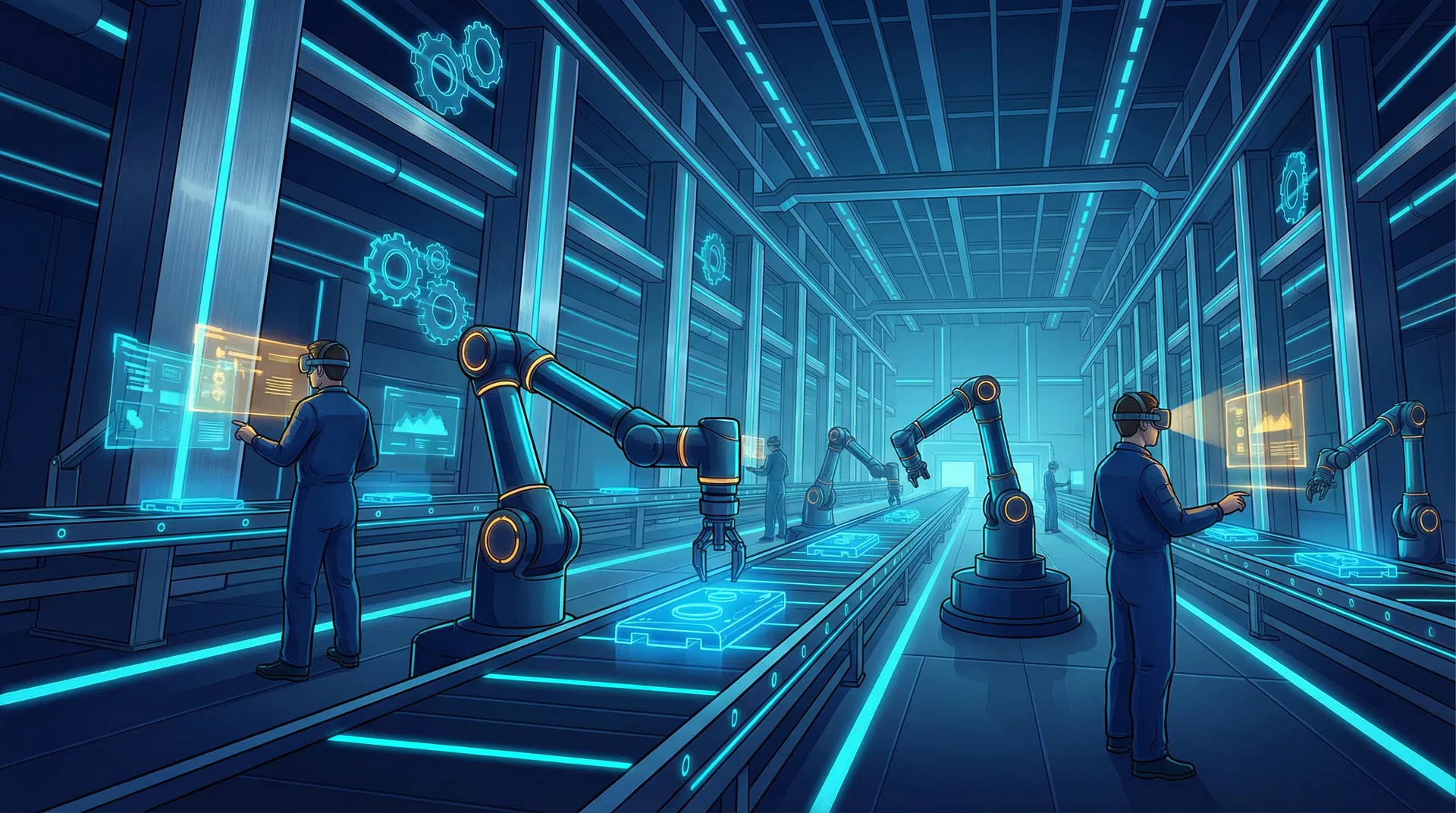
The global industrial robotics market is set to cross the threshold of $30.71 billion in 2026, up from $26.98 billion in 2025, and is expected to reach $93.31 billion by 2035, showing a compound annual growth rate of 13.21% [1]. This expansion is not simply an acceleration of traditional automation, but a symptom of a profound transformation orchestrated by embedded artificial intelligence. AI gives machines decision-making autonomy that redefines production processes, logistics, and the very nature of industrial work. As collaborative robots (cobots) and autonomous mobile robots (AMRs) are deployed massively, the question of impact on employment and skills adaptation becomes central. Pioneer nations like Germany, Japan, and South Korea, facing demographic challenges and intense technological competition, are already developing large-scale retraining strategies to prepare their workforce for this new era.
Growth driven by autonomy and technological integration
The current market dynamic is less a matter of robot quantity than quality of autonomy. According to the International Federation of Robotics (IFR), five major trends structure this evolution through 2026 [2]. The first is the shift from automation to autonomy through artificial intelligence. Analytical AI enables robots to optimize their actions by analyzing massive data flows. One of the most impactful application areas is predictive maintenance. By continuously analyzing sensor data from equipment (vibrations, temperature, etc.), machine learning algorithms can predict imminent failure, allowing intervention to be planned before breakdown. Case studies show this approach can reduce unplanned downtime by up to 50% and maintenance costs by 10 to 40%. For example, turbine manufacturer GE implemented a predictive maintenance system that significantly improved efficiency and achieved substantial savings by avoiding costly breakdowns. Generative AI allows them to learn new tasks by simulating scenarios and interact more intuitively with human operators through natural language.
This sophistication is made possible by deep convergence between information technologies (IT) and operational technologies (OT). This integration breaks down silos between data management systems and physical equipment control, creating a continuous information flow between the digital and physical worlds. Robots thus become more versatile, capable of adapting to complex and changing environments, a necessity for companies aiming for flexible and personalized production.
The Asia-Pacific region dominates this market, representing more than 65% of revenue in 2025, with growth projected to reach $43.50 billion in 2035 [1]. This lead is visible in robot density per 10,000 employees in manufacturing in 2021: South Korea (1000 robots), Singapore (670), Japan (399), Germany (397), and China (322) form the leading group of the most automated nations [1].
Cobots and AMRs: new faces of automation
One of the most dynamic segments is collaborative robots. Representing 10.5% of industrial robot installations in 2023 [3], cobots are distinguished by their ability to work safely alongside humans. Four main types of collaborative operations can be distinguished: monitored safety stop (the robot stops if a human enters its workspace), manual guidance (the operator directly guides the robot arm), speed and separation monitoring (the robot slows down when approached by a human), and power and force limitation (the robot's force is limited to avoid injury in case of contact). This flexibility, coupled with simplified programming, makes them particularly attractive for SMEs. For these companies, the lower initial investment and reduced total cost of ownership of cobots, compared to traditional industrial robots, lower the barrier to automation entry. Return on investment (ROI) is often rapid, sometimes less than a year, thanks to productivity gains, better quality, and reduced musculoskeletal disorders among operators. The global collaborative robot market, valued at $1.4 billion in 2022, is expected to reach $27.4 billion by 2032, demonstrating their growing adoption.
Meanwhile, autonomous mobile robots (AMRs) are transforming internal logistics. Unlike automated guided vehicles (AGVs) that follow fixed paths, AMRs navigate dynamically through technologies like SLAM (Simultaneous Localization and Mapping), allowing them to create maps of their environment and adapt to changes in real time. While their potential for optimizing material flows is immense, their deployment presents challenges. Integration with existing warehouse management systems (WMS), traffic management in mixed environments (with humans and forklifts), and the need for robust and secure network infrastructure are common obstacles. Nevertheless, AMR ROI is often convincing. Well-executed projects can achieve return on investment in 1 to 3 years, through reduced labor costs, increased order processing speed, and decreased picking errors.
The impact of these technologies is concrete. Companies in the World Economic Forum's Global Lighthouse Network report significant gains. Siemens reduced its automation costs by 90% through AI-assisted robots, while Midea decreased its development cycles by 25% and quality defects by 53% [4]. These gains are not limited to productivity; they also contribute to sustainability, as at Jubilant Ingrevia, which reduced its Scope 1 emissions by 20% by optimizing energy consumption through AI [4].
The employment challenge and the reconversion pivot
Intelligent automation does not translate into simple substitution of humans by machines, but a redefinition of roles. While repetitive, predictable, and physically demanding tasks are increasingly automated, new needs emerge for skills related to supervision, maintenance, programming, and analysis of robotic systems. The global shortage of skilled labor, exacerbated by demographic aging in many industrialized countries, makes automation a necessary solution to maintain production capacity.
However, the transition is not automatic and requires massive investments in training. Three countries show the way with distinct strategic approaches:
-
Germany and Industry 4.0: The country has made Industry 4.0 a pillar of its professional training strategy. The dual system ("Ausbildung") has been adapted to integrate skills in digitization, automation, and data analysis. Professional profiles, such as those of mechatronics technician or production technologist, have been modernized to include IT skills, process control, and complex problem solving. The federal government, through the Ministry of Education and Research (BMBF), funds initiatives like the "VET 4.0" program to modernize inter-company training centers and develop qualification modules adapted to new requirements. The objective is to train qualified workers capable not only of operating automated systems, but also of configuring, maintaining, and optimizing them [5].
-
Japan facing its demographics: In response to accelerated demographic decline, Japan launched a "New Strategy for Robotics" that aims to make the country a global showcase for robot use. This strategy is not limited to industry, but also encompasses services, healthcare, and agriculture. The government actively encourages companies to invest in automation through subsidies and tax incentives. Meanwhile, a national effort is being made for worker retraining. Continuing education programs, often in partnership with companies, are deployed to develop "AI and robotics skills." The objective is to transform the existing workforce into a workforce capable of collaborating with intelligent systems, focusing on higher value-added tasks like supervision, engineering, and innovation [6].
-
South Korea and its "Manufacturing Renaissance Vision": The South Korean government launched an ambitious plan in 2019 to revitalize its manufacturing sector, with the goal of creating 30,000 smart factories by 2025. This "manufacturing renaissance vision" is supported by massive R&D investments and incentives for companies, particularly SMEs, to adopt digital technologies. A crucial component of this strategy is human capital development. The "Smart Manufacturing Innovation Support" program includes training for leaders, engineers, and employees, focused on AI, big data, and robotics. Specialized training centers have been created throughout the country to provide these skills and accompany companies in their transition, with the goal of training 50,000 smart manufacturing experts by 2025 [7].
These national strategies recognize that the future of industry does not lie in a binary choice between humans and robots, but in their effective collaboration. The real challenge is not technological, but human: it involves building a skills bridge strong enough to cross the ongoing transformation and ensure that automation productivity gains translate into shared prosperity.
References
- [1] Precedence Research. (2026). Industrial Robotics Market Size to Hit USD 93.31 Billion by 2035. https://www.precedenceresearch.com/industrial-robotics-market
- [2] EEWORLD. (2026). IFR Forecast | Top 5 Global Robotics Trends in 2026. https://en.eeworld.com.cn/news/robot/eic716331.html
- [3] International Federation of Robotics. (2024). Collaborative Robots - How Robots Work alongside Humans. https://ifr.org/ifr-press-releases/news/how-robots-work-alongside-humans
- [4] World Economic Forum. (2024). How AI is transforming the factory floor. https://www.weforum.org/stories/2024/10/ai-transforming-factory-floor-artificial-intelligence/
- [5] GoAusbildung. (2025). Industry 4.0 Ausbildung Germany 2026. https://goausbildung.com/blog/industry-40-ausbildung-germanys-3800-smart-manufacturing-career-revolution
- [6] IT Business Today. (2026). Japan Plans National AI & Robotics Strategy. https://itbusinesstoday.com/tech/ai/japan-moves-to-draft-national-ai-and-robotics-strategy-targeting-service-robot-gap/
- [7] International Trade Administration. (2023). South Korea - Manufacturing Technology - Smart Factory. https://www.trade.gov/country-commercial-guides/south-korea-manufacturing-technology-smart-factory
- Receive Journal analyses directly in your mailbox.
- China's CO2 emissions fell by 0.3% in 2025. This is a modest figure. But it extends a trend that has lasted for 21 consecutive months: since March 2024, emissions from the world's largest polluter have been "stable or declining."
- Does AI destroy jobs? Two studies published in March 2026 — one by Harvard Business School, the other by Anthropic — provide the first solid empirical data. And the answer is more nuanced than the public debate suggests.
- Malaria killed 608,000 people in 2022, 95% of them in sub-Saharan Africa and 78% children under five. And for the first time, a vaccine deployed at scale is showing measurable results in the field.
- Wanting to be 20 years old today. An independent media that documents progress with rigor, without naivety or catastrophism.
- Structured reading sheets: central thesis, key arguments, limitations, and verdict.
- JdP is an independent editorial project based on data, counter-narratives, and lucid optimism. Each article is sourced, nuanced, and open to discussion.
- Le Journal d'un Progressiste uses cookies to improve the reading experience and understand how the site is used. No data is collected for commercial, advertising, or resale purposes. Cookies necessary for site operation are always active. Optional cookies are only activated with your explicit consent, in accordance with GDPR.