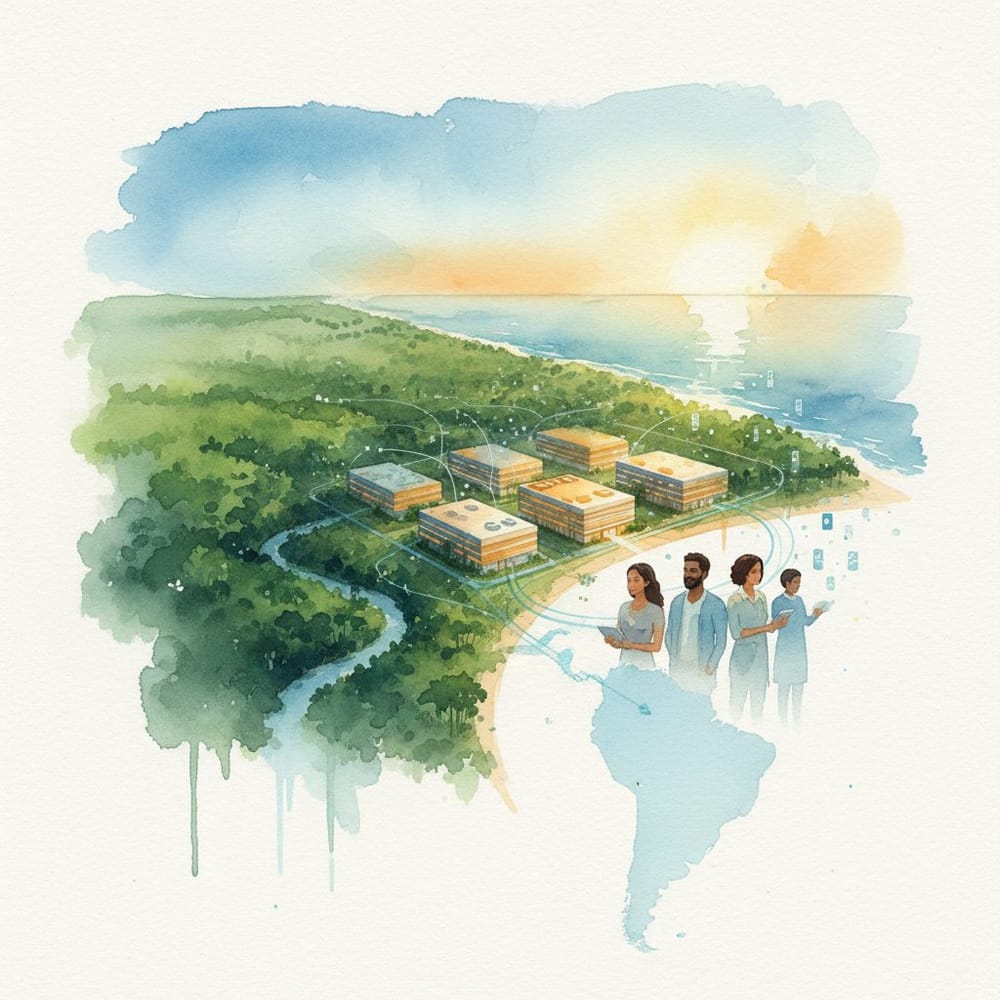
54.2 gigawatts of demand projected on Brazil’s national grid by 2038, more than half the peak electricity consumption ever recorded in the country (105 GW in February 2025). According to the Brazilian Energy Research Company (EPE), this demand concerns 26.3 GW for data centers and 27.9 GW for hydrogen. While Europe and the United States struggle to power their digital ambitions, Brazil is weaponizing its renewable surplus on a massive scale.
This energy strategy could reshuffle the deck of the global digital economy. With 88% of its electricity production from renewable sources according to the International Energy Agency, Brazil offers what Silicon Valley can no longer guarantee: clean and abundant energy for the most energy-intensive artificial intelligence infrastructure. Microsoft will invest $2.7 billion over three years in cloud and AI infrastructure in Brazil, while Amazon Web Services has committed $1.8 billion through 2034.
The Energy Equation Has Shifted Quietly
Brazil has 12 GW of ready power on its transmission network, and its operators have been able to secure 5 GW of these 12 GW, according to Scala CEO Marcos Peigo. Compare this to Northern Virginia, where electricity moratoria have delayed construction for years. This comparison reveals the scale of the geopolitical reversal underway.
As AI’s electricity demand grows faster than the American electrical grid—built decades ago and not designed to support it—approximately 70% of the American grid is approaching the end of its lifecycle. The United States faces a temporal paradox: building a state-of-the-art data center takes 12 to 24 months, but expanding the electrical grid to power it can take a decade. By 2026, demand is higher than ever because AI workloads require high-density power—often 50 to 100 kW per rack, compared to the 5 to 10 kW used by traditional cloud storage.
In the United States, which hosts more than half of the world’s data centers, they could represent up to 13% of total electricity consumption by 2030 (versus 4% in 2024), or 560 TWh of consumption. In Europe, AI’s electricity needs should represent 4 to 5% of total electricity demand by then (versus 2-3% in 2024).
Brazil is exploiting this Western energy constraint. Brazil’s energy mix, composed of 83% renewables, vast land availability, and buildable sites make it an ideal environment for large-scale developments on virgin terrain. This geography of energy abundance is redrawing the flows of global technological investment.
Brazil’s Fiscal and Logistical Arsenal
The Redata program, which reduces capital costs by 50% by exempting taxes on information technology assets, is already spurring large-scale projects (500 MW to 1.5 GW), with benefits in effect through December 31, 2026. Redata’s fiscal incentives have attracted 75 mapped projects.
The Redata framework, scheduled for late 2025 launch, eliminates import duties that can double equipment costs, provided operators source 100% renewable energy and reserve 10% of their capacity for domestic consumption. Government projections indicate this policy could unlock $2 trillion in cumulative investments by 2035. This aggressive fiscal strategy aims to divert the comparative advantage of Chile and Mexico.
Brazil imposes duties reaching up to 100% on critical equipment, driving new construction costs to $40-50 million per MW. Redata transforms this weakness into an asset: the exemption covers servers, batteries, and equipment not produced locally, harmonizes customs procedures under the Ex-Tariffário regime, and accelerates clearance to under 10 days. Redata also institutes accelerated environmental licenses for projects in designated digital corridors, reducing the authorization backlog that historically extends over 18 months.
Through the Growth Acceleration Program (PAC), the Brazilian federal government has committed $350 billion for infrastructure—much of which supports digital expansion. The Brazilian Development Bank (BNDES) has already approved a $35 million credit line for Scala and is preparing additional capital injections for qualified operators.
Technology Giants Redrawing Their Geography
Data center localization logic now follows energy geography rather than market proximity. Hyperscale data centers, like those of AWS and Google—used for training neural networks and AI models—can be located in isolated areas, favoring regions like Brazil’s Northeast, which has abundant renewable energy and underwater cables for international data traffic. Low-latency applications are concentrated in the South and Southeast regions, where demand is higher and the grid more robust. Approximately 60% of AI projects follow this model.
Brazil’s data center market reached a capacity of 950 MW in 2025 and is expected to climb to 1,460 MW by 2030, growing at a CAGR of 8.91%. Brazil represents approximately 40% of all new data center investments in Latin America.
Geographic location reveals a geopolitical strategy. In December, ByteDance, the Chinese company behind TikTok, announced a $38 billion investment for a data center at Porto do Pecém, in the eastern coastal state of Ceará. Other Chinese companies interested in Brazil include Huawei and Alibaba. Chinese companies are thus exploiting Brazil’s energy infrastructure to circumvent Western restrictions while fueling their AI ambitions.
An analysis of internal documents seen by The Intercept Brasil indicates that the daily electricity consumption of the TikTok project equals that of 2.2 million Brazilians. São Gonçalo do Amarante, where Porto do Pecém is located, has only 54,000 inhabitants. This disproportion illustrates the scale of the energy transformation underway.
The Global South’s Energy Advantage
Brazil is part of a broader geopolitical trend. Global South countries possess 70% of the world’s renewable energy potential. This renewable resource is becoming increasingly cheaper, surpassing fossil fuels in price. In 2024, clean sources surpassed fossil fuels by a factor of 7 in electricity investments in the Global South, compared to an equal split a decade ago.
One-fifth of the Global South—from Brazil to Morocco, Bangladesh to Egypt, and Namibia to Vietnam—has already surpassed the Global North in terms of solar and wind adoption or electrification rates. This energy transition is repositioning Global South countries as preferred destinations for energy-intensive digital infrastructure.
Affordable and clean energy can act as a magnet for global manufacturing, with industries gravitating toward cheap energy. Brazil is exploiting this economic logic: unlike European energy tensions, it can offer decarbonized energy without compromising availability.
To attract data center investments, Global South countries must position themselves as low-cost locations with competitive land and energy resources and strict but equitable environmental regulations. Brazil embodies this geoeconomic positioning strategy.
The Limits of the Brazilian Model
Brazil’s energy optimism faces structural constraints. High construction costs of $8.50 to $10.10 per watt remain a significant burden. Bureaucracy and permits: regulatory consistency is essential to de-risk foreign capital. Grid modernization: while generation is strong, transmission infrastructure must keep pace.
Geographic concentration of demand is uneven, with hydrogen projects primarily clustered in the Northeast and data centers concentrated in São Paulo. This imbalance prompted EPE to undertake targeted transmission expansion studies to ensure reliable service to these large loads over the medium and long term, while minimizing risks of congestion and curtailment.
By late February 2026, Brazil’s data center momentum had nonetheless stalled. Fabro Steibel, executive director of the Institute for Technology and Society, argues that the strategy proposed by the government remains vague and unclear. Publicly shared information on projected water and energy use has been minimal.
José Renato Laranjeira, founder of the Brazilian Laboratory for Public Policy and Internet, notes that while a closed-loop system reduces water usage, it requires more electricity to operate than alternatives because of its dependence on powerful refrigerators. Experts question the reasons for the government’s push to attract facilities, particularly without integrating effective environmental protections. “Artificial intelligence for what? For whom? Under what conditions? Do we really need it?”
Infrastructure as a Geopolitical Weapon
The impact of these projects is reflected in the Transmission section of the Ten-Year Energy Expansion Plan (PDE 2035), published December 23, 2026, which projects approximately $24 billion in transmission. Investments will concentrate on transmission lines and substations designed to expand grid capacity, improve reliability, and accommodate new demand at industrial scale. For American companies, the scale and technical complexity of these investments translate into concrete opportunities.
This grid modernization transforms Brazil into an energy hub for the global digital economy. Brazil is not simply trying to join the global AI infrastructure club—it is developing a Global South model for sovereign digital development. This strategy goes beyond energy opportunism to sketch a geopolitical alternative to Northern technological monopolies.
The Ten-Year Energy Plan (PDE) 2035 project, from the Energy Research Company (EPE), identified 77 data center projects in the country, totaling installed capacity of 26.3 GW, compared to 12 projects with 2.5 GW indicated in the previous PDE (2034). According to EPE, the increase in figures reflects the rapid recent growth of artificial intelligence and greater digitization of the economy.
Brazil is betting on geopolitical timing. While the United States debates space funding and Europe elaborates digital sovereignty strategies, the South American giant is building the energy infrastructure that will power tomorrow’s AI. Capital deployment in the AI data center sector is increasingly directed at mitigating energy constraints, with multi-billion-dollar investments now strategically linked to regions offering reliable large-scale power. This marks a departure from previous investment models that prioritized network connectivity, with access to a stable energy source becoming the dominant factor.
This geographic reorientation of the digital economy could redefine global technological balances. Brazil is transforming its energy advantage into a lever of attraction for the information economy, proving that the geopolitics of AI is played out as much in power plants as in research laboratories.
Sources
- Hightower Advisors - Brazil’s 2026 Economic Inflection Point
- Behind the R$500 billion investment in data centers in Brazil lies a stress test for the electricity sector - NeoFeed
- ‘AI for whom?’ Inside Brazil’s data centre boom - Dialogue Earth
- Brazil’s $350B Data Center Power Play - Global Data Center Hub