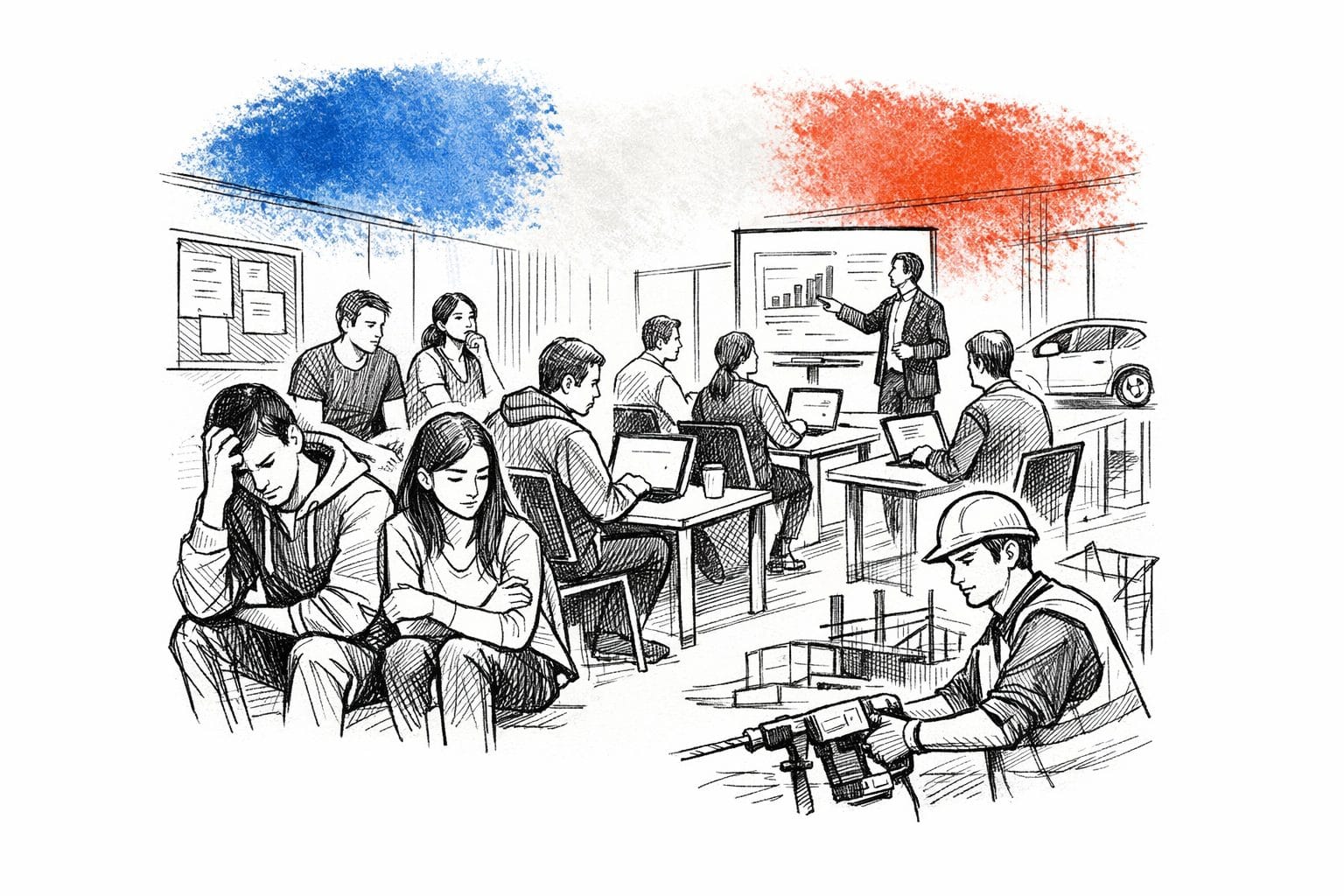
Dan Wang documents in “Breakneck: China’s Quest to Engineer the Future” how China has become an “engineer state” that applies a jackhammer to all problems, physical and social, while America develops a “lawyer society” that paralyzes almost everything, good and bad, with its judicial hammer. Where the United States relies on legalism—imposing tariffs and designing ever more sophisticated sanctions regimes—China focuses on creating the future by physically building better cars, more beautiful cities, and larger power plants. This systemic opposition explains why the two powers clash without understanding each other.
The Essential Points
- China trains 1.5 million engineers per year and has a technical workforce of over 5 million people, compared to 140,000 engineering degrees per year in the United States
- In 2002, all nine members of the Chinese Politburo Standing Committee held degrees in engineering or related fields, while elite law schools shape the simplest pathway to the highest levels of American government
- China has more than 40,000 kilometers of high-speed rail, tens of thousands of kilometers more than any other railway system in the world
- Chinese investments in the Belt and Road Initiative reached $122 billion in 2024, a 31% increase from 2023
The Engineer State Versus the Procedural Society
Deng Xiaoping made a deliberate decision to promote engineers into the leadership of the Communist Party to correct the chaos of the Mao Zedong years. The result: Xi Jinping himself studied chemical engineering at Tsinghua, China’s leading scientific university. What do engineers do? They build.
The track record is impressive. A road network twice as long as that of the United States, a high-speed rail network 20 times longer than Japan’s, and nearly as much solar and wind energy as the rest of the world combined. This massive construction capacity now extends beyond China’s borders.
In 2024, Chinese engagement in the Belt and Road Initiative reached record levels with $70.7 billion in construction contracts and approximately $51 billion in investments. Cumulatively, Chinese BRI engagement has reached $1.175 trillion since 2013.
On the opposite side, the idea of a lawyer society became evident when Wang returned to the United States in 2023. The Paul Tsai China Center was the best possible place to write this book, not only because it was very supportive but also because it placed him inside Yale Law School. Elite law schools, now and in the past, shape the simplest pathway for ambitions to reach the upper ranks of American government.
The United States Mires Itself in Its Own Procedures
The difference in approach is measured concretely. China has built approximately 26,000 miles (42,000 kilometers) of dedicated high-speed rail since 2008 and plans to exceed 43,000 miles (70,000 kilometers) by 2035. Meanwhile, the United States has only 375 miles of rail authorized to operate at speeds exceeding 100 mph.
ECB data contradicts the dominant narrative about AI destroying jobs shows how Europe is developing its own approach, but the United States remains paralyzed by its procedures. American reluctance to develop high-speed rail is generally attributed to automobile dependence induced by highway lobbying, similar dependence on air transport and its lobby, the federal government’s reluctance to subsidize passenger rail transport the way it subsidizes highways and air transport, and a railway system primarily designed for freight. Ezra Klein views the failure to deliver high-speed rail in California as a case study of the broader American inability to build new public transportation, housing, or other infrastructure due to a “culture of delay.”
Some American experts emphasize that investments remain woefully insufficient. “The $66 billion the federal government has allocated to passenger rail transport represents a huge boost, but it’s probably half of what we need to be on par with the rest of the world,” says William Vantuono, editor-in-chief of Railway Age.
The Limitations of Both Models Come to Light
The Chinese engineer state shows its flaws when it tackles social problems. The problem is that they cannot stop, applying their methods to social problems even when it is inappropriate. After an inspiring description of the rise of venture capital and high-tech manufacturing in Shenzhen, Wang turns his attention to the brutal implementation of the one-child policy and severe Covid lockdowns that pushed people to despair.
The policies of the Chinese engineer state are one of the main reasons youth unemployment is so high today. Starting in 2020, leader Xi Jinping decided to initiate a crackdown against some of China’s largest internet platforms. Suddenly, many of China’s most dynamic companies had to lay off workers, particularly those involved in online education and e-commerce.
The engineer state is far more attentive to advanced manufacturing than to the type of service jobs that attract more young Chinese. This is another indication that the Chinese state is more interested in national power than in the happiness of its people.
On the American side, China became a major manufacturing power in part by welcoming many foreign engineers (particularly American) to develop its industrial base; conversely, ICE expelled hundreds of South Korean engineers attempting to build an advanced factory in Georgia.
AI-Assisted Engineering as an American Solution
Facing this structural deficit, the United States is seeking technological solutions. The new generation of AI agents, trained on large datasets of engineering designs and taught to use engineering design tools, can already perform at the level of a junior engineer. These “AI engineers” can help analyze requirements, customize products, select components, maintain bills of materials, generate documentation, configure and run simulations, sift through test data, identify failure modes, and flag compliance issues. They do not replace human engineers—they handle the repetitive structural work that consumes 40-60% of an engineer’s day. The result is not substitution but amplification: human engineers focus on conceptual design, system trade-offs, and strategic product decisions, while their AI teammates perform the routine tasks that set the pace and constrain the bandwidth of an engineering organization.
This approach reveals a fundamental philosophical difference. Where China bets on massive training of human engineers, the United States gambles on artificially multiplying its existing engineering capabilities. AI opens a path to break free from Chinese rare earths in electric vehicles illustrates how this technological strategy can circumvent Chinese physical advantages.
Toward Limited Mutual Learning
Wang wishes the Chinese would become somewhat more procedural. China desperately needs a more procedural society where leadership respects rights, takes care not to trample public interest, and is held accountable by an independent judicial system. He would like the United States to be 20% more engineering-oriented to meet the people’s needs. And he would like the Chinese to become 80% more procedural to provide substantial protections against the depredations of the state.
For decades, it was just and good for China to learn from the United States, Wang told NPR in a recent interview, and it is now time for the United States to learn a few things from China. But unfortunately, President Trump is learning some of the worst elements from China. But America is not learning some of the more useful lessons from the engineer state.
The question is no longer which model will prevail, but whether the two giants can integrate the strengths of the other without reproducing their weaknesses. China continues to build at a breakneck pace, but at the cost of growing social imbalances. The United States preserves its democratic safeguards, but mires itself in infrastructure inaction. The future may belong to whoever can combine constructive efficiency and democratic controls, without sacrificing either ambition or caution.
Sources
- Breakneck: China’s Quest to Engineer the Future | Dan Wang
- China graduates 1.3 million engineers per year, versus just 130,000 in the U.S. We need AI to bridge the gap | Fortune
- China Belt and Road Initiative (BRI) Investment Report 2024 – Green Finance & Development Center
- China has the world’s largest high-speed rail network with over 40,000 km
- High-speed rail in the United States - Wikipedia