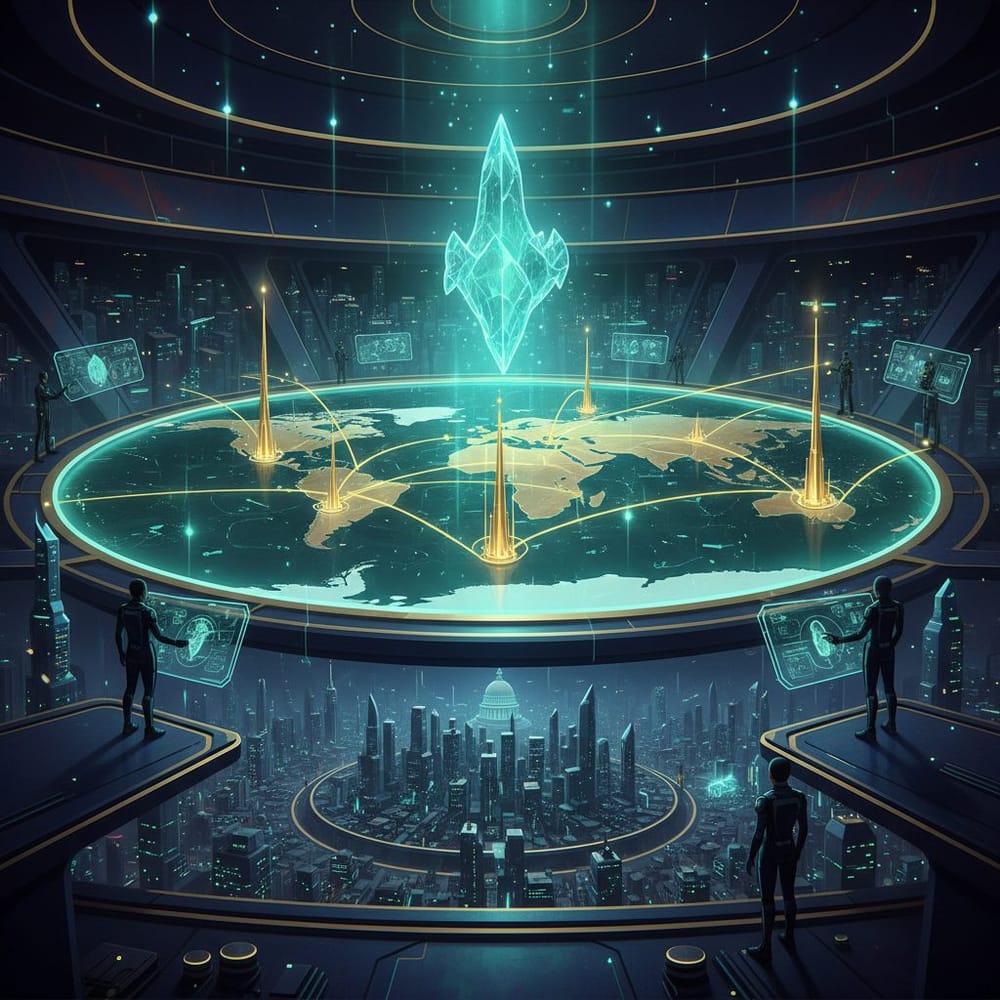
Ravaging an enemy country’s economy once required blocking its ports and besieging its cities. Today, it takes only a declaration published online by the American government. In “Chokepoints,” Edward Fishman unveils the silent metamorphosis that has transformed the global economy into the geopolitical battlefield of the 21st century.
The author depicts a group of American officials who quietly reinvented American foreign policy, experimenting with sanctions and other obscure tools to combat the greatest geopolitical threats of the era: a nuclear Iran, a revanchist Russia, and an assertive China.
The Essentials
- Fishman proposes an impossible geopolitical “trinity”: states cannot simultaneously maintain deep economic interdependence, guarantee their economic security, and engage in geopolitical competition
- Every American president of the 21st century has imposed sanctions at a rate roughly twice that of his immediate predecessor
- “Chokepoints” include the American dollar, advanced microprocessor technology, and key nodes in energy supply chains
- The book culminates with reflection on the erosion of chokepoints, fragmentation of the global economy, and the possible collapse of globalization itself
The Author
Edward Fishman is an American specialist in international relations and former diplomat, currently a senior research scholar at the Center on Global Energy Policy and adjunct professor of international and public affairs at Columbia University. He was previously a member of the policy planning staff of the U.S. Secretary of State and head of Russia and Europe at the office of economic sanctions policy and implementation at the State Department. Between 2011 and 2017, Fishman served in various roles at the State Department, Department of Defense, and U.S. Treasury Department, including special assistant to the under secretary for terrorism and financial intelligence at the Treasury, member of the Iran sanctions team at the State Department, and special assistant to the president of the Joint Chiefs of Staff at the Pentagon. This cross-cutting experience in the inner workings of American power directly nourishes the writing of this book.
The Central Thesis: Economics as a New Theater of War
Fishman argues that we are witnessing the emergence of a new form of conflict. These chokepoints have become powerful tools of economic warfare precisely because they can be wielded unilaterally and without military force. Just as air power transformed warfare by allowing states to inflict damage without suffering losses on the battlefield, hyper-globalization has enabled a more vigorous form of economic coercion that operates below the threshold of armed conflict.
The book describes the emergence of economic warfare as a defining feature of 21st-century geopolitics, examining how the United States and its allies have exercised control over what the author calls “chokepoints” to confront rivals such as Russia, China, and Iran. This analysis is rooted in a personal understanding of the mechanisms: the book combines political analysis with narrative, following diplomats, lawyers, and financial regulators through the process of transforming sanctions, export controls, and investment restrictions into vital instruments of state policy.
Fishman’s originality lies in his ability to render an intricate phenomenon intelligible. Edward Fishman combines his deep knowledge of the subject with a dynamic and engaging writing style, recasting American government technocrats as superheroes waging high-stakes economic battles.
The Impossible Trinity: The Theoretical Heart of the Work
At the center of Fishman’s argument lies his concept of a geopolitical “impossible trinity.” This triangle comprises economic interdependence, economic security, and geopolitical competition. Two of these elements can coexist. All three cannot exist together.
During the Cold War, geopolitical competition reigned supreme, and consequently, one could have economic security and geopolitical competition because there was no economic interdependence. In the 1990s, we had no geopolitical competition — we regarded China and Russia as friends or potential friends rather than rivals, and therefore one could embrace economic interdependence without losing a sense of economic security. What we have now is that economic interdependence persists, but geopolitical competition has returned in force. And therefore we have lost our sense of economic security.
This analytical framework illuminates contemporary tensions. The underlying driver is a structural mismatch: the global economy is still designed for the benign geopolitical environment of the 1990s, not for the far more contested world in which we live today. Until this mismatch is resolved — through deeper changes in how the global economy is organized — economic warfare is likely to intensify.
The Anatomy of American Chokepoints
Fishman meticulously details how the United States has built and exploited its economic advantages. These chokepoints include the dominance of the American dollar and the New York banks and correspondent accounts through which almost all dollar transactions pass, as well as payment systems and banking messaging platforms. In a dollar-centric world, those who control dollar flows are the leaders.
The book extends the idea of geographical chokepoints — such as the Bosphorus and the Strait of Hormuz — to critical domains of the global economy dominated by the United States and its allies, notably the dollar-based financial system, marine insurance, and advanced technologies such as semiconductors. Fishman argues that these chokepoints give Washington extraordinary leverage, while warning that their exploitation pushes America’s adversaries to build alternatives.
The author illustrates this dynamic through concrete cases. Contemporary American economic warfare has its origins in the mid-2000s, when Iran began rapidly expanding its nuclear program. With the United States already engaged in wars in Afghanistan and Iraq — and little appetite for another military conflict — officials in the George W. Bush administration sought alternatives.
The Race for Economic Weapons
Structured in six parts, the book ranges from the creation of the globalized economy in the second half of the 20th century to the rise of financial warfare after September 11, the campaign against Iran’s nuclear program, sanctions imposed on Russia after its annexation of Crimea, and efforts to block China’s technological ascendancy.
This chronology reveals an escalation. More importantly, it triggered a broader race for economic security. Now that the United States has used its power to strike back against its political opponents, trust is lost, and it is very difficult to regain. This has triggered a broader race for economic security. Now that the United States has used its power to strike back against its political opponents, trust is lost, and it is very difficult to regain.
Adversaries adapt. As they sought to protect themselves from this power, the Russian central bank exchanged dollars for euros and gold, the Chinese central bank promoted its own digital currency the renminbi. Moreover, the Chinese have also begun developing their own chokepoint, taking the lead in clean energy.
Blind Spots: The Limits of the Analysis
Despite its richness, the work has several analytical gaps. Fishman, as a former practitioner of the system he describes, sometimes adopts an overly America-centric perspective. His analytical framework, though pertinent, may underestimate the adaptive capacity of targeted economies in the medium term.
Although the book, written before Trump’s return to power, does not account for Trump’s application of sanctions and tariffs against allies, international institutions, and even ICC judges, and how this risks accelerating the decline of American economic power. However, it is prescient in that Fishman rightly emphasizes that measures that instrumentalize the dollar for overtly political purposes could undermine the dollar’s role as a reserve currency.
The author acknowledges this structural limit. The book also includes a stern warning: that economic interdependence will continue to unravel, making these tools less effective. This legacy of dollar dominance has created the very chokepoints that now empower American economic warfare, but also expose the vulnerabilities that could dismantle globalization in the decades to come.
Why Read It
“Chokepoints” appeals to three distinct audiences. Policymakers find in it a sharp analytical framework and a strategic manual. His work bridges a critical gap between high-level theory and political execution, and will resonate with specialists in international political economy, students of American foreign policy, and practitioners grappling with the challenges of economic warfare.
Multinational corporations discover a practical guide. Economic policy is actively reshaping the business environment. Choices concerning supply chains, capital structures, and technological platforms that made business sense five or ten years ago may now carry unacceptable risks. The challenge for companies is that we are in a prolonged transition period.
The general public gains access to an accessible narrative about contemporary geopolitical transformations. What “Chokepoints” does admirably is bring it all together, explaining both how the United States acquired the disproportionate power to punish anyone, anywhere, and how it learned to use and abuse this power. For a reader seeking an accessible guide to how we got here and what comes next, Fishman’s book is invaluable.
The work stands out for its ability to transform complex technical mechanisms into compelling narrative. The Economist review highlighted Fishman’s chronological narration, which “helps him show how economic weapons have evolved through trial, error, and political pressure,” and lauded his portraits of policymakers such as Stuart Levey, Daleep Singh, and David Cohen for bringing drama and immediacy to a complex subject.
This synthesis of technical expertise and narrative talent makes “Chokepoints” an indispensable reference for understanding how the global economy became the new theater of power rivalries in the 21st century. At a time when China is building its own instruments of economic coercion and Europe is attempting to develop its “strategic autonomy,” Fishman’s analysis offers the keys to decoding the stakes of an era in which superpowers wage relentless economic war.
Bibliographic Information - Title: Chokepoints: American Power in the Age of Economic Warfare - Author: Edward Fishman - Publisher: Penguin Random House - Publication date: February 2025, 560 pages, $40