
Arnaud Miranda, a researcher specializing in radical ideologies, publishes with “Dark Enlightenment” a detailed cartography of neoreactionary thought. This essay, published in January 2026, arrives at a pivotal moment when the ideas of this movement, born in the corners of the internet, find growing resonance up to the heart of American political power. The work dissects a complex ideology that combines a virulent critique of democracy with faith in the transformative potential of technocapitalism, proposing an analytical framework to understand a facet of contemporary politics.
A Cartographer of New Radicalities
Arnaud Miranda has established himself as one of the most incisive French-speaking analysts of contemporary political ideologies. His trajectory is that of a researcher who was able to identify, well before it achieved public visibility, the emergence of neoreactionary thought (NRx). His work, begun in 2019, demonstrates in-depth research on this intellectual current that defines itself through its radical opposition to progressivism and democratic egalitarianism. A specialist in political theory, Miranda has devoted several years to studying the origins, figures, and networks of this ideological “constellation.” His approach is distinguished by a “cartographer’s” stance: he does not seek controversy, but focuses on precisely describing the topography of a hostile intellectual territory. He takes these thinkers seriously, reads their texts and dissects the internal logic of their system, without minimizing its danger.
Before the publication of “Dark Enlightenment,” he had already gained attention through his contribution to the “Atlas of Neoreactionary Thought” for Le Grand Continent magazine, where he began to sketch the contours of this movement. This patient approach allowed him to navigate through a complex corpus, often hermetic and deliberately provocative, to extract fundamental theses and show their coherence. The work is therefore the fruit of long immersion in a right-wing counterculture that has managed to create an original synthesis between traditions that seem opposed at first glance, such as technophilic libertarianism and authoritarian traditionalism. By positioning himself thus, Miranda offers the reader not a pamphlet, but an analytical instrument to apprehend an ideological threat.
An Essay Published in the Shadow of New Power
The publication of “Dark Enlightenment” by Gallimard in January 2026 is not insignificant. It coincides with the beginning of Donald Trump’s second term as President of the United States, a context that gives the essay particular resonance and immediate relevance. Miranda’s book does not merely analyze an intellectual curiosity; it offers an essential analytical framework for understanding the ideological foundations of an administration that seems to be putting certain neoreactionary precepts into practice. The work comes out at a time when the influence of this movement, once confined to online forums and confidential blogs, becomes tangible in the corridors of Washington.
The book precisely documents the trajectory of this thought, from its birth in Silicon Valley in the 2010s to its progressive infiltration into circles of power. Supported by influential and wealthy figures like billionaire Peter Thiel, NRx sees in Trump’s victory a historical opportunity to dismantle what it calls “The Cathedral”: the progressive media-academic complex that, according to it, constitutes the real power in the West. Miranda’s essay thus appears at a moment when the questions it raises are of burning relevance, as massive deregulation decrees, hyper-centralization of executive power, and repeated attacks against knowledge institutions seem to respond directly to the wishes of neoreactionary thinkers. The book thus becomes an indispensable tool for deciphering the present.
NRx or the Alliance of Code and Scepter
The heart of Arnaud Miranda’s work is devoted to dissecting the theses of neoreactionary thought. He describes it not as a unified movement, but as a “constellation” of diverse doctrines, a “right-wing counterculture” whose cement is hatred of “democratic egalitarianism.” The great strength of Miranda’s analysis is showing how NRx achieves the synthesis, seemingly impossible, of three currents that everything seems to oppose: Silicon Valley technolibertarians, fascinated by creative destruction; religious traditionalists, seeking a stable moral order; and ethnonationalists, obsessed with preserving an identity deemed threatened. Their common objective is not to preserve the existing order, but to destroy it to replace it. This is authentically reactionary thought, in the historical sense of the term, and not simply conservative.
Miranda identifies and explains several fundamental concepts. The first is a radical critique of democracy, judged ineffective, sclerotic and constituting a brake on innovation and “technocapitalism.” The ambition is to “re-accelerate capitalism” by freeing it from its regulatory and social constraints. To do this, NRx advocates a return to “natural hierarchies” and unashamed elitism. The author explores with precision the political proposals that result from this, notably the “Neocameralism” theorized by Curtis Yarvin (alias Mencius Moldbug). This model aims to restructure the State on the model of a startup: territory is an asset, managed by a “CEO-President” who is only responsible to his “shareholders” and whose legitimacy rests on his economic and security performance, not on democratic principles. Miranda also details the concept of “The Cathedral,” this decentralized network (universities, media) that would maintain progressive orthodoxy.
The work presents the tutelary figures of the movement: Curtis Yarvin, the engineer and blogger who laid the conceptual foundations; Nick Land, the British accelerationist philosopher, more radical and esoteric; and especially Peter Thiel, the co-founder of PayPal and Palantir, who plays the role of strategic and financial godfather, working to connect the different chapels of this new right. Miranda shows how, behind sometimes abstruse discourse, a concrete political program emerges: abolition of democracy, establishment of a form of entrepreneurial monarchy, and restoration of inequalities (of gender, of “genetic heritage”) deemed legitimate and efficient.
An Illuminating Cartography of Contemporary Radicalism
One of the most convincing contributions of Arnaud Miranda’s essay is its capacity to make intelligible a thought that is voluntarily opaque and designed to be repulsive. As several critics emphasize, the work is praised for its clarity and pedagogy. Miranda succeeds in guiding the reader through the labyrinth of neoreactionary concepts, showing their internal logic and frightening coherence. He thus offers the first accessible synthesis in French on a subject whose political importance is growing. By not merely denouncing, but seeking to understand the structure of the opposing argument, he provides robust intellectual tools to grasp the nature of this ideology.
The book is also powerful in its highlighting of the fundamental tension that structures NRx: the alliance between technological capitalism that claims to be radically transformative and a reactionary political project that aspires to an immutable and rigid social order. Miranda convincingly demonstrates that this apparent contradiction resolves itself in a common rejection of the Enlightenment heritage. NRx proposes nothing less than an inversion of this heritage, “Dark Enlightenment” to replace that of the 18th century, deemed responsible for Western decline.
Finally, the work’s strength lies in its capacity to connect the abstract and the concrete. The analysis of texts by Yarvin or Land is never disconnected from the real political influence of these ideas, notably via Peter Thiel’s role and their reception within the Trump administration. The book is not a simple exegesis of marginal texts, but an analysis of how radical ideas, born online, infuse the political field and can transform into a government program. It shows how the meme becomes political.
An Influence Still Difficult to Measure
While Miranda’s work is essential for understanding the structure of neoreactionary thought, it necessarily leaves questions in suspense, which constitutes less a weakness than an invitation to continue reflection. One of the main limitations of the analysis relates to the very nature of its object. NRx being a decentralized movement, a “constellation” without formal membership, it remains particularly difficult to measure its real influence. The essay establishes convincing correlations between NRx ideas and Trump administration policies, but direct causality is, by nature, complex to prove. The book shows that ideas circulate and are taken up at the highest level, but it cannot always quantify their precise impact on political decision-making in the face of other more traditional factors.
Another important nuance concerns movement cohesion. Although Miranda takes care to distinguish different figures and tendencies, presenting a strategic alliance between technolibertarians, traditionalists, and ethnonationalists could mask the profound divergences that exist between these groups. Common hostility to progressive democracy is powerful cement, but one can wonder if this alliance would resist the test of power. The book describes the formation of a front, but internal tensions within this front — for example between the desire for total technological liberation and aspiration to strict moral order — could be a future field of analysis.
Finally, by focusing on theorists and their political relays, the work explores less the reception and diffusion of these ideas in a broader militant base. How are these concepts, often arduous and formulated in specific jargon, translated, simplified and disseminated to a wider public, notably via social media? The analysis of NRx as a “long uninterrupted meme” opens an interesting path, but the sociology of sympathizers of this current remains largely to be done. These limitations do not detract from the quality of the work, but underscore the scope of the research field it helps to open.
Notable Quotes
“Neoreaction is a true right-wing counterculture.”
“With neoreactionary thought, we are dealing with an intellectual constellation: diverse doctrines that aggregate around common problematics and references.”
“Neoreactionary thought is an attempt to reconcile technocapitalist innovation with the stability of a hierarchical society. Of course, this strategic union is made above all against a common enemy: democratic egalitarianism.”
“I no longer believe that freedom and democracy are compatible.” - Peter Thiel
Bibliographic Information
- Title: Dark Enlightenment: Understanding Neoreactionary Thought
- Author: Arnaud Miranda
- Publisher: Gallimard / Le Grand Continent
- Collection: Geopolitics Library
- Publication date: January 22, 2026
- Number of pages: 176
- Price: 18 EUR
- EAN: 9782073140326
Sources
Receive Journal analyses directly in your mailbox.
Also Read
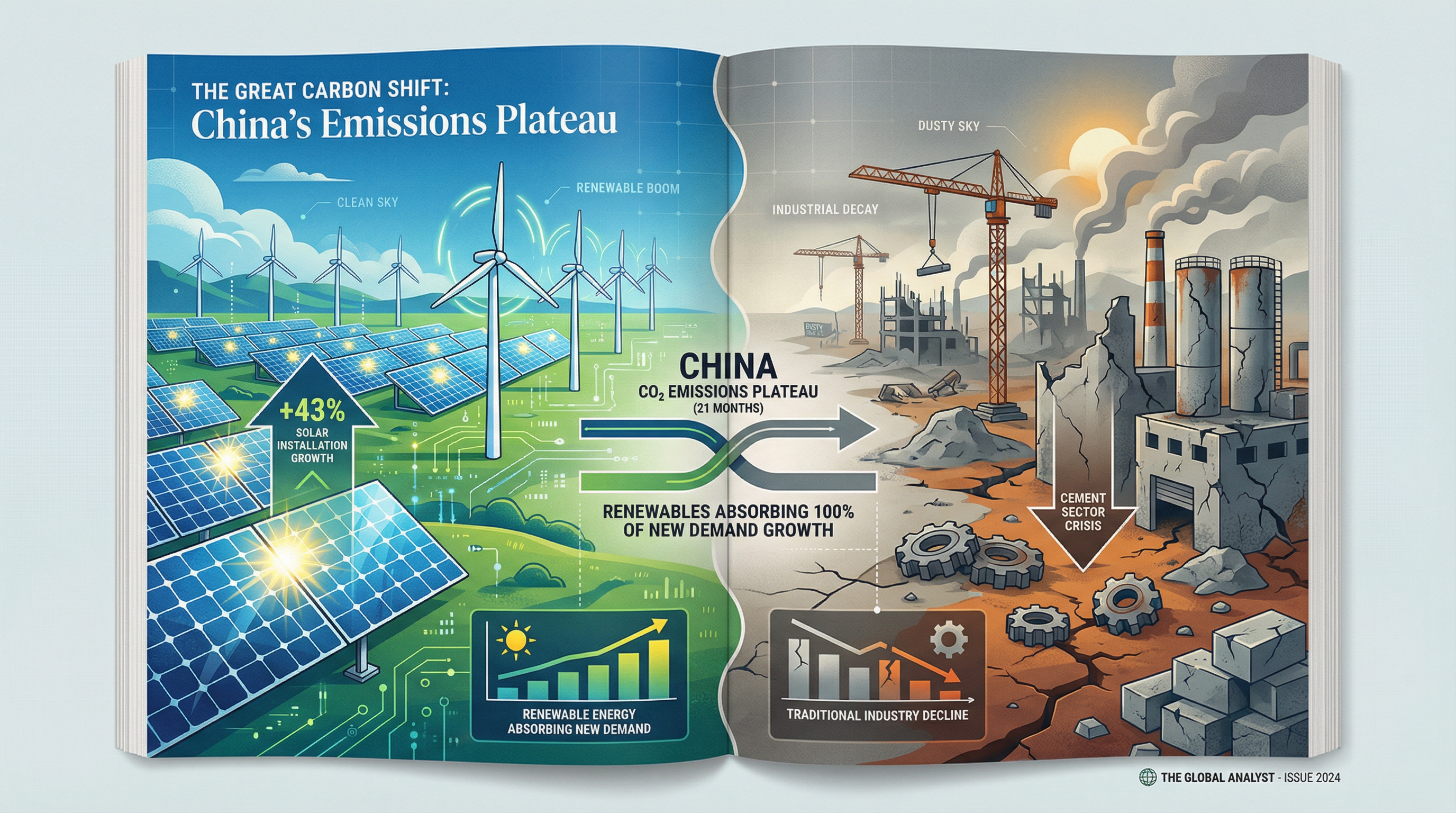
China’s CO2 emissions have stagnated for 21 months: structural peak or cyclical accident?
China’s CO2 emissions fell by 0.3% in 2025. This is a modest figure. But it extends a trend that has lasted for 21 consecutive months: since March 2024, emissions from the world’s largest polluter have been “stable or declining.”

AI and employment: two March 2026 studies reveal -13% automatable positions and +20% augmented roles
Does AI destroy jobs? Two studies published in March 2026 — one by Harvard Business School, the other by Anthropic — provide the first solid empirical data. And the answer is more nuanced than public debate suggests.

The malaria vaccine in Nigeria: 200,000 children vaccinated and a 50% drop in cases in Kebbi State
Malaria killed 608,000 people in 2022, 95% of them in sub-Saharan Africa and 78% children under five. And for the first time, a vaccine deployed on a large scale shows measurable results in the field.