
After two decades of notable economic convergence with the European Union, several Central and Eastern European countries – Bulgaria, Croatia, Poland and Romania, designated as the 4CEE – find themselves at a transition point. Their growth model, traditionally based on investment and gradual integration into global value chains, shows signs of running out of steam. Factors such as eroding labor cost competitiveness, concentration in low value-added segments, skills shortages and demographic pressures call for a reorientation toward growth sources focused on innovation and productivity increases.
Digital transformation represents a major lever for this evolution. A World Bank Group report, published in March 2026, estimates that Bulgaria, Croatia, Poland and Romania could increase their labor productivity by 10 to 15% through broader adoption of digital technologies, particularly software and artificial intelligence-based tools. Yet this opportunity remains largely underexploited, hindered by insufficient investment, delayed adoption by small and medium enterprises, and gaps in skills and regulatory frameworks.
The region thus faces the need to move beyond its current model to avoid finding itself "trapped" between low-wage economies and innovation leaders. The adoption of digital technologies, coupled with a coherent innovation strategy, represents a path to stimulate growth, create skilled jobs and improve living conditions, as highlighted in the World Bank report "Innovation Rising: Lifting Central and Eastern Europe's Jobs and Growth Potential".
Labor productivity: a persistent gap with advanced economies
Labor productivity in the 4CEE, while progressing, remains low in absolute terms. Between 1995 and 2019, productivity per hour increased by 50% in the United States, compared to only 28% in the eurozone over the same period. This gap indicates different growth dynamics and a lesser capacity to generate added value per unit of work. Real GDP growth in the 4CEE rebounded to 2.4% in the second quarter of 2025, which is a positive sign, but does not solve the structural question of productivity.
This discrepancy is all the more concerning as productivity is an essential driver of economic growth and improvement in living standards. Anna Akhalkatsi, Division Director for the European Union at the World Bank, stated that maintaining the region's economic progress "will depend on increasing productivity – through wider use of digital technologies, stronger investment in skills, and clear and predictable rules that help businesses innovate, grow, and be competitive" according to a World Bank press release. Companies' ability to integrate digital technologies, particularly software and AI-based tools, is identified as a key factor in reducing this gap and achieving the estimated productivity gains.
R&D spending and intangible assets below the European average
Investment in research and development (R&D) and intangible assets is an indicator of an economy's capacity to innovate and modernize its production processes. In the 4CEE, R&D spending is below the EU average, standing at less than 1.5% of GDP, compared to 2.2% on average in the Union. This low level of investment limits these countries' capacity to develop their own technologies or adapt existing innovations to their specific contexts.
Similarly, investment in intangible assets, such as software, databases, internal R&D and brands, is also lower, particularly in Poland, where it represents 26% of total investment, compared to 37% on average in the EU. Yet these assets are essential vectors of digital transformation and productivity improvement. Insufficient investment in these areas makes it difficult for companies in the region to fully integrate modern digital tools and compete in high value-added markets.
Small businesses' digital adoption lag hampers growth
Small and medium enterprises (SMEs) constitute the economic fabric of the 4CEE, but their adoption of digital technologies lags notably. This phenomenon is particularly marked in Bulgaria and Romania. Many SMEs struggle to invest in digital infrastructure, train their employees in new skills, or integrate advanced software solutions. This gap has direct implications for the region's overall productivity.
While large companies can often afford larger investments in digitization, SMEs face constraints in resources, skills and access to financing. The World Bank report emphasizes that the digital adoption gap between large companies and SMEs is a major obstacle to increasing productivity. Without further digitization of this economic segment, the 4CEE's growth potential, particularly through the integration of software and AI-based tools, cannot be fully realized.
Brain drain and skills mismatch limit human potential
Despite often high education levels, including in science, technology, engineering and mathematics (STEM) fields, the 4CEE encounter difficulties in translating this human capital into productivity gains and innovation. One of the major problems is brain drain: nearly one in five skilled workers leaves their country in Romania, Bulgaria and Croatia. This departure of talent weakens the local skills base and reduces companies' capacity to innovate and adopt advanced technologies.
At the same time, a mismatch exists between the skills taught by education systems and the real needs of the labor market. Training programs do not always adapt quickly enough to the rapid evolution of digital technologies and the requirements of the innovation economy. This mismatch, combined with the migration of skilled workers, creates a skills shortage that hinders digital transformation and limits the effectiveness of technological investments. Productivity does not result solely from tools, but also from individuals' capacity to use and develop them, as the World Bank report reminds us: "Productivity and innovation do not simply result from increased research and development, but from the efficient functioning of a complete system of interactions."
Dependence on EU funds for R&D and the limits of local venture capital
The 4CEE depend heavily on European Union funds to finance their R&D and innovation projects. While these funds are essential, this dependence raises questions about the sustainability and autonomy of national innovation strategies. Moreover, the absorption capacity for these funds is not always optimal; Bulgaria, for example, only absorbed 79% of the cohesion funds allocated for the 2014-2020 period. This indicates gaps in planning, project management or local administrative capacities to fully mobilize these resources.
Furthermore, the venture capital market remains underdeveloped in the region. Innovative companies, particularly tech startups, have limited access to the private financing necessary to develop and commercialize their innovations. This weakness in venture capital constrains many companies to seek financing abroad or slow their growth, which limits the creation of local added value and the development of a dynamic innovation environment. Diversifying funding sources and strengthening local venture capital capacities appear as paths to support more endogenous innovation.
The risk of "intermediate technology trap" and the need for a systemic approach
The 4CEE face the prospect of an "intermediate technology trap." The World Bank report describes this situation as "an economy 'getting stuck' producing and assembling moderate-technology goods." This production model, which enabled initial convergence, shows its limits in the face of eroding labor cost competitiveness and competition from low-wage economies. The region risks no longer being able to compete on prices while being excluded from high value-added markets, dominated by actors with strong innovation capacity.
To avoid this trap, a systemic approach to innovation is necessary. This implies more efficient coordination between different actors – governments, universities, companies, research centers – and a long-term strategic vision. Institutional fragmentation, characterized by a lack of coordination between ministries and agencies, as well as sometimes inadequate regulatory frameworks, hinders the development of a coherent innovation environment. Escaping this trap requires a profound transformation of economic and institutional structures, beyond simple increases in R&D spending.
AI and climate technologies: opportunities to be framed
The rapid emergence of artificial intelligence (AI) and climate technologies offers new perspectives for the 4CEE. In the first quarter of 2024, these domains represented 45% and 26% of venture capital investments in the region respectively, indicating significant interest and growth potential. These technologies can enable the 4CEE to leapfrog development stages and position themselves in future markets, provided the conditions are met.
To capitalize on these opportunities, it is necessary to establish agile regulatory frameworks and appropriate support for innovation. This includes policies favoring training in new skills, access to financing for startups, and the
Receive Journal analyses directly in your inbox.
Also read
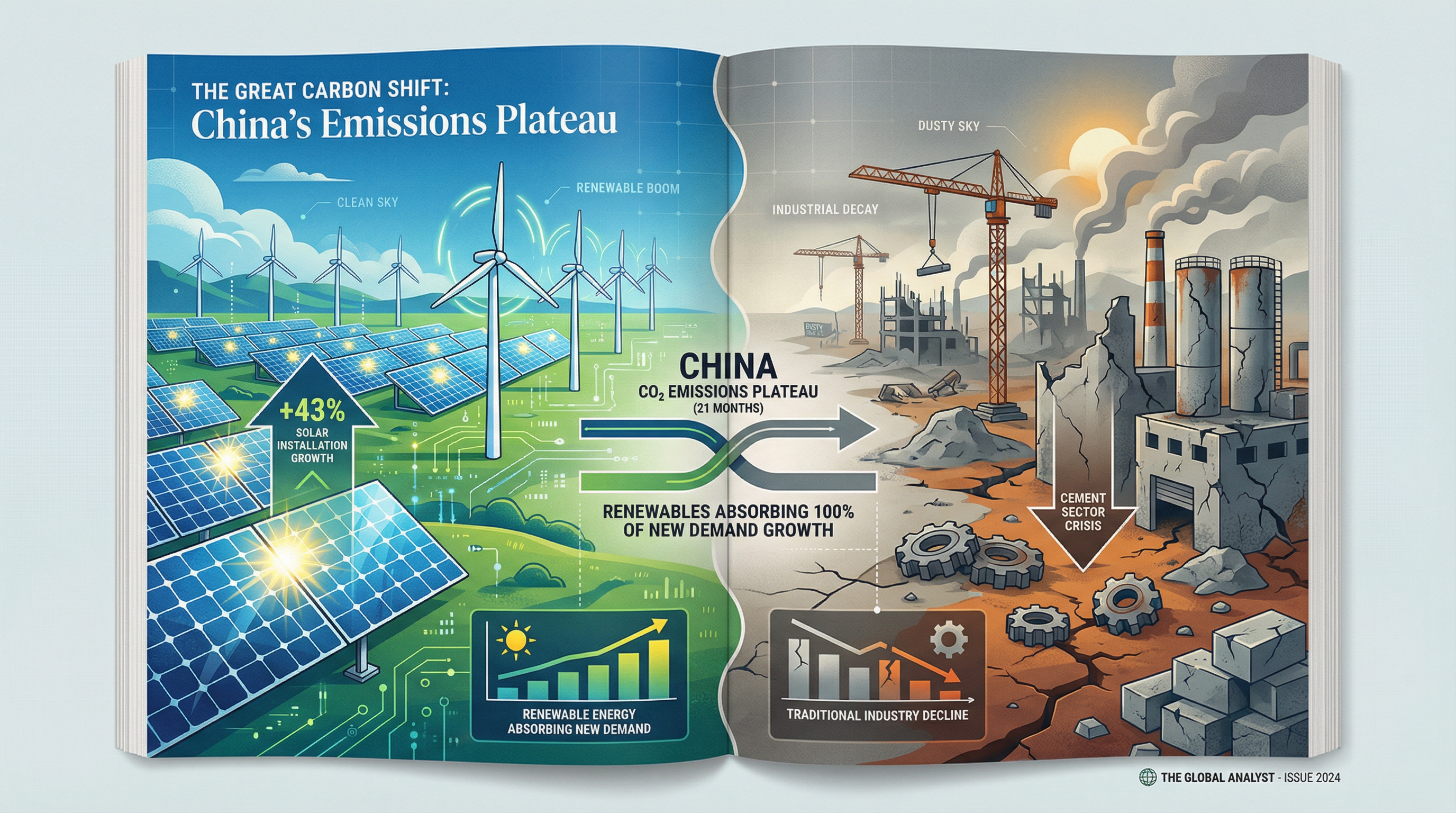
China's CO2 emissions stagnant for 21 months: structural peak or cyclical accident?
China's CO2 emissions fell by 0.3% in 2025. It's a modest figure. But it extends a trend that has lasted for 21 consecutive months: since March 2024, emissions from the world's largest polluter have been "stable or declining."

AI and employment: two March 2026 studies reveal -13% automatable jobs and +20% augmented roles
Does AI destroy jobs? Two studies published in March 2026 — one by Harvard Business School, the other by Anthropic — provide the first solid empirical data. And the answer is more nuanced than public debate suggests.

The malaria vaccine in Nigeria: 200,000 children vaccinated and a 50% drop in cases in Kebbi State
Malaria killed 608,000 people in 2022, of which 95% in sub-Saharan Africa and 78% children under five years old. And for the first time, a vaccine deployed at large scale shows measurable results in the field.