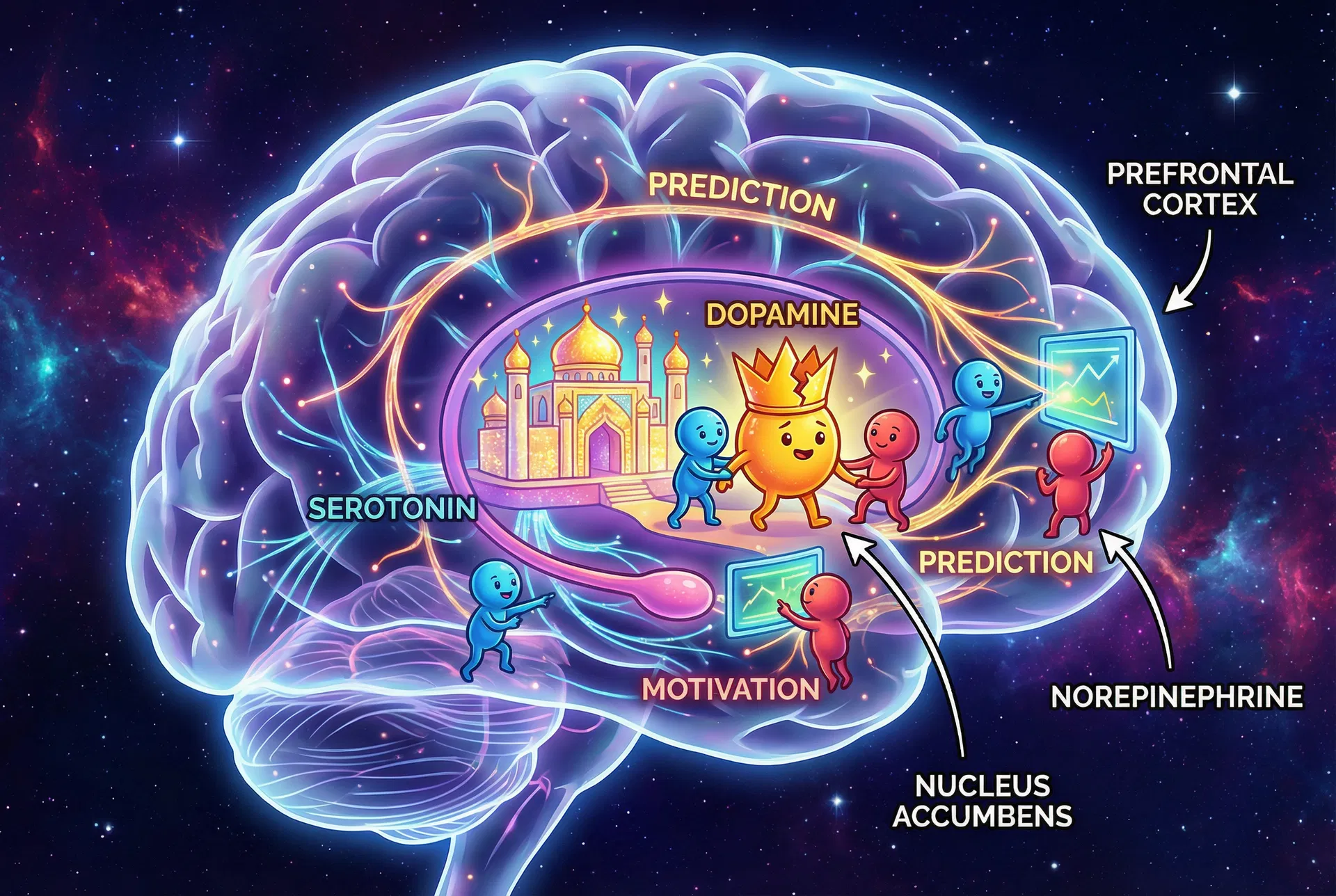
Long reduced to its role as the “pleasure molecule,” dopamine is now at the center of a paradigm shift in neuroscience. Recent research, particularly studies conducted between 2024 and 2026, reveals a far more complex agent, acting as the primary regulator of our motivation and learning processes. This new understanding of its mechanism is fundamental for addressing mental health disorders and modern addictions.
A Motor Called Desire: Dopamine as a Motivation Signal
Contrary to a widely held belief, dopamine does not directly produce the sensation of pleasure. It functions rather as a predictive signal, a catalyst for action oriented toward obtaining a reward. Its role is to evaluate what deserves our attention and to push us to act. The dopaminergic system is therefore the motor of our motivation, allowing us to initiate projects, persevere in the face of obstacles, and engage in long-term activities. A publication by Carenity from January 2026 specifies that its primary function is “to help the brain determine what deserves our attention and which actions are worth repeating” [1]. This distinction is essential: dopamine does not reward possession, but anticipation and pursuit.
Healthy dopaminergic signaling is synonymous with dynamism and engagement. Conversely, a disruption of this system can manifest as profound apathy, generalized loss of interest, and an inability to initiate action. These symptoms, often wrongly attributed to laziness or lack of willpower, are actually clinical manifestations of a neurobiological dysregulation. Chronic stress, poor sleep quality, or inflammatory states can be enough to disturb this delicate balance, highlighting the fragility of our motivational systems in the face of modern life’s aggressions [1].
Learning to Want: How Dopamine Engraves Our Habits
Dopamine is at the heart of reinforcement learning, a fundamental mechanism for our survival. When an action is followed by an unexpected reward, a dopamine release occurs. This peak signals to the brain that the event is positive and worthy of being memorized. The neurotransmitter then reinforces the synaptic connections involved in the behavior that led to the reward, thus increasing the probability that we will repeat it in the future. This is how we learn to seek food, establish social bonds, or master a new skill.
This process is neutral by nature; it does not distinguish between a reward beneficial to our well-being and a harmful substance or behavior. As Professor Boris Hansel and addiction specialist Laurent Karila explain, this learning mechanism is precisely what is hijacked in addiction [2]. Drug consumption, for example, causes a massive and artificial release of dopamine, far superior to that triggered by natural rewards. The brain interprets this overpowering signal as an event of capital importance for survival. It will then disproportionately reinforce the neural circuits associated with substance use, creating a lasting memory and compulsive craving to repeat the experience. Learning transforms into conditioning.
When the Machine Breaks Down: 3 Types of Disorders Linked to Dysregulated Dopamine
The complexity of the dopaminergic system makes it vulnerable to dysregulations whose consequences can be severe. Insufficient dopamine production or dysfunction of its receptors is implicated in Parkinson’s disease, which is characterized by progressive motor disorders. Conversely, hyperactivity of this system is associated with certain symptoms of schizophrenia. Beyond these well-identified pathologies, more subtle dysregulation of dopamine is now linked to a wide range of neuropsychiatric disorders.
First, attention deficit disorders with or without hyperactivity (ADHD) are increasingly understood as a consequence of ineffective dopaminergic signaling in the prefrontal regions of the brain. This area, responsible for executive functions such as planning, concentration, and impulse control, depends heavily on optimal dopamine levels. A deficit can lead to difficulties maintaining attention, impulsivity, and motor agitation. Second, many forms of depression, particularly those marked by anhedonia (the inability to feel pleasure) and apathy, are associated with a hypoactive reward system. The lack of motivation and emotional blunting reflect an inability of the dopaminergic system to generate the momentum necessary for action [1]. Finally, burnout, or professional exhaustion, is also analyzed from the angle of depletion of dopamine circuits, drained by chronic over-solicitation and a lack of perceived rewards.
The Reward Trap: From Habit to Addiction
Addiction represents the most extreme form of reward circuit dysregulation. It is characterized by loss of control and compulsive pursuit of a behavior despite its negative consequences. Professor Laurent Karila describes this process as a “desynchronization” of brain circuits [2]. Under the effect of intense and repeated stimulations, the reward and memory-learning circuit literally takes control over the motivation and executive control circuits, located in the prefrontal cortex.
This shift has concrete consequences. The person no longer seeks the substance or behavior for the pleasure it provides (which moreover diminishes over time, a phenomenon known as tolerance), but to calm the irrepressible craving generated by the habit circuit. Motivation is no longer directed toward constructive life goals, but entirely absorbed by the search for immediate reward. A thesis from the University of Bordeaux from 2025 reminds us that adaptive decision-making, our ability to adjust our choices according to a changing context, depends crucially on the modulation of these prefrontal circuits by dopamine [3]. In addiction, this flexibility is lost, replaced by a rigid and automatic response.
Your Attention Please: 4 Social Media Techniques to Hack Your Brain
The attention economy, which governs the business model of many digital platforms, has quickly understood how to exploit the flaws in our dopaminergic system. Former executives of giants like Facebook have publicly acknowledged that their goal was to consume as much time and attention as possible by exploiting “the vulnerability of human psychology” [4]. To do this, engineers and designers use “persuasive design” techniques, whose purpose is to create involuntary habits.
The “Hook” model, theorized by Nir Eyal, is one of the best known. It breaks down into four stages: a trigger (a notification), an action (opening the application), a variable reward (a “like,” a comment, new information) and an investment (posting a photo, leaving a comment). The variability of the reward is particularly effective for stimulating dopamine and reinforcing the habit. Never knowing whether the action will produce a gratifying social reward, the user is encouraged to check constantly. Other features, such as “infinite scroll” which eliminates any natural stopping point, or Snapchat’s “streaks” which create social pressure to maintain daily interaction, are specifically designed to be addictive, as psychologist Vincent Joly points out [4]. These mechanisms are not aimed at improving user experience, but at maximizing time spent on the platform, transforming our brains into targets of dependency engineering.
The consequences of this artificial and incessant stimulation on mental health are increasingly documented. Multiple studies correlate intensive use of social media with increased rates of anxiety, depression, and decreased self-esteem, particularly among younger populations. By hacking our motivation system, these technologies could alter our ability to concentrate on complex tasks and engage in activities that provide deeper and more lasting satisfaction.
Contemporary neurosciences offer us a renewed vision of dopamine, far from the reductive image of the simple pleasure molecule. By placing it at the heart of motivation, learning, and decision-making, they give us keys to better understand the mechanisms of our actions, but also the mechanisms of addiction and certain mental disorders. This knowledge, while opening promising therapeutic avenues, imposes a new vigilance on us. It confronts us with the collective responsibility of designing an environment, particularly digital, that respects our brain biology rather than exploiting it. The debate on the ethics of persuasive design and platform regulation is just beginning. It raises profound questions about the definition of autonomy and free will in a society where our attention has become the most precious currency of exchange. The way we respond to these questions collectively will largely determine our ability to get the best out of our brain, without becoming its slaves.
References
- [1] Carenity. (2026, January 10). Dopamine: what role does it play in motivation, mood and daily life? https://www.carenity.com/infos-maladie/magazine/actualites/dopamine-quel-role-jouetelle-dans-la-motivation-lhumeur-et-la-vie-quotidienne-3335
- [2] Hansel, B., & Karila, L. (2020, November 3). From pleasure to addiction, what happens in our brain? The Conversation. https://theconversation.com/du-plaisir-a-laddiction-que-se-passe-t-il-dans-notre-cerveau-148701
- [3] Plat, H. (2025). Learning to decide: a neurocognitive perspective in rats: the role of rat prefrontal noradrenaline in adaptive behavior [Doctoral thesis, University of Bordeaux]. HAL. https://theses.hal.science/tel-05457529/
- [4] Joly, V. (2022, April 7). Dopamine and social networks: this hormone that manipulates us. Psy à Paris. https://psyaparis.fr/dopamine-reseaux-sociaux/
- Faced with this observation of a motivational system under influence, the idea of a “dopaminergic detox” has gained popularity. The concept proposes abstaining from any activity providing instant gratification for a given period, in order to “reset” the brain. While the intention is laudable, neuroscientists remain cautious. The term “detox” is scientifically inappropriate; it is impossible and moreover undesirable to suppress dopamine. However, the idea of reducing over-stimulation and relearning to appreciate more natural and less intense rewards is a serious avenue.
- Several strategies, based on scientific evidence, allow for the restoration of dopaminergic balance. First, diet plays a significant role. Dopamine is synthesized from tyrosine, an amino acid present in protein-rich foods. A balanced diet, rich in fruits, vegetables and proteins, and low in sugars and ultra-processed foods, provides the brain with the materials necessary for its proper functioning. Second, regular physical activity is one of the most effective means to regulate mood and motivation. Exercise increases dopamine receptor sensitivity and promotes neurogenesis. Third, sleep is a critical period for brain maintenance. Quality sleep in sufficient quantity (7-9 hours for an adult) is essential for regulating dopamine production and consolidating learning. Finally, practices like mindfulness meditation can help strengthen prefrontal control over impulses and better regulate emotional responses. It is therefore not so much a “detox” as a re-education of our attention and habits, a conscious effort to regain control over the mechanisms that guide our desires.
- Receive Journal analyses directly in your email inbox.
- China’s CO2 emissions decreased by 0.3% in 2025. This is a modest figure. But it extends a trend that has lasted for 21 consecutive months: since March 2024, the world’s largest polluter’s emissions have been “stable or declining.”
- Does AI destroy jobs? Two studies published in March 2026 — one by Harvard Business School, the other by Anthropic — provide the first solid empirical data. And the answer is more nuanced than public debate suggests.
- Malaria killed 608,000 people in 2022, 95% of them in sub-Saharan Africa and 78% children under five years old. And for the first time, a vaccine deployed on a large scale shows measurable results in the field.
- Wanting to be 20 years old today. An independent media that documents progress with rigor, without naivety or catastrophism.
- Structured reading sheets: central thesis, key arguments, limitations, and verdict.
- The JdP is an independent editorial project founded on data, counter-narratives and lucid optimism. Each article is sourced, nuanced and open to discussion.
- Le Journal d’un Progressiste uses cookies to improve the reading experience and understand how the site is used. No data is collected for commercial, advertising or resale purposes. Cookies necessary for site functioning are always active. Optional cookies are only activated with your explicit consent, in accordance with GDPR.