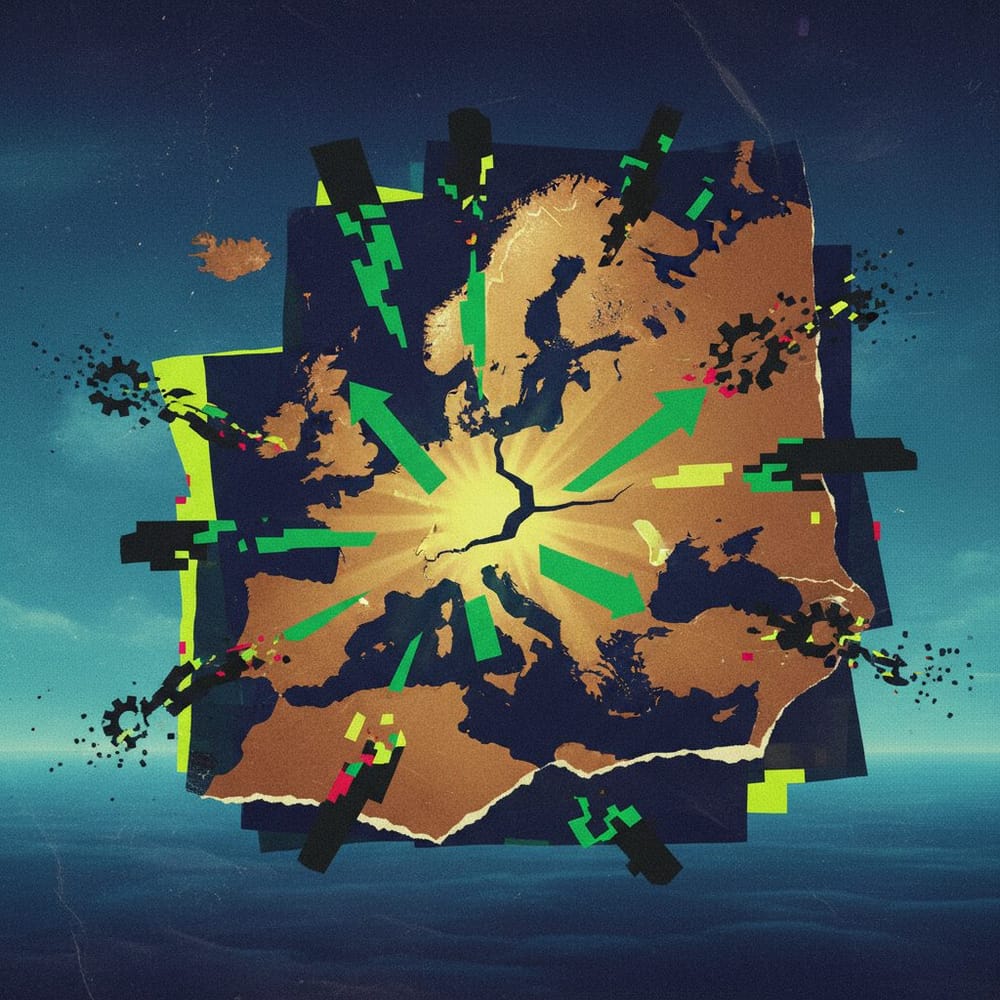
Europe’s Own Protectionism: 44% Hidden Tariffs Paralyze the Single Market
Internal barriers within the European single market are equivalent to 44% tariffs on goods and 110% on services. These obstacles exceed internal commercial barriers within the United States threefold and have been hampering European growth for three decades.
Thirty-two years after its creation, the single market remains an unfinished project. The European Commission is launching a radical plan to dismantle the “Dreadful Ten” obstacles that transform Europe into a fragmented economic archipelago rather than a unified commercial space.
The Essentials
- Internal European barriers are equivalent to 44% tariffs on goods and 110% on services
- These obstacles represent a significant economic loss for the European Union according to economist estimates
- The Commission proposes the “28th regime” to bypass 27 divergent national regulations
- The “Dreadful Ten” obstacles identified mainly affect digital and professional services
The Numbers Behind Failure: Three Times More Barriers Than the United States
A study by the Centre for Economic Policy Research reveals the scale of the problem. While American companies face internal commercial frictions equivalent to 15% tariffs, their European counterparts endure obstacles of 44% on goods.
The situation becomes dramatic in services. Barriers reach 110% tariff equivalent, transforming each national border into a commercial wall. A French lawyer cannot practice in Germany without completely redoing their training. A qualified electrician in Poland must retake certifications in Italy.
This fragmentation represents a loss of several hundred billion euros in economic growth for the Union. The American economy, with a truly unified market across 50 states, generates 25% higher productivity than Europe in services.
The “28th Regime”: Bypassing 27 National Bureaucracies
Facing this paralysis, Brussels proposes the “28th regime.” This legal innovation allows companies to choose a unified European regulatory framework rather than navigate between 27 divergent national systems.
In practical terms, a fintech startup could operate across the entire Union with a single European authorization. Today, it must obtain 27 national licenses, each with its specific criteria. BNP Paribas employs 400 lawyers just for European regulatory compliance.
The mechanism draws inspiration from the banking passport, which has allowed banks to operate in the EU with a single license since 1989. This exemption has quadrupled cross-border financial flows in Europe. Extension to other sectors could unlock 800 billion euros in private investment according to the Commission.
The “Dreadful Ten”: Anatomy of Obstacles Strangling Europe
The Commission has identified ten priority categories of obstacles. Digital services lead the way. Each country imposes its own data protection rules, content moderation criteria, and fiscal obligations for platforms.
Regulated professions constitute the second major lock. Europe has 800 regulated professions compared to 100 in the United States. A Czech engineer cannot sign plans in France. A Spanish accountant cannot certify accounts in Belgium.
Public procurement represents the third major brake. Despite European directives, 80% of public contracts remain awarded to national companies. Germany buys German, France buys French. This national preference deprives taxpayers of 40% in potential savings.
Technical standards then fragment the industry. BMW produces 47 different versions of its cars to meet national specifications. Unilever manufactures 312 variants of its products for 27 markets that should be identical.
State Resistance: When Paris Defends Its Notaries
National governments protect their champions and corporations. France maintains the monopoly of its notaries over real estate transactions. This profession generates 4.5 billion euros in annual revenue with tariffs set by the State.
Germany defends its 860,000 Meister, highly skilled artisans who control access to 130 professions. This corporatist system limits competition but guarantees exceptional quality. German products command prices 15% higher thanks to this reputation.
Italy blocks the opening of its pharmacies. The country has one pharmacy for every 4,300 inhabitants compared to one for every 2,100 in France. This artificial scarcity maintains margins of 35% on non-reimbursable medications.
These national resistances rest on legitimate arguments. The global economy is shifting into an era of debt-financed infrastructure, and states fear losing their industrial policy tools in the face of Chinese competition.
Geopolitical Urgency: Catching Up with the Giants
European fragmentation is becoming a major geopolitical handicap. Chinese companies operate in a unified market of 1.4 billion consumers. American giants dominate a commercial space of 330 million inhabitants with no internal barriers.
Europe artificially divides its 450 million consumers into 27 separate markets. This economic Balkanization explains why none of the world’s top 20 technology capitalizations is European.
European startups raise significantly fewer funds than their American counterparts. They struggle to grow in a fragmented environment. Spotify had to negotiate 27 different licensing agreements to distribute music across Europe. Netflix bypassed the problem by establishing itself in the Netherlands with a pan-European strategy from the start.
The technological war between Washington and Beijing reinforces the urgency. Chinese chips are reshaping the geography of artificial intelligence while Europe struggles to nurture its champions amid regulatory fragmentation.
Early Results: 2026 as a Test Year
The first experiments with the 28th regime begin in 2026 in three pilot sectors: digital financial services, telecommunications, and cross-border e-commerce.
Revolut, the British neobank, has already announced its intention to test the new framework to restart its European operations after Brexit. The company could save 15 million euros annually in compliance costs.
The pharmaceutical industry is watching the experiment closely. Laboratories currently spend 200 million euros per drug to navigate between the 27 national regulatory authorities. A unified regime could cut these costs in half.
Preliminary results will determine the system’s extension to other sectors. The Commission targets 15 application areas by 2030, with an objective of doubling intra-Community trade.
Europe is discovering that its greatest challenge is not external competition but its own internal fragmentation. After three decades of partial integration, it is finally attempting to create the true single market promised by the Treaty of Maastricht. European companies and their 190 million jobs depend on it.