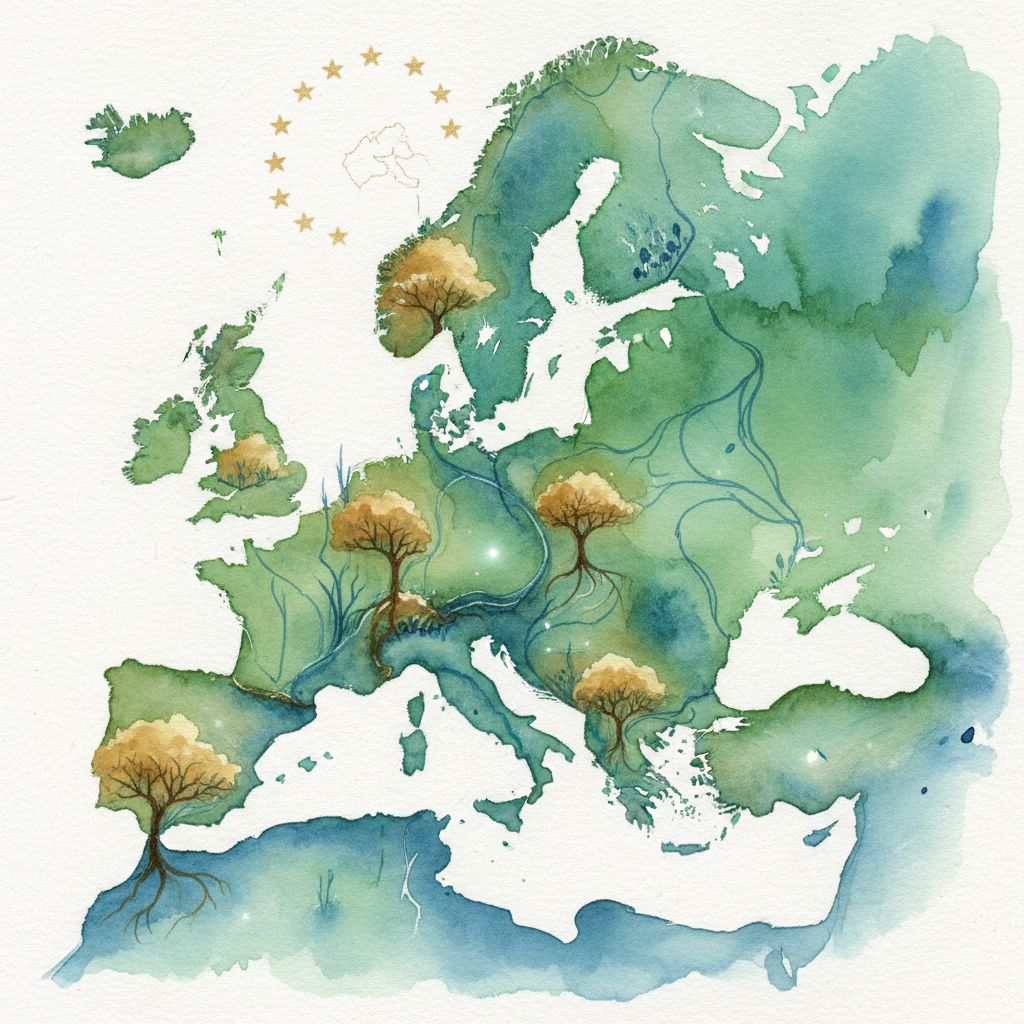
70 billion euros per year. This is Europe’s climate adaptation bill until 2050, according to the first systemic assessment conducted by the European Commission. A sum equivalent to 0.5% of continental GDP, divided between resilient infrastructure (30 billion), ecosystem restoration (21 billion), and coastal protection (10 billion).
This risk cluster approach marks a break from project-by-project logic. For the first time, the EU quantifies its climate vulnerabilities with a reproducible methodology, transforming adaptation into an exact political science.
30 billion for infrastructure that resists
European infrastructure lags critically behind new climate extremes. Electrical networks, designed for maximum temperatures of 40°C, now fail at 45°C. Railway tracks deform. Data centers overheat.
The Commission identifies three investment priorities. First item: modernizing electrical networks for 12 billion euros annually. Current transformers lose 20% efficiency beyond 35°C. New models, cooled by synthetic oil circulation, maintain performance up to 50°C.
Second project: railway adaptation for 8 billion annually. Steel rails expand by 12mm per kilometer at 50°C, creating dangerous deformations. New reinforced anchoring techniques and resistant alloys allow continuous operation up to 55°C.
Third urgency: urban cooling systems for 10 billion per year. Barcelona is testing collective cooling networks powered by geothermal heat pumps. These systems consume 60% less electricity than individual air conditioning during heat peaks.
This infrastructure planning draws inspiration from Asian feedback. Japan has invested 2% of its annual GDP in seismic resilience since 1995. Result: no post-1995 standard building collapsed during the 2011 earthquake.
European ecosystems are worth 21 billion in annual investment
Ecological restoration becomes a quantifiable economic investment. European wetlands, covering 2% of the territory, store 30% of continental carbon and filter 40% of freshwater. Their degradation would cost 180 billion euros in replacement services.
The Commission targets four priority ecosystems. Boreal forests absorb 15% of European emissions but lose 2 million hectares per decade to droughts. Their restoration requires 7 billion annually: replanting resistant species, ecological corridors, adaptive soil management.
Grasslands store 34 tons of carbon per hectare, three times more than intensive crops. Their conversion represents a sequestration potential of 50 million tons of CO2 annually. Cost: 6 billion euros per year to convert 5 million hectares.
European coastlines, 70,000 kilometers long, protect 200 million inhabitants. Natural dunes absorb 90% of wave energy versus 60% for artificial dikes. Restoring 10% of degraded coasts costs 5 billion annually but prevents 45 billion in potential damage.
Peatlands, representing only 3% of emerged land, store 25% of global soil carbon. Their restoration in Central Europe could sequester 20 million tons of CO2 per year for an investment of 3 billion euros.
This ecosystem approach relies on emerging technological tools. AI monitors forest health by satellite, detects water stress before visible symptoms, optimizes planting schedules according to microclimates.
New financial instruments: adaptation becomes profitable
Europe develops unprecedented financial mechanisms to mobilize the 70 billion annually. Green bonds already represent 40% of European emissions, totaling 350 billion in 2024. Adaptation bonds, launched in 2025, specifically target climate resilience.
The European Adaptation Fund, endowed with 50 billion until 2030, guarantees loans to local authorities. Its criteria: quantified demonstration of risk reduction, reproducible methodology, measurable co-benefits. Strasbourg obtains 150 million for its urban drainage system that quarters floods and creates 30% additional green spaces.
Public-private partnerships multiply. Veolia invests 2 billion in European water resilience in exchange for 25-year contracts with guaranteed returns. These agreements secure water supply for 50 medium-sized cities facing recurring droughts.
European financial innovation inspires other regions. Latin America adapts these instruments to valorize its critical resources, creating bridges between climate adaptation and technological sovereignty.
The European methodology spreads to other continents
The systemic approach developed by the EU extends beyond its borders. The Commission shares its risk assessment methodology with 15 partner countries. This analysis grid crosses physical vulnerabilities, adaptation capacities, and inaction costs across five climate scenarios.
Australia adapts the European model to quantify its needs in the Pacific: 12 billion Australian dollars annually against strengthened cyclones and rising waters. The European methodology identifies synergies between adaptation and marine biodiversity.
South Africa applies these tools to quantify its water transition: 8 billion rands per year to secure water supply for 30 million urban dwellers. The cluster approach reveals that 40% of adaptation investments simultaneously strengthen food security.
Canada integrates the European grid into its Arctic strategy. Result: coordinated planning of 15 billion Canadian dollars to protect permafrost infrastructure and maintain northern supply routes.
2030-2050: European adaptation changes scale
The 2030-2040 decade will concentrate 60% of identified investments. This acceleration stems from the convergence of three dynamics: technological maturity of solutions, availability of European funding, growing climate urgency.
The first returns on investment appear by 2028. Rotterdam already measures the benefits of its 2 billion invested since 2020: 70% reduction in urban flooding, creation of 5,000 green jobs, savings of 400 million annually in avoided damages.
The scale effect transforms the European economy. The 70 billion annually generates 2 million direct jobs in ecological construction, natural restoration, risk management. These sectors show 8% annual growth since 2024.
Resilience becomes a European competitive advantage. Continental companies export their expertise to Asia-Pacific, a 200 billion dollar market by 2035. This technical skill development strengthens Europe’s position against traditional Chinese and American leaders.
The European methodological approach inspires a new generation of international agreements. The next 2026 climate summit will study the generalization of these quantitative tools to plan global adaptation.
Sources: 1. European Commission - EU needs to invest €70 billion per year in climate adaptation to 2050