The European Union Facing the Enlargement Challenge: Between Unity and Variable Geometry
The European Union currently has 27 member states compared to 6 founders in 1957. The probable accession of Ukraine in the coming years could bring this number to 30, with a population reaching 450.4 million inhabitants by 2025. This growth exposes a fundamental contradiction: how to maintain European unity with member states that are increasingly diverse economically, politically, and culturally.
Ukraine Reveals the Inadequacy of the Current Institutional Model
Ukrainian accession would transform the Union’s political geography. With approximately 38-39 million inhabitants in 2024-2025, Ukraine would become the fifth largest member country, just behind Germany, France, Italy, and Spain. Its GDP per capita, which varies according to sources between $2,200 and $6,400 in 2024, remains well below the European average, creating a significant gap since the 2004 enlargement.
This economic disparity poses concrete challenges. European cohesion funds, which already represent 0.35% of the Union’s GDP, would need to increase substantially to integrate a country of this size with such investment needs. Germany and the Netherlands, the main net contributors, are already expressing reservations about the necessary budgetary expansion.
The voting system in the Council reveals its limitations. Currently, a qualified majority requires 55% of member states representing 65% of the population. The integration of new members mechanically dilutes the weight of founding countries. France would move from 15% to 13% of the total population, Germany from 18.5% to 16%. This evolution concerns Paris and Berlin, which see their capacity for direct influence diminishing.
The European Commission Prepares Institutionalized Differentiated Integration
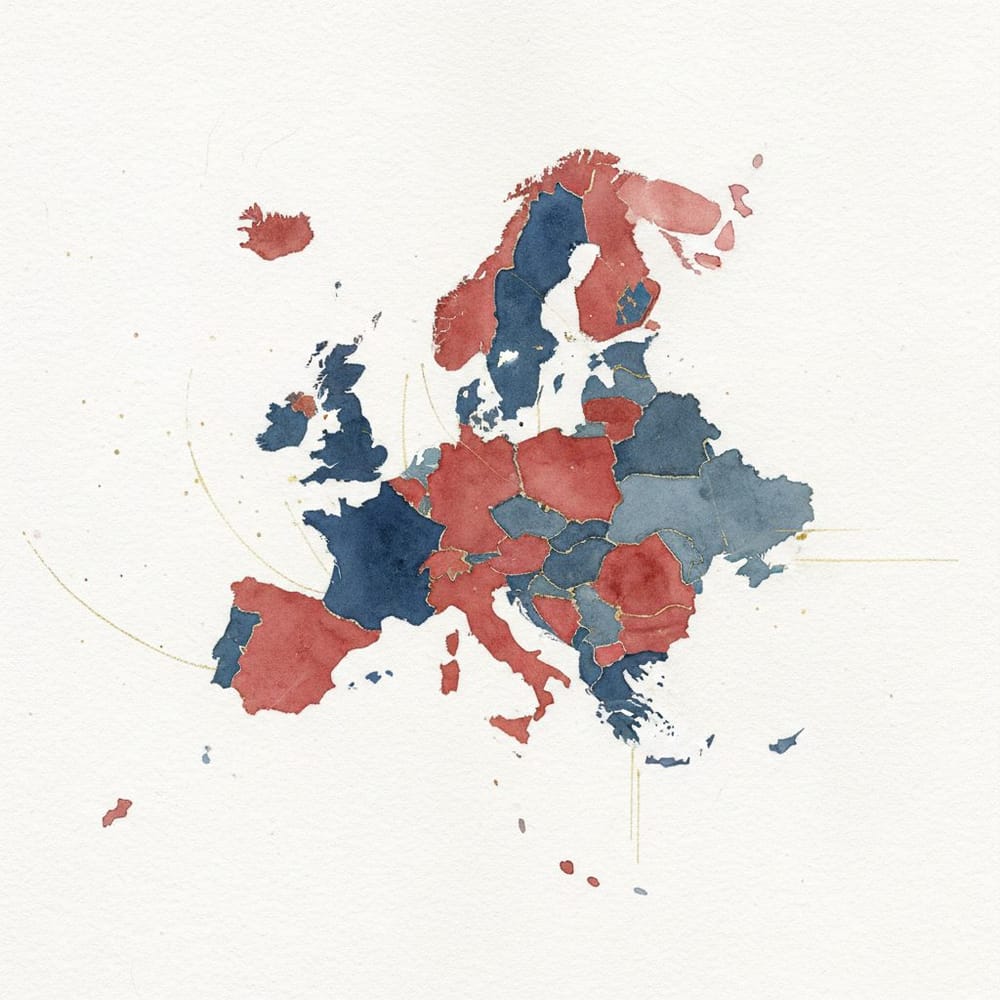
Facing this growing complexity, the European Commission is developing the concept of differentiated integration. This break with the principle of institutional unity already exists de facto: 20 countries use the euro, 25 participate in the Schengen area, 22 cooperate in the European Public Prosecutor’s Office.
The innovation lies in the formal institutionalization of this variable geometry. The Treaty of Lisbon already allows “enhanced cooperation” with a minimum of 9 member states. The Commission proposes lowering this threshold to 7 states and automating accession procedures for willing countries. This development would transform the Union into a modular system where each state would choose its level of integration according to its national priorities.
Priority sectors identified include common defense, tax harmonization, and energy integration. The European Defense Initiative, driven by France, Germany, and Italy, could serve as a model. It brings together 14 countries representing 75% of European military spending, without imposing constraints on neutrals such as Ireland or Austria.
Small States Fear a Two-Speed Europe
This reform is meeting with opposition from Central and Eastern European states. Poland and Hungary denounce a return to a Europe of directorates dominated by great powers. Their fears are not unfounded: the 7 largest countries in the Union concentrate 80% of the population and 85% of GDP. A system of differentiated integration could structurally marginalize the 20 other members.
Luxembourg is leading institutional resistance. Jean Asselborn, Minister of Foreign Affairs, proposes a compromise: maintaining unanimity on questions of sovereignty (taxation, defense, foreign policy) while extending majority voting to sectoral policies. This approach would preserve the veto power of small states on essential matters.
Nordic countries support an intermediate position. Sweden and Denmark accept differentiated integration on the condition that it remains temporary and reversible. They propose automatic review clauses every 5 years to prevent the crystallization of closed circles. This position influences the debate: the European Commission is studying mechanisms of “institutional catch-up” to facilitate later accession to enhanced cooperations.
Council Reform Becomes Unavoidable Before 2030
Enlargement forces a modernization of the voting system. The current qualified majority rule dates from 2009 and no longer works efficiently with 27 members. Debates on the Green Deal showed the limits: 6 months of negotiations to obtain consensus on measures supported by 22 member states nonetheless.
Several scenarios are emerging. The first maintains qualified majority by lowering the population threshold from 65% to 60%. This technical modification would avoid paralysis without fundamentally transforming the institutional balance. Germany and France support this option because it preserves their influence while improving efficiency.
The second scenario introduces simple double majority voting: 50% of states plus 50% of the population. This formula, inspired by the American system, would accelerate decisions but concerns small countries. Malta represents 0.1% of the European population but has the same veto power as Germany. Double majority would drastically reduce this influence.
The third scenario, more radical, institutes variable qualified majorities depending on the sectors. Budget matters would require 60% of states and 70% of the population, sectoral policies 50% and 55%. This gradation would reflect the political importance of decisions but would complicate procedures.
Germany and France Define a Common Strategy
Berlin and Paris are converging on a pragmatic approach. Emmanuel Macron and Olaf Scholz are developing a shared vision on the institutional future, proposing to combine differentiated integration and voting reform to preserve Franco-German influence while avoiding paralysis.
This architecture would preserve European unity symbolically while allowing practical deepening. New members would automatically join the single market and progressively choose their level of integration. Ukraine could thus rapidly adhere to the single market while deferring its integration into banking union or defense policy.
Toward a Geopolitical Reconfiguration of the European Union
This institutional mutation reflects a broader geopolitical transformation. Europe must simultaneously respond to Russian expansion in the east, Sino-American competition, and migratory pressure in the south. Enlargement toward Ukraine fits into this security logic but complicates collective action.
Differentiated integration could resolve this contradiction. It would allow willing countries to deepen their military, fiscal, or technological cooperation without waiting for unanimous consensus. France could develop its defense industry with Germany and Italy while Estonia and Poland strengthen their eastern cooperation.
This development would transform the European Union from a unified supranational organization into a platform of multiple and interlocking cooperations. The model recalls ASEAN, which combines light economic integration and deepened sectoral cooperations according to national affinities. Europe would thus assume its institutional diversity as a geopolitical asset rather than as a weakness to overcome.
The coming months will determine whether this transformation occurs through strategic choice or through constraint of events. Ukrainian accession, considered unrealistic by European experts by 2027-2028, nonetheless leaves time to complete this institutional transformation. The European Union of 2030 could thus reconcile geographic enlargement with political deepening, provided it definitively renounces the myth of perfect institutional unity.
Sources: