
The European Commission launched two formal procedures in February 2026 that mark a turning point in the implementation of the Digital Services Act (DSA), the regulation aimed at holding digital platforms accountable. By targeting e-commerce giant Shein and social network TikTok, Brussels is no longer content with stating principles, but is using its new investigation and sanction powers to impose a digital model centered on user protection. These actions, which directly target addiction mechanisms and the proliferation of illegal content, constitute the first real test of Europe's ability to enforce its digital sovereignty against the commercial logic of tech giants, whether Chinese or American.
Addiction and illegal products: the Commission opens fire on Shein and TikTok's models
On February 17, 2026, the Commission officially opened an investigation against Shein, designated as a "Very Large Online Platform" (VLOP). The procedure focuses on alleged serious breaches of DSA obligations. Brussels is examining the systems put in place by Shein to counter the sale of illegal products, a concern that has grown following the discovery of products like child-appearance sex dolls on the platform. The investigation also covers the very design of the interface, suspected of creating consumer addiction through reward systems and points, as well as the lack of transparency of its recommendation algorithms. European Commission (February 17, 2026). Commission launches investigation into Shein under the Digital Services Act.
A few days earlier, on February 6, 2026, it was TikTok that was the subject of preliminary findings from the European executive. The Commission determined that the app's design violated the DSA due to its addictive nature. Features like infinite scroll, video autoplay, and an ultra-personalized recommendation system are being called out. According to the preliminary findings, TikTok allegedly failed to properly assess the risks these mechanisms pose to the physical and mental well-being of users, particularly minors, and parental control tools or screen time management would be deemed largely ineffective as they are too easy to circumvent. European Commission (February 6, 2026). Commission preliminarily finds TikTok's addictive design in breach of the Digital Services Act.
The DSA, an arsenal of rights for 450 million digital citizens
Beyond these emblematic investigations, the DSA primarily constitutes a major advance for the rights of European citizens in the digital environment. The regulation provides users with a set of concrete tools to regain control of their online experience. If a platform removes content, it must now provide clear justification. In case of disagreement, the user can challenge the decision, either directly with the platform or through an out-of-court dispute resolution body, a faster and less expensive procedure than legal recourse.
The DSA also imposes simplified mechanisms for reporting illegal content, products, or services. Protection of minors is a central focus, with a total ban on targeted advertising directed at them and the obligation for platforms to design their services to mitigate risks of exposure to inappropriate content. Very large platforms, counting more than 45 million monthly users in the EU, must offer an alternative to algorithmic news feeds, for example chronological display. Transparency is also strengthened in advertising, with the obligation to clearly identify ads and advertisers, and the prohibition of using sensitive data (sexual orientation, religion, etc.) for targeting. Finally, the regulation bans "dark patterns," those interfaces designed to deceive users and push them to actions they would not have undertaken otherwise. European Commission (Page consulted March 24, 2026). The Digital Services Act.
Facing the European regulator, Chinese cooperation contrasts with American confrontation
The implementation of the DSA reveals a notable strategic divergence between American and Chinese tech giants. While American companies, supported by part of their political class, adopt a confrontational posture, their Chinese competitors choose the path of cooperation. Firms like X (formerly Twitter) and Meta have openly criticized European regulation, presenting it as a hindrance to freedom of expression and a form of disguised protectionism. This resistance is rooted in the American tradition of "laissez-faire," embodied by Section 230 of the Communications Decency Act, which grants broad immunity to platforms regarding content published by third parties.
Conversely, Chinese players like TikTok, Shein, Temu, or AliExpress show themselves more inclined to negotiate with Brussels. They accept to conclude compliance agreements and adapt their services to maintain their access to the precious European market. This pragmatic approach is part of China's broader geopolitical strategy, which seeks to position itself as a stable and cooperative partner on the global digital scene to extend its influence. For the European Commission, this willingness to dialogue is preferable to long and uncertain legal battles, as it allows for concrete and rapid changes for users. Scott, M. (December 8, 2025). Europe's Tech Rules Are Driving a New US–China Divide. TechPolicy.Press.
Media protection, a key issue but without a 24-hour deadline
Contrary to a common misconception, the DSA does not impose a strict 24-hour response deadline on platforms when a media outlet reports a problem. However, the regulation introduces specific protections for journalistic content. Article 14 of the DSA obliges platforms to duly take into account freedom of expression and media freedom when applying restrictions based on their terms and conditions. Although there is no prior notification before moderation, platforms must integrate the particular status of media in their decision-making process.
Furthermore, Article 17 guarantees that any restriction (removal, demotion, etc.) must be accompanied by a detailed statement of reasons, allowing media to understand and challenge the decision. While a "media exemption" that would have imposed prior notification was not retained in the final version of the text, the debate nevertheless led to strengthened procedural guarantees. The Court of Justice of the European Union has moreover emphasized that freedom of expression (Article 11 of the Charter of Fundamental Rights) must be interpreted in light of the jurisprudence of the European Court of Human Rights, which considers that "information is a perishable commodity." A removal, even temporary, can cause it to lose all its value. The DSA thus paves the way for fairer and more transparent moderation for the press, a crucial issue in the fight against disinformation. Buijs, D. (September 29, 2022). The Digital Services Act and the Implications for News Media and Journalistic Content (Part 1). DSA Observatory.
Conclusion: Europe imposes its third digital model
With the investigations into TikTok and Shein, the Digital Services Act has entered its active phase. It is no longer just a regulatory text, but an instrument of power that the European Commission is beginning to wield firmly. By moving from principles to action, Europe is not content with regulating its internal market; it proposes a third way between the American "laissez-faire" model and the Chinese state control model. This model, centered on citizens' fundamental rights and the accountability of dominant players, is already forcing global tech giants to adapt their strategies. The long-term success of this ambition will depend on the ability of the Commission and national coordinators to maintain constant pressure, resist inevitable legal battles, and make the European digital space a truly safer and fairer environment.
Receive analyses from the Journal directly in your mailbox.
Also read
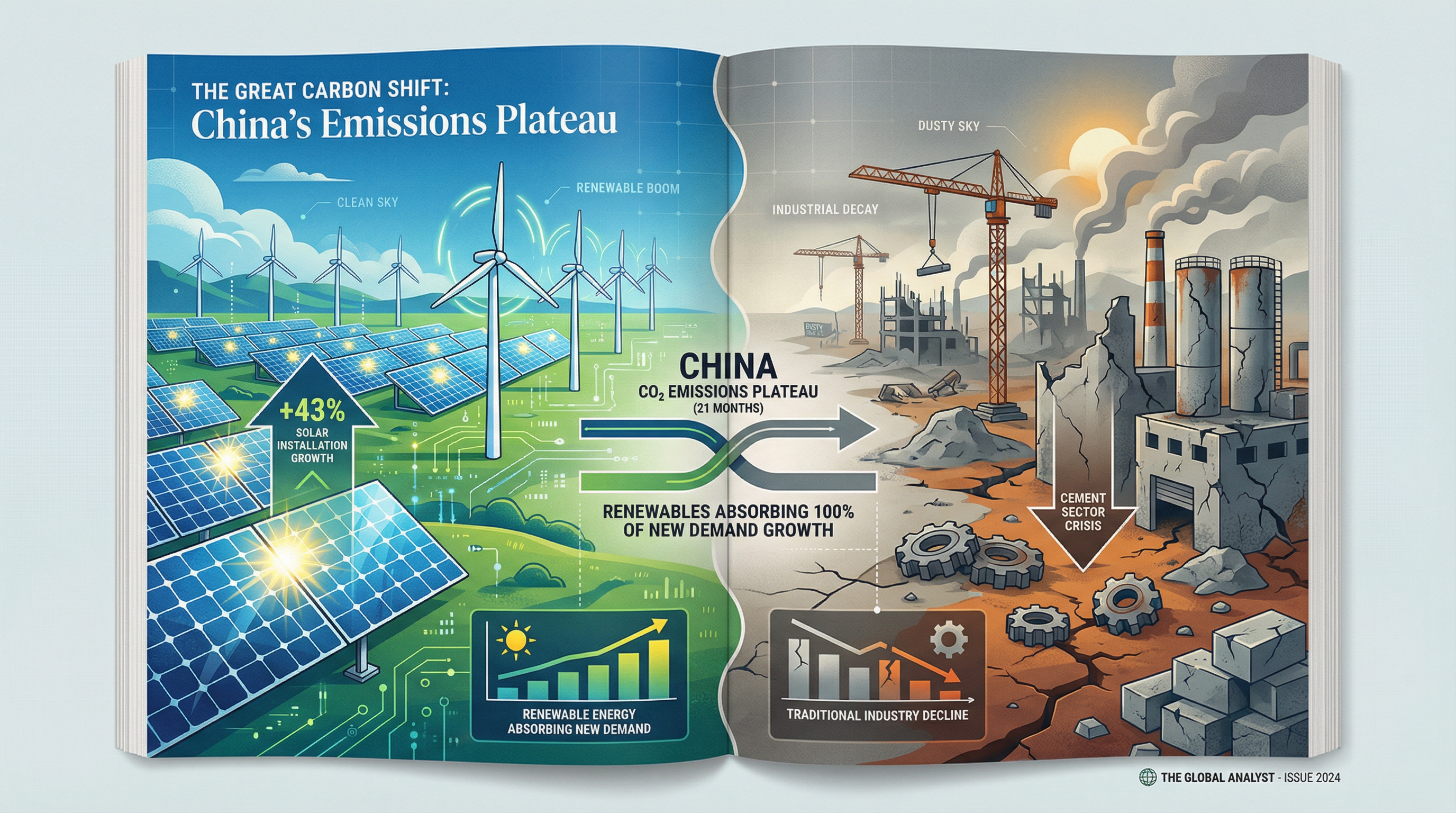
China's CO2 emissions stagnate for 21 months: structural peak or cyclical accident?
China's CO2 emissions fell by 0.3% in 2025. It's a modest figure. But it extends a trend that has lasted for 21 consecutive months: since March 2024, emissions from the world's largest polluter have been "stable or declining."

AI and employment: two March 2026 studies reveal -13% automatable offers and +20% augmented roles
Does AI destroy jobs? Two studies published in March 2026 — one by Harvard Business School, the other by Anthropic — provide the first solid empirical data. And the answer is more nuanced than the public debate suggests.

The malaria vaccine in Nigeria: 200,000 children vaccinated and a 50% drop in cases in Kebbi State
Malaria killed 608,000 people in 2022, 95% of them in sub-Saharan Africa and 78% children under five years old. And for the first time, a vaccine deployed on a large scale shows measurable results in the field.