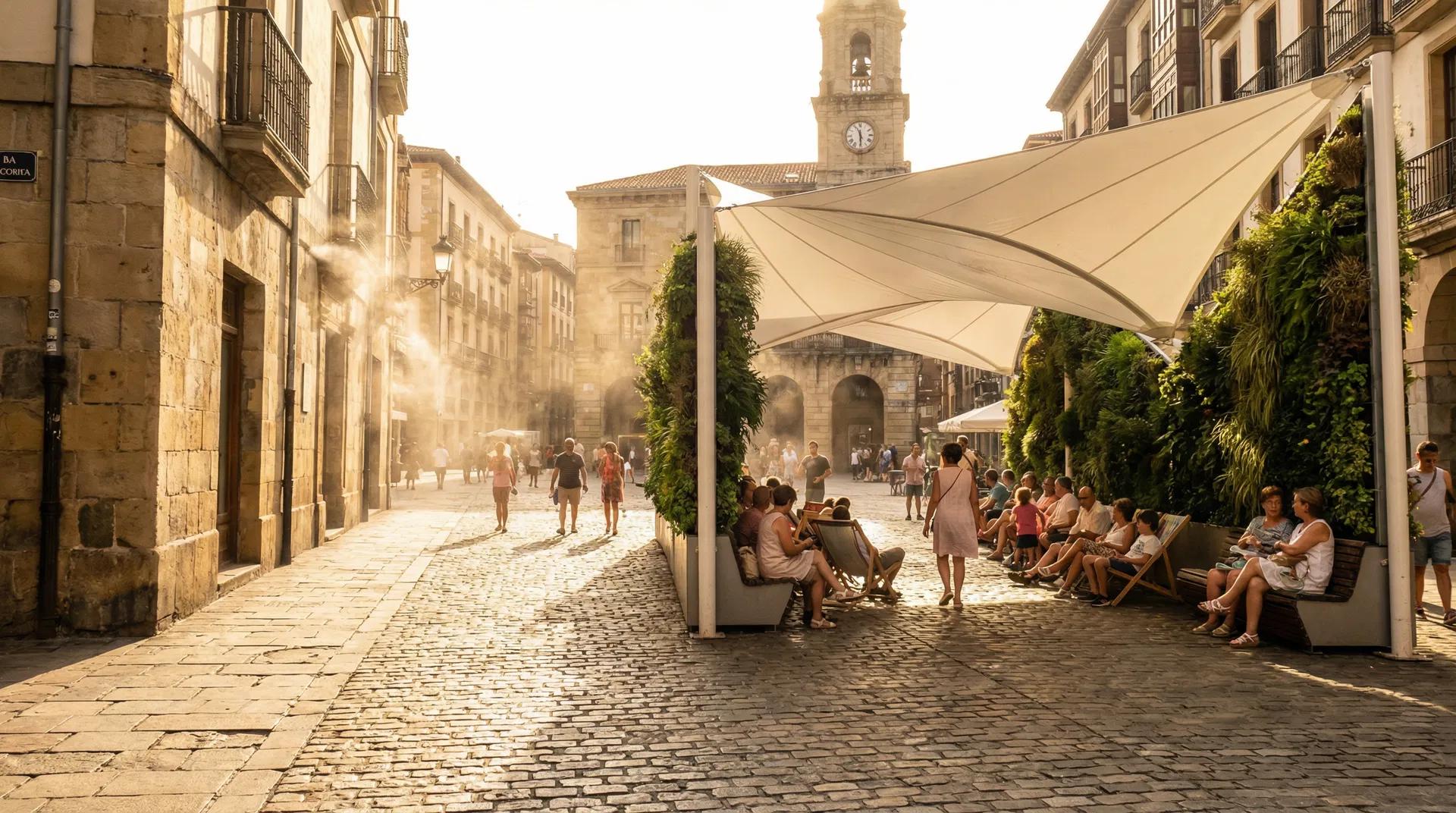
In August 2023, the city of Bilbao, the economic capital of Spain's Basque Country, experienced an unprecedented heatwave, with temperatures reaching a record 44.0°C. This event, once considered an anomaly for northern Spain, has become a symptom of an accelerating climate crisis that forces urban areas to radically rethink their design. In direct response to this threat, the municipality of Bilbao has implemented a concrete and ambitious adaptation strategy: a network of 131 climate shelters, designed to offer accessible refuge to virtually all of its inhabitants. This system now covers 96% of the population, placing Bilbao at the forefront of European cities seeking pragmatic solutions to protect their citizens from the most severe impacts of global warming.
Bilbao's initiative is not limited to a simple emergency measure; it represents an integrated model of preventive urbanism. By combining existing infrastructure and new green spaces, the city has created a dense territorial network that guarantees rapid and equitable access to cooling zones. This article analyzes in depth how this network functions, evaluates its relevance in the face of growing health risks, and compares it to strategies adopted by other European metropolises such as Paris, Vienna, and Athens, in order to determine the key factors for successful urban adaptation to heatwaves.
A territorial network covering 96% of inhabitants within 5 minutes
The pillar of Bilbao's strategy is accessibility. The program, officially integrated into the "Heat Plan for the Prevention of Health Effects of High Temperatures in Euskadi," was designed so that no resident would be left behind. Official municipal data confirms that 96% of the city's 348,089 inhabitants are located within 300 meters of a climate shelter, approximately a five-minute walk. Even more remarkably, 43% of the population has one of these refuges within 100 meters of their home 1. This hyper-proximity is essential to ensure the system's effectiveness, particularly for the most vulnerable populations: elderly people, young children, pregnant women, and people suffering from chronic diseases, for whom even brief exposure to extreme temperatures can have serious consequences.
The network consists of two types of complementary spaces:
-
65 indoor shelters: These refuges are set up in existing public and private buildings. The list includes municipal libraries, civic centers, sports facilities, transport stations (metro, train stations), museums, exhibition halls, and even shopping centers. To qualify as a shelter, a space must maintain a controlled temperature around 26-27°C, guarantee free and universal access, and be clearly identified by visible signage.
-
66 outdoor shelters: These are green spaces carefully selected for their ability to create natural cooling islands. Parks, public gardens, and tree-lined squares provide protection through the shade of their canopy and the phenomenon of plant evapotranspiration, which significantly reduces ambient temperature. The presence of fountains and water points is also a selection criterion.
To ensure that information reaches all citizens, the municipality has launched a proactive communication campaign. Field teams, called "Sombralagun" (a Basque portmanteau meaning "friend of the shade"), travel through neighborhoods to inform residents, distribute network maps, and explain how the shelters work. This human and direct approach aims to ensure that the system is not only available but also fully used by those who need it most.
A scientific study published in 2026 in the journal npj Urban Sustainability analyzed the planning methodology of this network. The researchers emphasize that this initiative goes well beyond a simple emergency response. It contributes to "solidifying Bilbao's reputation as an innovative and adaptive city that proactively addresses the growing challenges of climate change" 2. The study highlights the importance of a data-based approach to optimize shelter placement based on population density, neighborhood vulnerability, and characteristics of urban development. The AccessiCity model, developed as part of this research, even proposes extending the network by including places of worship, schools, and metro entrances to fill coverage gaps.
Urban adaptation facing rising heat-related mortality
The implementation of this network is not simply a matter of comfort, but a public health imperative. Heatwaves are silent killers. Exposure to extreme temperatures can lead to severe dehydration, heat stroke, cardiovascular and respiratory disorders, and, in the most critical cases, death. Bilbao's population, with an average age of 45.7 years, is particularly exposed to health risks, a vulnerability aggravated by the broader climatic context of the Basque Country. The region faces multiple risks: 81% of its municipalities are threatened by river flooding, 23% by sea level rise along the coast, and the entire territory is subject to increasingly frequent drought episodes.
Faced with this reality, European cities are beginning to integrate climate adaptation at the heart of their public policies. Bilbao's model, while very comprehensive, is part of a broader trend where metropolises experiment with various solutions.
In Paris, the "oasis courtyards" program, launched in 2017, has transformed 165 asphalt school courtyards into genuine green cooling islands. These spaces are open to the public during summer holidays, offering welcome refuge zones in neighborhoods that are often dense and poorly provided with green spaces. The French capital also made headlines by making swimming in the Seine possible again, a strong symbol of reclaiming urban waterways as a cooling tool 3.
In Vienna, innovation lies in the details of daily life. The city has begun installing bus shelters with green roofs. Although modest in appearance, this measure helps reduce the perceived temperature at public transport stops, places where users are often forced to wait in full sun.
Hamburg, Germany, has adopted a large-scale approach with its "green roof strategy" initiated in 2014. The city subsidizes between 30% and 60% of costs for property owners who voluntarily green their rooftops and aims to make this practice mandatory for all new suitable buildings. The goal was to reach 100 hectares of green roofs in a decade, contributing both to building insulation and reducing the urban heat island effect.
Complementary strategies for a replicable and holistic model
The success of Bilbao's model and other pioneering cities is based on understanding that climate shelters are just one piece of a much larger puzzle. An effective adaptation strategy must be holistic and combine short, medium, and long-term interventions.
The city of Getafe, in Madrid's working-class suburbs, illustrates this complementary approach well. Through its "Hogares Saludables" (Healthy Homes) program, the municipality tackles the problem at its source: building overheating. The program finances thermal insulation improvements, installation of solar protection, and development of small green infrastructure (green balconies, etc.), primarily targeting housing in low-income neighborhoods, where residents are often the most vulnerable and least able to finance such work.
The nature of urban materials is another essential lever. The small city of Rethymno, in Crete, has demonstrated that it is possible to cool public spaces by replacing asphalt with more suitable materials. Using permeable compressed soils, pavements painted with reflective coatings (cool pavements), and light-colored paints on buildings can considerably reduce solar heat absorption and decrease surface temperature by several degrees.
These examples converge toward a clear conclusion: the replicability of Bilbao's model in Europe does not consist of copy-pasting a list of measures, but of drawing inspiration from its methodology. Success depends on each city's ability to analyze its own vulnerabilities (demographic, urban planning, climatic) and build a tailored portfolio of solutions. The npj Urban Sustainability study on Bilbao confirms this: the effectiveness of a shelter network depends on a detailed analysis of "spatial accessibility, opening hours, and building typology" 2. A museum, for example, does not offer the same schedule flexibility as a metro station. Cities like Toronto, Seoul, and Melbourne go further by activating exceptional opening hours for their shelters during heatwave alerts, a protocol that Bilbao could also adopt to strengthen its system.
The study goes even further by testing the replicability of the refined "Bilbao Strategy." By extrapolating it to 131 cities across different continents, climate zones, and colonial legacies, researchers found that the strategy achieves more than 60% of maximum potential coverage in 74.81% of cases and exceeds 40% in 96.18% of cases. These results highlight the importance of urban density, climatic context, and typological availability in strategy performance, offering an adaptable model for improving resilience on a global scale.
In conclusion, Bilbao's strategy constitutes a valuable roadmap. It demonstrates that rapid, data-informed action centered on social equity is possible. By offering quasi-universal protection to its citizens, Bilbao is not just managing a crisis; it is redefining what it means to be a resilient city in the 21st century. Its model, enriched by innovations from other European cities, proves that climate adaptation is not just a technical constraint, but an opportunity to create cities that are more just, healthier, and more pleasant to live in for everyone.
References
- [1] Bilbao pone en marcha de nuevo este verano 131 refugios climáticos. (2025, June 18). Bi-Aste. Retrieved March 24, 2026, from https://www.bi-aste.com/articulo/actualidad/bilbao-pone-marcha-nuevo-verano-131-refugios-climaticos/20250618154609005219.html
- [2] Divasson-J, A., Macarulla, A. M., Garcia, J. I., & Borges, C. E. (2026). Seeking protection in times of turbulence: A methodology to assess and optimise the location of indoor climate shelters. npj Urban Sustainability, 6(1). https://www.nature.com/articles/s42949-026-00356-7
- [3] European cities step up as record heatwaves highlight urgent need for climate adaptation. (2025, July 22). Energy Cities. Retrieved March 24, 2026, from https://energy-cities.eu/european-cities-step-up-as-record-heatwaves-highlight-urgent-need-for-climate-adaptation/
- Receive Journal analyses directly in your inbox.
- China's CO2 emissions fell by 0.3% in 2025. This is a modest figure. But it extends a trend that has lasted for 21 consecutive months: since March 2024, emissions from the world's largest polluter have been "stable or declining."
- Is AI destroying jobs? Two studies published in March 2026 — one by Harvard Business School, the other by Anthropic — provide the first solid empirical data. And the answer is more nuanced than public debate suggests.
- Malaria killed 608,000 people in 2022, 95% of them in sub-Saharan Africa and 78% children under five. And for the first time, a vaccine deployed on a large scale shows measurable results in the field.
- Wanting to be 20 years old today. An independent media that documents progress with rigor, without naivety or catastrophism.
- Structured reading sheets: central thesis, key arguments, limits, and verdict.
- JdP is an independent editorial project based on data, counter-narratives, and lucid optimism. Each article is sourced, nuanced, and open to discussion.
- Journal d'un Progressiste uses cookies to improve the reading experience and understand how the site is used. No data is collected for commercial, advertising, or resale purposes. Cookies necessary for site operation are always active. Optional cookies are only activated with your explicit consent, in accordance with GDPR.