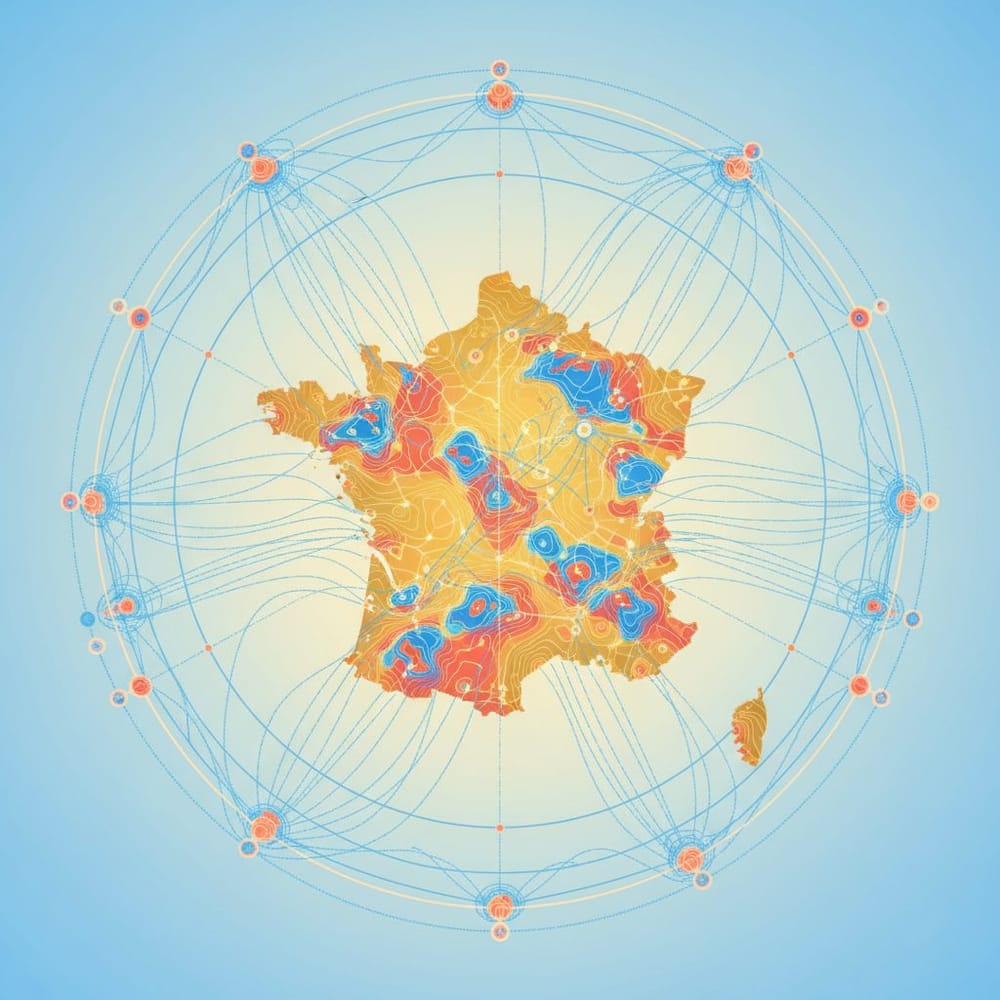
Édouard Geffray, Minister of National Education, announces the creation of a general competition for middle schools, with the first edition taking place during the 2026-2027 school year. 3.38 million middle school students will be eligible for this new initiative, which aims to democratize academic excellence upstream of high school.
This extension of the general competition model, created in 1744 and distinguishing the best high school students for over two centuries, responds to a logic of early talent detection across the entire territory. Each middle school may enroll up to 10% of its ninth-grade students, with a requirement for gender parity between girls and boys.
The Rules of the Game for 338,000 Potential Ninth-Grade Students
National examinations will take place in January 2027 in all regional academies. These will announce results in spring, thus allowing laureates to be recognized across the entire territory, after which a national event will bring together the best candidates for an awards ceremony.
The general competition for middle schools will include five possible individual examinations. These disciplines cover different forms of excellence: Mathematics and sciences, with a problem-solving examination. Other subjects include French, history-geography, arts, and digital-coding. Each student may only apply in a single subject, with registrations in autumn and examinations organized in January and February.
The competition is gender-balanced: for each examination, equal numbers of girls and boys will be enrolled. This equality requirement aims to correct imbalances observed in certain scientific disciplines where boys remain overrepresented.
Priority Education Facing the Excellence Challenge
The creation of this competition occurs in a context marked by significant territorial inequalities. At the 2023 school year start, 1,093 networks comprise the priority education map: 731 middle schools and 4,136 primary schools in REP (Priority Education Networks), 362 middle schools and 2,459 primary schools in REP+ (Reinforced Priority Education Networks). In total, more than 1.7 million students benefit from various priority education initiatives.
Four out of ten REP+ middle schools are concentrated in five departments: Nord, French Guiana, Seine-Saint-Denis, Bouches-du-Rhône, and Réunion. This geographic concentration of difficulties results in substantial performance gaps. The proportion of students “mastering French elements” at the start of sixth grade stands at 91.6% in Paris, 90.8% in Rennes, and 89.7% in Clermont-Ferrand.
47% of first-grade students in REP+ schools have satisfactory mastery of oral word comprehension, compared to 79.7% in public schools outside priority education areas. These early gaps mechanically affect the chances of success in the new competition.
The General Competition for High Schools: A Double-Edged Model
Experience with the general competition for high schools reveals the stakes of the new middle school initiative. In 2022, 17,543 candidates entered and 281 were rewarded. In 2023, the competition brought together 19,870 candidates with 150 prizes awarded to 148 laureates.
The ranking of high schools best preparing students for the general competition examinations is dominated by four institutions: Henri IV and Louis-le-Grand followed by Collège Stanislas and Saint-Louis de Gonzague. 50% of distinctions in prestigious subjects come from students at the 4 best high schools and nearly 20% from Louis-le-Grand High School alone. The results achieved by these four high schools remain fairly close and create a significant gap with those that follow.
This Parisian concentration illustrates the limits of a system that can reinforce existing inequalities rather than correct them. From the 2026 session onward, the number of candidates is limited to 10% of the rounded-up total number of students following that discipline in the establishment at the competition-relevant levels.
Syndicalist Resistance Converges Against Early Selection
Édouard Geffray’s statements recall forcefully those of Gabriel Attal, former Minister of National Education, who assumed responsibility for ability grouping in the “Knowledge Shock” as a means allowing the best students to “take flight.”
If this general competition is to be made the antechamber to the general high school competition, symbol of a form of elitism and insularity, SNES-FSU reaffirms forcefully that our educational system has no need for this! The unions point out a major contradiction with the stated democratization objectives.
This responds to no demand from personnel to restore meaning to their work, nor from students. For the CFDT, this responds to no social demand in the educational community. We are adding evaluative pressure instead of allowing time for learning. We glorify competition, which several studies show can have detrimental effects on mental health.
The Parallel Tightening of the Brevet Fuels Tensions
This initiative is accompanied by reinforced requirements for the national brevet diploma. From the 2026 session onward, final examinations will count for 60% of the grade, compared to 50% previously. Édouard Geffray moreover anticipates a clear drop in the brevet pass rate. He even mentions a possible decline that is “quite drastic” and says he expects “75% success on the brevet with far fewer distinctions.”
Geffray confirmed that “work has begun” in these priority middle schools, where reinforced support will be implemented from the 2026 school year. Following a diagnostic phase in the first quarter, the concerned establishments will need to identify “priority levers” to raise the level of the most vulnerable students.
This dual dynamic—tightening of evaluations and creation of an excellence competition—raises questions among those working in the field. “We risk stigmatizing struggling students by reminding them that they are not in the right group,” worries a teacher in Seine-Saint-Denis.
The general competition for middle schools crystallizes the French debate on equality versus excellence. The French school system aims to select a minority of very good students and guide them toward schools of excellence in higher education, via preparatory classes. Not to lift all children upward by leaving no student behind. The French school, despite being overwhelmingly public, operates on a market model, on the basis of competition between children. This initiative confirms a philosophical orientation that prioritizes talent detection over collective development.
Sources:
-
Creation of the general competition for middle schools in 2026-2027 | Ministry of National Education
-
National education in figures, 2025 edition | Ministry of National Education
-
Social inequalities, from primary school to the end of middle school
-
The Ministry of Education has mapped territorial school inequalities