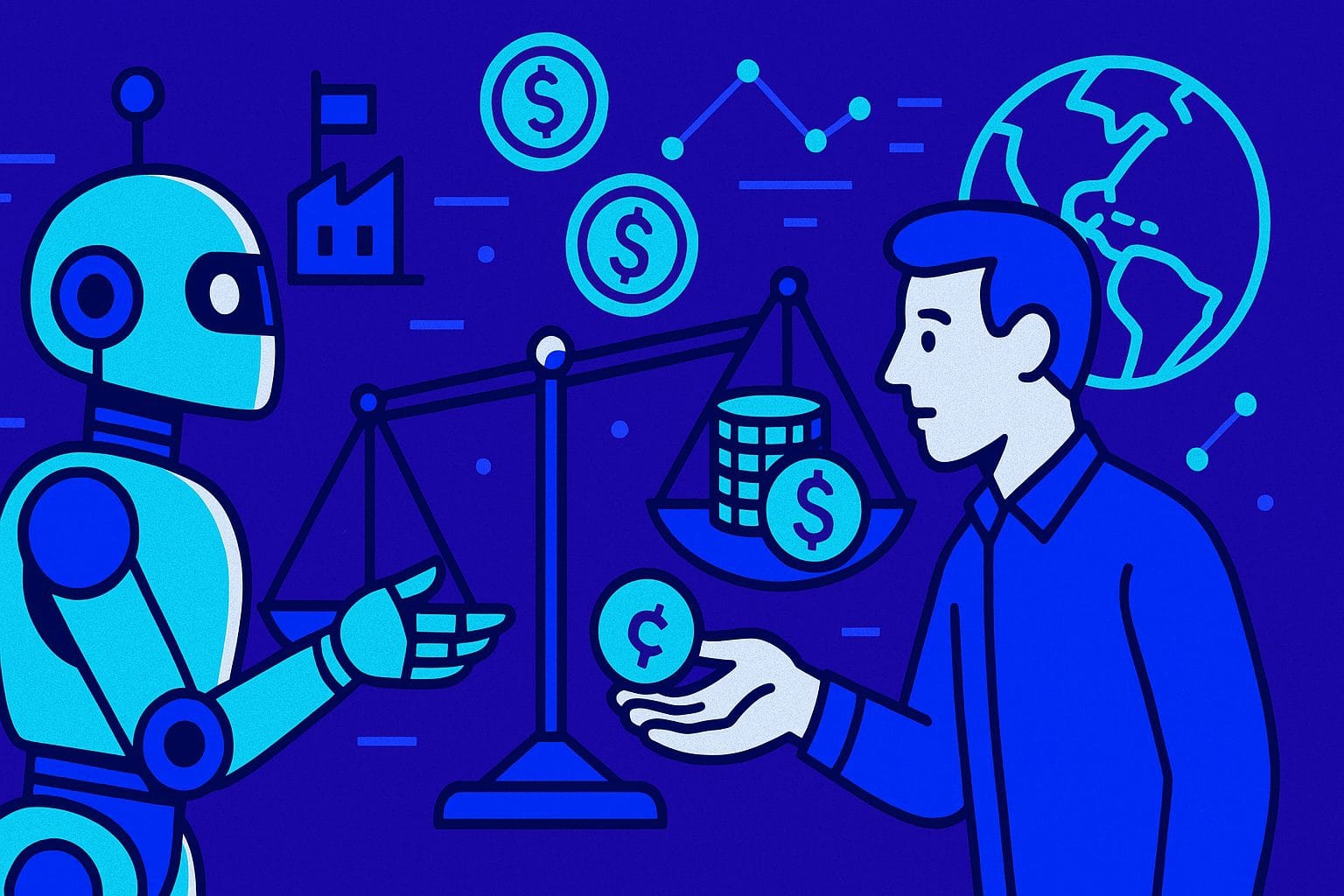
300 million ChatGPT users each week. This critical mass of adoption reveals a fascinating paradox: 2025 studies show that AI exhibits the same fixation biases as humans, confirming that constraints foster innovation rather than hinder it.
This convergence between cognitive research and massive usage redefines our understanding of creativity at work. 2025 research using the egg test shows that ChatGPT-4o faithfully reproduces human fixation biases, with results comparable to 47 human participants. Paradoxically, this shared limitation opens new perspectives on creative mechanisms.
The Essentials
- ChatGPT reached 300 million weekly users by late 2024, tripling in one year
- 2025 studies reveal that ChatGPT-4o exhibits the same creative fixation biases as humans
- AI users save 5.4% of their work time, equivalent to 2.2 hours per week
- Moderate constraints generate maximum creativity according to the “sweet spot” effect
ChatGPT Confirms That Humans and AI Share the Same Creative Limitations
A 2025 study reveals that ChatGPT-4o exactly reproduces human fixation biases in the egg test, a task measuring creativity. This surprising discovery overturns technological predictions: AI does not overcome human cognitive constraints, it reproduces them.
The proportion of fixation ideas relative to expansion ideas does not differ significantly between AI and human participants. ChatGPT generates more ideas than the average human, but remains “similarly constrained by dominant associations.” This tendency reflects patterns learned in its training data rather than genuine spontaneous originality.
Both systems—human and artificial—are subject to the same biases, with AI inheriting the diversity limitations present in its training data. This convergence reveals that creativity, even artificial creativity, depends on similar structural constraints.
Constraints Stimulate Innovation More Than Total Freedom
Research on mood boards confirms the existence of a “sweet spot”: moderate constraints generate maximum creativity. This discovery corroborates a long-standing intuition among creatives: absolute freedom paralyzes, intelligent constraint liberates.
The facilitative effect of constraints on creativity is observed across multiple domains: visual arts, dance, innovation design, product development, and even patent filings. Constraints affect creative cognitive processes by modifying opportunity identification, cognitive fixation, and search strategies.
In conceptual design, constraints of novelty, feasibility, and sustainability are not mere limitations but important drivers that shape the creative process. The most effective creators do not seek to eliminate constraints, but to transform them into creative resources.
AI Amplifies Human Creativity According to Level of Expertise
A study in real-world conditions reveals that generative AI boosts creativity, but only among employees with strong metacognitive skills. This discovery nuances technological optimism: the tool alone is insufficient; the capacity for self-reflection determines its effectiveness.
Co-creation with AI can help overcome human cognitive fixation by transforming creators into evaluators of a range of automatically generated solutions. AI assistance increases productivity by 15% on average, with variable gains: novices improve speed and quality, while experienced experts see speed gains but a slight drop in quality.
Risks of excessive dependence lead to fixation on AI outputs and reduce divergent thinking. The solution lies in structured integration: beginners use AI to overcome initial cognitive barriers, experts exploit it selectively for refinement.
75% of Workers Adopt AI Despite Absence of Corporate Strategies
75% of knowledge workers already use AI at work, and 46% of users started less than six months ago. This bottom-up adoption contrasts with managerial caution: 79% of leaders consider AI necessary to remain competitive, but 59% struggle to quantify its productivity gains and 60% believe their organization lacks vision.
In 2024, 9% of American workers use AI daily and 14% at least once per week. Reported benefits are tangible: time savings (90%), focus on essentials (85%), increased creativity (84%), enjoyment at work (83%).
Teams using AI report 77% acceleration of tasks, 70% reduction in distractions, and 45% improvement in productivity. These individual gains accumulate into systemic impact: generative AI usage represents a potential 1.1% increase in American productivity in the second half of 2024.
Constrained Creativity Redefines Competitive Advantage
Research from the University of Bergen shows that AI can generate more ideas than the average person, but the most creative human solutions significantly surpass AI in originality and innovation. This asymmetry reveals the human comparative advantage: the capacity to transform constraints into creative opportunities.
AI excels in “convergent thinking”—finding the optimal solution within defined limits. Humans excel in “divergent thinking”—breaking boundaries, reimagining the entire problem, establishing unexpected connections. This discovery reveals the “phenomenon of first insight”: when a disruptive idea breaks through the invisible walls of conventional thinking and triggers a cascade of creative possibilities.
Sectors with high AI exposure recorded 10% productivity increases, 3.9% employment growth, and 4.8% wage increases in 2024. These results suggest that AI acts as a productivity enhancement tool that complements workers rather than replacing them.
AI does not replace human creativity; it reveals its mechanisms. As analysts of work transformations observe, the true revolution is not technical but cognitive: understanding that constraints, whether algorithmic or human, constitute the fertile ground of innovation.
Sources: 1. ChatGPT Statistics - Active Users & Growth Data 2. The paradox of creativity in generative AI: high performance, human-like bias, and limited differential evaluation 3. The Impact of Generative AI on Work Productivity | St. Louis Fed 4. AI at Work Is Here. Now Comes the Hard Part | Microsoft 5. Fostering better creativity in design education: Exploring the “sweet spot” effect