
For the average citizen worldwide, the level of democracy has returned to that of 1978. This is the central finding of the V-Dem 2026 report, published by the V-Dem Institute at the University of Gothenburg, which covers 179 countries through the end of 2025. Titled "Unraveling The Democratic Era?", this report documents a regression that erases almost all the gains of the "third wave of democratization" initiated in 1974 with the Carnation Revolution in Portugal.
The figures are precise. At the end of 2025, the world has 92 autocracies versus 87 democracies — this is the second consecutive year that authoritarian regimes outnumber democratic ones. 74% of the world's population, or 6 billion people, live under autocratic regimes. Only 7% of the world's population, or 0.6 billion people, live in liberal democracies. A record 41% of the world's population resides in countries currently undergoing autocratization.
This data is not an extrapolation or projection: it results from systematic coding work conducted by more than 4,200 researchers and national experts distributed worldwide, who annually evaluate hundreds of institutional, electoral, and civil indicators in each country.
The third wave of democratization: what was built and what is collapsing
The "third wave of democratization," theorized by Samuel Huntington in 1991, refers to the period of democratic expansion that began with the fall of military dictatorships in Southern Europe in the 1970s, accelerated with the end of the Cold War, and reached its peak in the early 2000s. In 2009, the world had 45 liberal democracies. In 2025, it has only 31.
This decline is not uniform. It affects very different regions, with distinct mechanisms. In South Asia, democracy erodes through the concentration of executive power and the suppression of media. In Latin America, through the personalization of power and the weakening of legislative checks and balances. In Central and Eastern Europe, through the capture of judicial and electoral institutions. In sub-Saharan Africa, through military coups and the suspension of constitutions.
But the novelty of the 2026 report lies elsewhere: for the first time in decades, democratic decline also affects established democracies in Western Europe and North America. The level of democracy in these regions is at its lowest in more than 50 years, primarily due to the trajectory of the United States under the second Trump administration.
The number of closed autocracies — the most repressive regimes, without competitive elections or minimal civil liberties — has increased from 22 in 2019 to 35 in 2025. This 59% increase over six years reflects an intensification of repression in already authoritarian regimes, not just a multiplication of new authoritarian regimes.
44 countries in autocratization, including historic democracies
The report identifies 44 countries currently in the process of autocratization — nearly a quarter of the world's nations. Among them are countries that had never been classified as autocratizing since the creation of the V-Dem index. The United States, Hungary, Turkey, India, Serbia, and Mexico are among the most documented cases.
The mechanisms of contemporary autocratization differ from those of classic coups d'état. In the majority of observed cases, the process appears legal: it proceeds through constitutional reforms, laws restricting civil society or media, partisan appointments in judicial institutions, and rhetoric that delegitimizes the opposition as enemies of the people. V-Dem calls this phenomenon "autocratization by legalism."
Freedom of expression is the most affected aspect: it has deteriorated in 44 countries in 2025. Media censorship is the most common tactic, used in 73% of countries undergoing autocratization. Torture to suppress political opposition is documented in 33 countries. Repression of civil society affects 68% of countries undergoing autocratization.
These figures describe concrete realities: imprisoned journalists, dissolved non-governmental organizations, political opponents prosecuted on fabricated charges, protesters dispersed by force. Autocratization is not an abstract phenomenon measured by indices — it has direct consequences on the lives of people living in these countries.
Legislative constraints at their lowest level in a century
One indicator particularly catches the attention of V-Dem researchers: legislative constraints on the executive have lost one-third of their value in 2025, reaching their lowest level in more than 100 years. This means that parliaments, in many countries, have ceased to play their role as a check on executives.
This phenomenon is particularly marked in the United States, where the Republican-controlled Congress has, according to the report, "abdicated its constitutional role in favor of the executive in 2025, ceding significant legislative, fiscal, and oversight powers." Judicial constraints have also diminished, reaching their lowest level since 1900.
Civil rights and equality before the law are at their lowest levels in 60 years. Freedom of expression and media follows the same trajectory. These indicators do not measure perceptions or opinions: they code institutional facts — laws adopted, courts reformed, journalists imprisoned, civil society organizations dissolved.
The measurement of legislative constraints is particularly revealing because it captures something fundamental in the definition of liberal democracy: the separation of powers. When a parliament ceases to control the executive, when courts cease to be independent, the democratic form may persist — elections take place, parties run — but the substance has evaporated.
Economic impact: democracy measured in GDP
V-Dem introduces in its 2026 report a rarely used measure: the level of democracy weighted by GDP. This measure gives more weight to economically important countries in the global calculation. Result: measured by GDP, democracy is at its lowest level in more than 50 years, after a persistent 25-year decline. The decline is more than 36% from the 2000 peak, and it is accelerating.
This measure reflects a simple fact: the countries that are autocratizing most rapidly — the United States, India, Turkey — are also among the world's most important economies. Their trajectory weighs more heavily in the global balance than that of smaller countries.
The economic impact of autocratization is documented by other independent work: authoritarian regimes tend to reduce the independence of central banks, increase corruption, restrict capital mobility, and weaken property rights. In the medium term, these effects translate into reduced growth and foreign investment. A study published in The Journal of Political Economy in 2023 estimated that the transition to autocracy reduced GDP per capita by 3 to 5% over a decade.
Only 18 countries in democratization, including 3 new ones in 2025
The picture is not entirely dark. V-Dem identifies 18 countries currently in the process of democratization. Among them, 3 new cases were identified in 2025. These positive dynamics are concentrated mainly in sub-Saharan Africa and Southeast Asia, where peaceful electoral transitions and institutional reforms have been documented.
But the imbalance is striking: 44 countries in autocratization versus 18 in democratization. And the countries in democratization are, on average, less populated and less economically influential than those that are autocratizing. The global dynamic therefore remains clearly unfavorable to democracy.
Among the cases of democratization documented in 2025, we find countries that have experienced transitions after major political crises, elections that ended authoritarian governments, or constitutional reforms that strengthened judicial independence. These cases show that democratization remains possible, even in an unfavorable global context.
What 47 years of progress represented
To understand what the erasure of 47 years of democratic progress means, we must recall what these years produced. Between 1974 and 2009, dozens of countries abandoned military regimes or single parties to adopt democratic constitutions, competitive elections, independent judicial systems, and civil liberties. In Spain, Portugal, Greece, Latin America, Central and Eastern Europe, South Africa, South Korea, Taiwan — transitions that seemed irreversible.
The V-Dem 2026 report does not say that these transitions are cancelled. It says that the levels of democratic quality — freedom of expression, judicial independence, civil rights, constraints on the executive — have declined to the point of returning to those that prevailed before these transitions produced their lasting effects.
This decline is gradual, not spectacular, and that is precisely what makes it difficult to counter. It does not occur through visible military coups, but through an accumulation of legal decisions that, taken in isolation, seem harmless and which, together, transform the nature of the regime.
Resistances: civil society, local elections, judicial checks and balances
V-Dem also notes resistances. In several countries undergoing autocratization, civil society continues to function, local elections remain competitive, and courts maintain their independence despite pressure. These resistances do not reverse the global trend, but they slow it down and maintain partial democratic spaces.
In the United States, the electoral components of democracy — the quality of elections themselves — remained relatively stable in 2025, with scores based on the 2024 elections, judged free and fair by international observers. This is an important nuance: the American autocratization documented by V-Dem proceeds through the weakening of institutions, not (yet) through direct electoral manipulation.
In Europe, several countries that had experienced episodes of autocratization — notably in Central Europe — show signs of stabilization or slight improvement. Poland, after the 2023 elections that ended eight years of PiS government, began a partial restoration of judicial independence. These cases show that democratic setbacks are not irreversible.
The question posed by the report's title — "Unraveling The Democratic Era?" — remains open. V-Dem does not predict the future. It documents a trajectory and identifies the mechanisms that produce it. The answer will depend, in part, on the capacity of civil societies, judicial institutions, and opposition parties to maintain effective checks and balances in the years to come.
Primary source: V-Dem Institute, Democracy Report 2026: Unraveling The Democratic Era?, University of Gothenburg, 2026.
Receive analyses from the Journal directly in your mailbox.
Also read
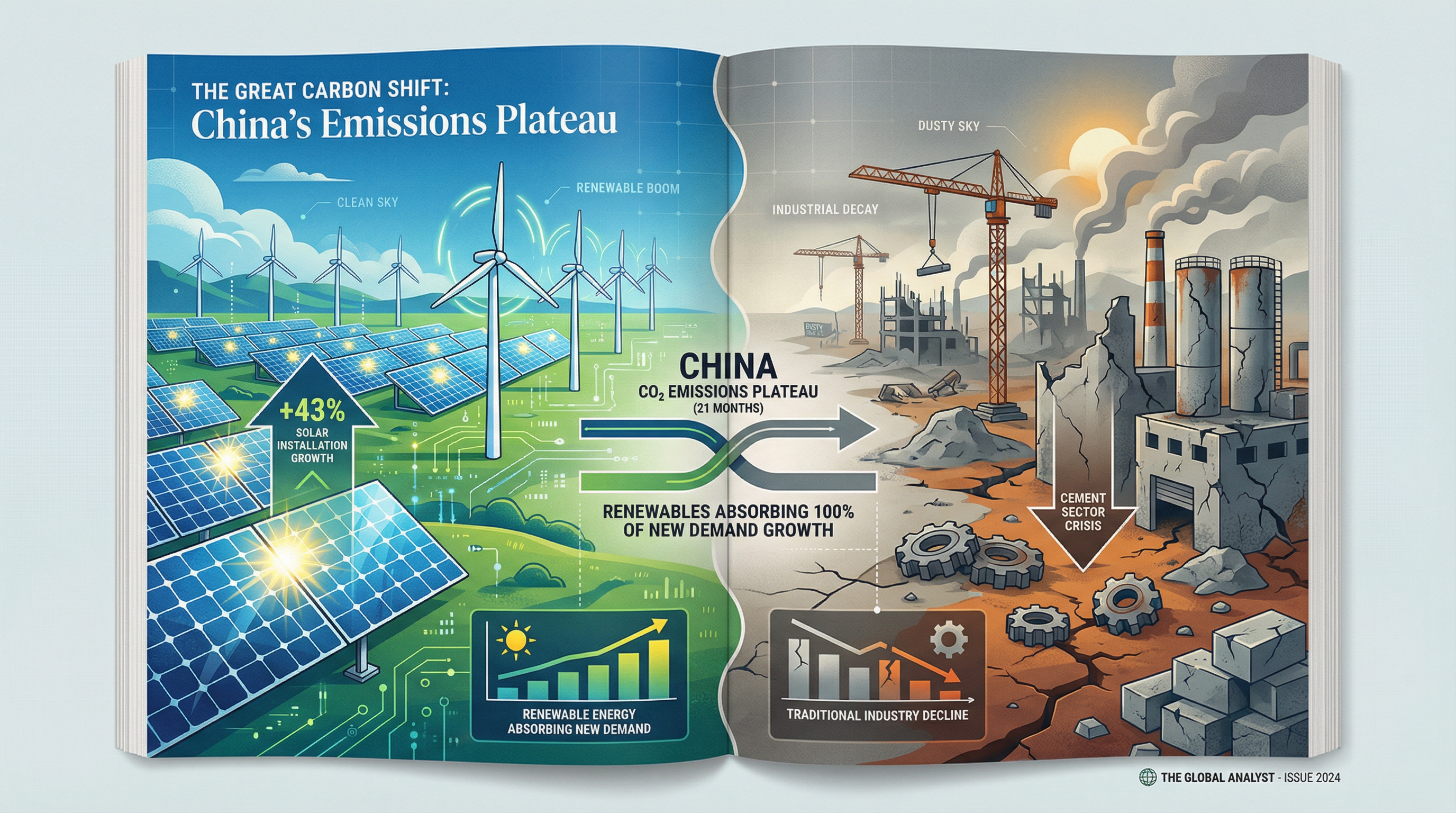
China's CO2 emissions stagnate for 21 months: structural peak or temporary accident?
China's CO2 emissions fell by 0.3% in 2025. It's a modest figure. But it extends a trend that has lasted for 21 consecutive months: since March 2024, the emissions of the world's largest polluter have been "stable or declining."

AI and employment: two March 2026 studies reveal -13% automatable jobs and +20% augmented roles
Does AI destroy jobs? Two studies published in March 2026 — one by Harvard Business School, the other by Anthropic — provide the first solid empirical data. And the answer is more nuanced than public debate suggests.

The malaria vaccine in Nigeria: 200,000 children vaccinated and a 50% drop in cases in Kebbi State
Malaria killed 608,000 people in 2022, 95% of them in sub-Saharan Africa and 78% children under five years old. And for the first time, a vaccine deployed at scale shows measurable results in the field.