George Steiner, In Bluebeard's Castle: Some Notes Towards the Redefinition of Culture, Yale University Press, 1971 (French translation: Gallimard, 1973, reissued Seuil, 1986). 154 pages.
In 1971, George Steiner delivered four lectures at the University of Kent as part of the T.S. Eliot Memorial Lectures. The result is a brief, dense, uncomfortable essay—one of the most disturbing texts of the second half of the 20th century on the question of culture and civilization. The central question is simple to formulate, impossible to evade: how could a civilization that had produced Goethe, Beethoven, Kant, and Hegel have engendered Auschwitz? And if culture does not protect from barbarity—if it can even coexist with it unfazed—what does the word "culture" still mean?
Steiner provides no consoling answer. He provides something more useful: a rigorous diagnosis, supported by scholarship that crosses philosophy, literature, musicology, and the history of ideas.
The 19th century as incubator: the boredom that precedes destruction
The first part of the essay traces back to the source. Steiner identifies in the 19th-century Europe—that century of relative peace, material progress, meliorist optimism—the seeds of the 20th century catastrophe. His central argument: the long peace (1815-1914) engendered a profound boredom in the cultivated layers of European society. Not the banal boredom of idleness, but a metaphysical boredom, a fatigue with civilization itself, a muted desire for violent dissolution.
Steiner detects this boredom in literature (Baudelaire, Flaubert, the decadents), in philosophy (Schopenhauer, Nietzsche), in music (Wagnerian chromaticism as aspiration to dissolution). This is no coincidence: the culture of the late 19th century is traversed by an aesthetics of violence, a fascination with destruction, a "call to brutality" that prepares the ground for the catastrophes to come.
"Are the forms of boredom and the call to brutal destruction constants in the history of social and intellectual forms, once they cross a certain threshold of complexity?"
This question, posed from the opening, is not rhetorical. It engages Freud (Civilization and Its Discontents), Rousseau and his nihilistic pastoralism, and the entire tradition of critique of modernity. Steiner does not respond directly—he sets the framework for an investigation.
The central thesis: culture does not immunize against barbarity
The second part is the best known, and the most provocative. Steiner formulates what will become one of his reference theses: European high culture did not constitute a rampart against Nazism. It coexisted with it. In certain cases, it accompanied it.
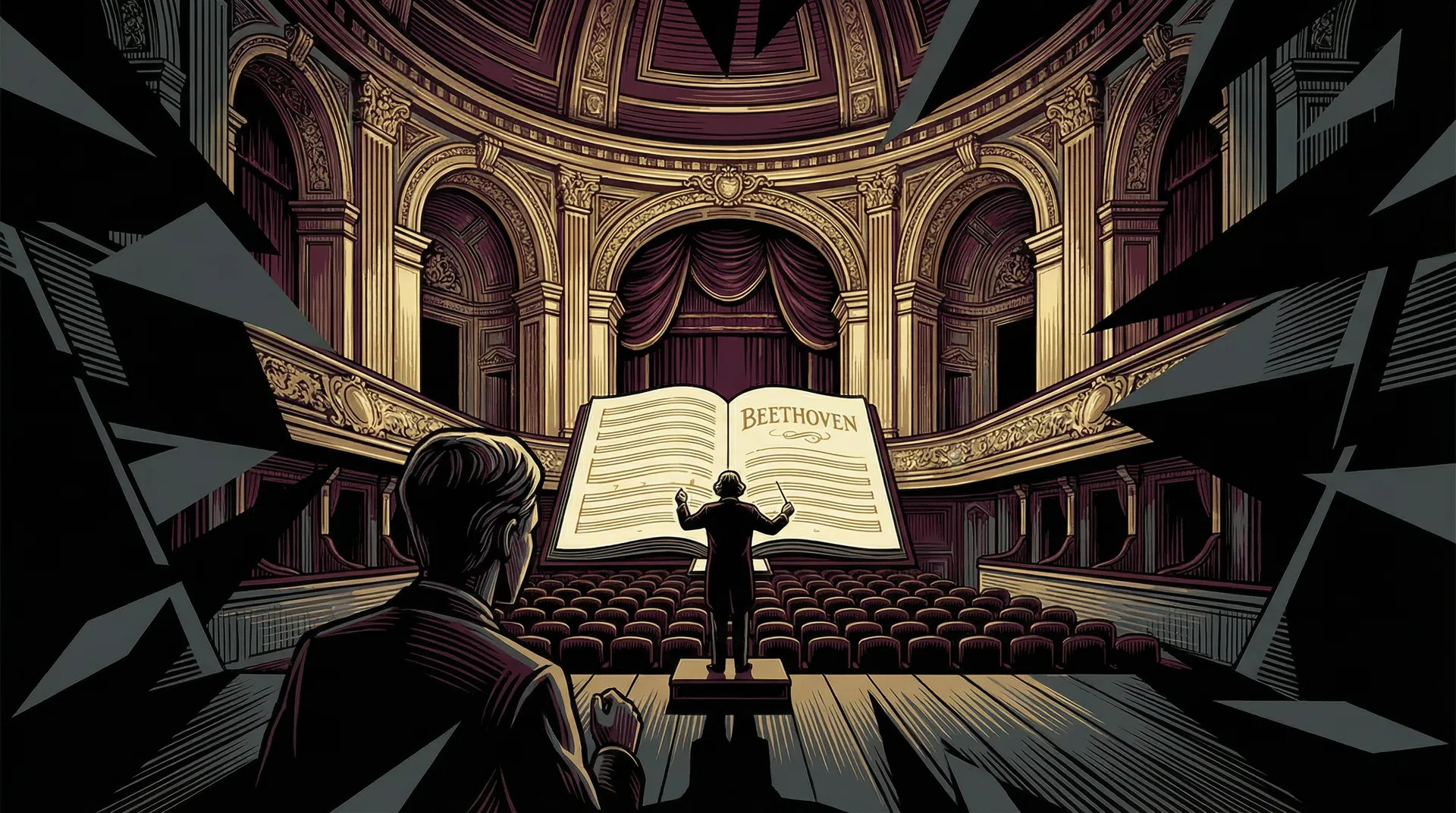
The image that crystallizes this thesis has become famous: nothing in the world neighboring Dachau interrupted the great winter cycle of Beethoven chamber music played in Munich. Camp guards could be readers of Schiller. SS officers took their children to museums on Sundays. Culture did not protect. It did not prevent.
Steiner goes further. He advances a hypothesis on the roots of Nazi antisemitism that remains one of the most discussed in the essay: in killing Jews, Western civilization sought to eliminate those who had "invented" God, who had imposed on the world the ethical demands of monotheism—what he calls the "blackmail of transcendence." The Holocaust would be, in this reading, a reflex of natural conscience against the moral constraint that Judaism had introduced into Western history.
This thesis has been vigorously contested—notably by Irving Howe in Commentary (1972), who reproaches it for being unverifiable and for dissolving the concrete historical responsibility of the Nazis in a metaphysical abstraction. The criticism is founded. But it does not diminish the force of the question posed: why was culture not enough?
The after-culture: the loss of center
The third part, titled "In a Post-Culture," is perhaps the most current. Steiner describes the situation of Western culture after World War II as a situation of "after-culture": the certainties that founded the Western cultural hierarchy—the conviction that the Greco-Latin and Judeo-Christian tradition represented "the best of what has been said and thought"—are irremediably shaken.
Two factors have produced this upheaval. The first is internal: the complicity of culture with barbarity has destroyed its pretension to moral authority. The second is external: decolonization and the rise of non-Western cultures have ended the monopoly of European civilization on the definition of the "superior" and the "inferior."
Steiner does not rejoice in this collapse. He does not deplore it either with nostalgia. He analyzes it. And he poses the question that follows from it: in a world where the cultural center has been destroyed, where the hierarchy of values is contested from all sides, how do we think about transmission, education, creation?
His response is provisional and honest: he does not know. What he knows is that the proposed substitutes—primitivism, neo-paganism, the counterculture of the 1960s—do not constitute viable alternatives. They are, in their way, symptoms of the same boredom he had diagnosed in the 19th century.
"Tomorrow": three scenarios for culture
The fourth and final part is the most speculative. Steiner sketches three possible scenarios for culture in what he calls the "after-culture."
The first is that of a high culture of the minority: a restricted elite maintains the humanistic tradition alive under increasingly marginal conditions, like the Irish monks who preserved ancient culture during the barbarian invasions. Steiner does not hide his ambivalence: this solution is perhaps the only realistic one, but it implies a break with the democratic ideal of shared culture.
The second scenario is that of a technicized mass culture: culture is reduced to the consumption of standardized cultural products, high culture survives as museum curiosity, and authentic creativity takes refuge in marginal forms. This is, Steiner suggests, the dominant trajectory of contemporary Western societies.
The third scenario—the most radical—is that of a total rupture: Western civilization does not survive its own contradictions, and something entirely new emerges from its ruins. Steiner does not say what this would be. He only says that history has already known such ruptures, and that they are not necessarily ends.
What Steiner still brings today
Published more than fifty years ago, In Bluebeard's Castle remains a reference text for several reasons.
The first is its central question, which has not lost its urgency: can culture—education, the arts, literature, philosophy—form moral beings? Steiner's answer is no, or at least: not necessarily, not automatically. This answer still disturbs, because it contradicts one of the founding postulates of liberal humanism.
The second is his diagnosis of boredom as precursor to violence. In a context where advanced democratic societies see rising forms of political nihilism and fascination with destruction, Steiner's thesis on the 19th century deserves to be reread with attention.
The third is his lucidity about the situation of the "after-culture." Steiner writes in 1971, but he describes with remarkable precision the cultural condition of the 2020s: loss of center, contestation of hierarchies, proliferation of substitutes, inability to formulate a credible alternative to the humanistic tradition without reproducing or caricaturing it.
The essay's limits are real. The thesis on antisemitism as "revolt against monotheism" is too abstract to be historically operational. The style—brilliant, sometimes too brilliant—can mask argumentative slippages that criticism has justly noted. And Steiner remains, despite his efforts, profoundly centered on the European tradition he claims to deconstruct.
But these limits do not diminish the value of the question posed. In Bluebeard's Castle is a book that refuses comfort. It asks its reader to look squarely at what culture cannot do—and to reflect, from there, on what it can still do.
George Steiner (1929-2020): born in Paris to Viennese Jewish parents, he grew up in New York and Paris, taught at Cambridge and Geneva. His other major works include Language and Silence (1967), After Babel (1975) and Real Presences (1989). In Bluebeard's Castle is often considered the most accessible synthesis of his thought on culture and barbarity.
Bibliographic record
- Title: In Bluebeard's Castle: Some Notes Towards the Redefinition of Culture
- Author: George Steiner
- Publisher: Gallimard, coll. Folio essais (n° 42)
- Publication date: October 13, 1986 (original English edition: Faber and Faber, 1971)
- Number of pages: 160
- Price: 8,90 €
- EAN: 9782070323678
Reading record written for the Readings section of Journal d'un Progressiste.
Receive the Journal's analyses directly in your mailbox.
Also read

China's CO2 emissions have stagnated for 21 months: structural peak or cyclical accident?
China's CO2 emissions fell by 0.3% in 2025. It's a modest figure. But it extends a trend that has lasted for 21 consecutive months: since March 2024, emissions from the world's largest polluter have been "stable or declining."

AI and employment: two March 2026 studies reveal -13% automatable job offers and +20% augmented roles
Does AI destroy jobs? Two studies published in March 2026—one by Harvard Business School, the other by Anthropic—provide the first solid empirical data. And the answer is more nuanced than public debate suggests.

The malaria vaccine in Nigeria: 200,000 children vaccinated and a 50% drop in cases in Kebbi State
Malaria killed 608,000 people in 2022, 95% of them in sub-Saharan Africa and 78% children under five years old. And for the first time, a large-scale deployed vaccine is showing measurable results in the field.