
German philosopher Jürgen Habermas, theorist of the public sphere and deliberative democracy, passed away on March 14, 2026. While his work aimed to ground political legitimacy in rational discussion, Western democracies, from Washington to Paris, are experiencing a profound crisis marked by polarization and distrust. Habermas’s legacy offers a powerful analytical framework for understanding these fractures, but raises an essential question: are his ideals still audible in the clamor of the digital age?
1929-2026: an intellectual life confronting the ruins of reason
Born in 1929 in Düsseldorf, Jürgen Habermas belonged to a generation of German intellectuals whose thinking was irredeemably shaped by the experience of Nazism. His adolescence under the Third Reich and his realization, in the war’s aftermath, of the scope of his country’s moral and political catastrophe, constituted the starting point of his philosophical quest. How, on the ruins of a nation that had sunk into the most barbaric irrationality, could one rebuild the foundations of a just and democratic society? This question would haunt his entire body of work. After studying philosophy, history and literature, he became assistant to Theodor W. Adorno at the Institute for Social Research in Frankfurt, the cradle of the famous “Frankfurt School.”
However, Habermas quickly distinguished himself from his elders, Adorno and Max Horkheimer. Where the first generation of Critical Theory developed a pessimistic diagnosis of modernity, seeing it as an iron cage of instrumental reason, Habermas sought a way out. He refused to conclude that the Enlightenment project had totally failed. On the contrary, he undertook a monumental task: reconstructing a theory of reason by grounding it no longer in the consciousness of a subject (as in Kant), but in language and intersubjective communication. His major works, such as The Structural Transformation of the Public Sphere (1962), The Theory of Communicative Action (1981) and Between Facts and Norms (1992), are the milestones of this project. In them he develops a vision of democracy where the legitimacy of power derives neither from tradition nor from simple majority force, but from the quality of public debate and the force of arguments exchanged between citizens.
3 concepts to refound democracy through discussion
At the heart of Habermasian thought lie three interconnected concepts that form a theoretical architecture for democracy. The first is that of the public sphere (Öffentlichkeit). For Habermas, this is a sphere of social life, distinct from the state (political power) and the market (economic interests), where private persons gather to discuss subjects of common interest. Historically, he sees its emergence in the literary salons, cafés and newspapers of the 18th century, where the nascent bourgeoisie began to criticize monarchical authority. This sphere is vital because it is where an enlightened public opinion is formed, capable of subjecting political power to rational control. Without a functioning public sphere, democracy is deprived of its breathing space. It is not a formal institution, but a communication network where viewpoints and arguments can circulate and be evaluated. The health of a democracy is measured by the vitality and inclusiveness of its public sphere.
The second concept is that of communicative action (kommunikatives Handeln). Habermas makes a fundamental distinction between two forms of action. On one side, strategic action, which is oriented toward personal success and aims to influence others through calculation, seduction or threat. On the other, communicative action, which is oriented toward mutual understanding. In this case, the participants in a discussion do not seek to “win” but to convince each other through the force of the better argument. This ideal rests on “validity claims”: when we speak seriously, we claim that what we say is true (factually), just (morally) and sincere (subjectively). These claims can be contested and must then be defended with reasons. It is this process that allows reaching a rational consensus rather than a simple compromise of interests. This distinction is fundamental because it shows that all discourse is not manipulation; language contains a potential for coordination and understanding that is the foundation of social life itself.
Finally, these two pillars support the model of deliberative democracy. For Habermas, the legitimacy of a law or political decision does not come simply from the majority vote. It depends on the quality of the public deliberation process that preceded it. A decision is legitimate if it could have been approved by all concerned citizens following a free, open and rational discussion. In such a discussion, it is “the strange non-coercive power of the better argument” that must prevail, and not power relations or particular interests. This is a demanding ideal that sets the bar for democratic legitimacy much higher than simple electoral procedure. This model does not deny the importance of elections, but resituates them in a broader process of political will formation that takes its source in the informal debates of civil society.
A “new structural transformation” in the age of algorithms
In his latest work, Habermas confronted his theory with the upheavals caused by the internet and social networks. Far from sharing the initial enthusiasm for the democratic potential of the web, he diagnosed a “new structural transformation of the public sphere” that threatens its foundations. Digital platforms, governed by commercial logic and opaque algorithms, undermine the conditions for healthy public debate. The fragmentation of audiences into personalized “filter bubbles” and “echo chambers” prevents confrontation with different perspectives, yet essential to the formation of critical judgment. The very architecture of these platforms, designed to capture attention and maximize engagement, privileges emotional, sensationalist and polarizing content over nuanced argumentation and complex reasoning.
Even more serious, the dynamics of social networks favor what Habermas execrated: replacing argumentation with emotion and simplification. The viral spread of disinformation and hate speech, optimized for engagement, short-circuits the long time and intellectual effort required by deliberation. This new media architecture does not foster mutual understanding, but polarization and the erosion of a common base of facts and norms. Without this shared foundation, democratic debate becomes a dialogue of the deaf, where hermetic communities confront each other without being able to understand each other anymore. As he wrote, “democracy cannot survive in a digital media system without an inclusive public sphere and a deliberative process for the formation of public opinion and consensus.” This new semi-privatized public sphere largely escapes the type of legal framework that governed traditional media, posing new questions regarding regulation and democratic sovereignty.
From Washington to Paris, the mirror of fractured democracies
The Habermasian analytical framework offers a striking illumination of the political turbulence shaking established democracies like the United States and France. The extreme polarization of American political life, which culminated with the assault on the Capitol on January 6, 2021, can be interpreted as a brutal manifestation of the breakdown of communicative action. Entire segments of American society seem to evolve in alternative factual realities, nourished by partisan media environments and recommendation algorithms that reinforce existing convictions. In such a context, the very possibility of contradictory debate based on shared facts diminishes, giving way to generalized distrust and the delegitimization of the political adversary, even of the democratic process itself. The erosion of trust in traditional institutions (media, science, justice) creates a void that conspiratorial narratives and identity entrepreneurs rush to fill, making the ideal of a rational public opinion almost inaccessible.
In France, although in a different context, similar symptoms are observable. The crisis of political representation, persistent distrust of institutions and elites, and the rise of populist movements testify to a degradation of the public sphere. Social movements like that of the “Yellow Vests” expressed a strong demand for recognition and direct participation, while showing the difficulty of channeling these aspirations into structured and constructive public debate. The emergence of new forms of citizen participation, such as the Citizens’ Climate Convention, can be seen as an attempt to recreate deliberative arenas to revitalize a democracy losing steam. These initiatives, although imperfect and often criticized for their lack of real impact on political decision-making, reflect a profoundly Habermasian intuition: the need to reinvent the spaces where citizens can become the authors of the laws to which they are subject. They highlight the need to complement representative democracy with more direct deliberative democracy mechanisms, capable of reweaving the link between governors and governed.
A legacy for the 21st century: reason as a project
The disappearance of Jürgen Habermas does not merely close a chapter in the history of philosophy. It reminds us with acuity of the fragility of the democratic ideal. His immense work constitutes a powerful antidote to ambient cynicism and technological fatalism that would have us believe that the degradation of public debate is inevitable. Habermas bequeaths to us not a set of ready-made answers, but a compass and a demand. The compass is that of communicational reason, the idea that human beings are capable of coordinating their actions and resolving their conflicts through dialogue rather than through violence or cunning. It is a wager on the capacity of language to create social bonds and common meaning.
The demand is to take the democratic promise seriously. This implies never giving up on building and defending the institutional, cultural and legal conditions for a living public sphere. Faced with the power of digital platforms, this raises the question of new regulations capable of preserving the diversity of opinions and the quality of information, without falling into censorship. It also questions our educational systems about their capacity to train critical citizens, capable of discerning true from false, of arguing rationally and of listening to viewpoints different from their own. Habermas’s legacy is a project: that of a society of free and equal women and men who give themselves their own rules, not through submission to authority, but through the constraintless force of the better argument. A project that, today more than ever, remains to be accomplished. His prudent optimism, founded on the conviction that the project of modernity is “unfinished” rather than failed, remains a source of inspiration for all those who refuse to resign themselves to democracy’s current crisis.
Receive analyses from the Journal directly in your mailbox.
Also read
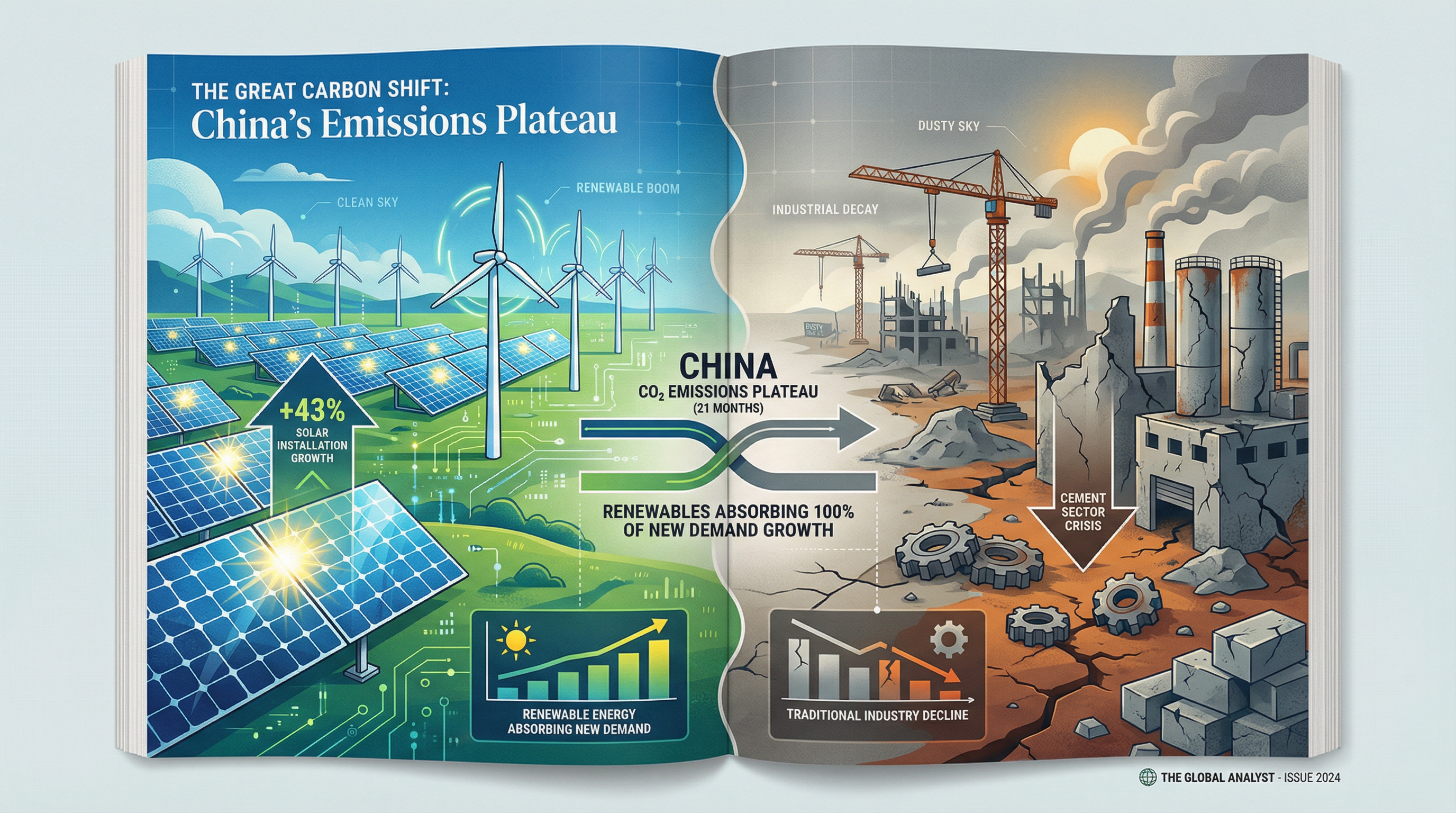
China’s CO2 emissions have stagnated for 21 months: structural peak or cyclical accident?
China’s CO2 emissions fell by 0.3% in 2025. It’s a modest figure. But it extends a trend that has lasted 21 consecutive months: since March 2024, the world’s biggest polluter’s emissions have been “stable or declining.”

AI and employment: two March 2026 studies reveal -13% automatable offers and +20% augmented roles
Does AI destroy jobs? Two studies published in March 2026 — one by Harvard Business School, the other by Anthropic — provide the first solid empirical data. And the answer is more nuanced than public debate suggests.

The malaria vaccine in Nigeria: 200,000 children vaccinated and a 50% decrease in cases in Kebbi State
Malaria killed 608,000 people in 2022, 95% of whom were in sub-Saharan Africa and 78% children under five years old. And for the first time, a vaccine deployed on a large scale is showing measurable results in the field.