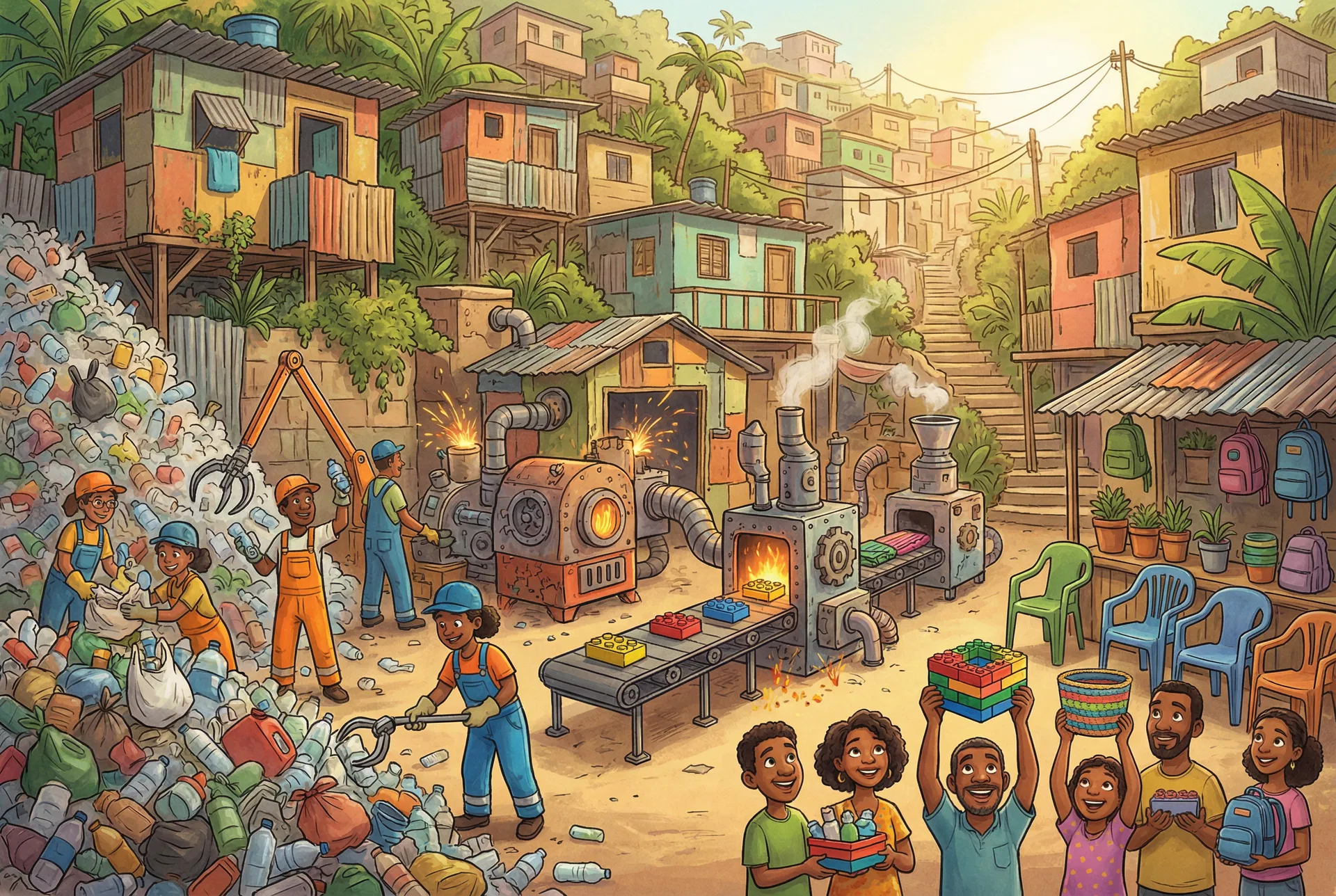
Latin America, a continent of exceptional natural wealth, faces a rising tide of plastic waste that threatens its natural environments and economies. Confronted with recycling rates that struggle to take off, a new approach is gaining ground: the circular economy. This model proposes to break with the “throwaway” logic to transform waste into a precious resource, paving the way for innovation and more sustainable development.
A Continent Producing 11% of Raw Materials But Recycling Only 4% of Its Plastics
The situation of plastic management in Latin America and the Caribbean is marked by a profound paradox. The region, which represents only 8.3% of the world’s population, is responsible for more than 11% of the planet’s raw materials. Yet it lags behind in recycling, with an average rate stagnating around 4%, far from European performance levels. This delay is explained by a combination of factors: waste treatment infrastructure that is still largely insufficient, public policies in favor of the circular economy that are just beginning to take shape, and the strong presence of an informal recovery sector.
This informal sector, composed of millions of “cartoneros” or “catadores,” is a cornerstone yet little-known piece of the system. It is estimated that these shadow workers are responsible for collecting nearly 50% of all recycled materials in the region. Their contribution is therefore fundamental, but their work is carried out under conditions of great precariousness and without official recognition. A report published jointly by the Inter-American Development Bank (IDB) and the United Nations Environment Programme (UNEP) in 2023 highlights the urgency of integrating these actors into formal value chains. The document, entitled “Unlocking Circular Economy Finance in Latin America and the Caribbean,” calls for rapid action to support micro, small and medium enterprises (MSMEs), including recycler cooperatives, considered essential drivers of the transition.
To achieve this, the report’s authors recommend overhauling environmental legislation, establishing solid public-private partnerships to finance circular projects, and establishing clear classification and measurement systems to guide investments. As Susana Cordeiro Guerra of the IDB emphasizes, the goal is to identify opportunities for governments and financial institutions to contribute to creating more sustainable and equitable economies.
Four Countries, Four Strategies for Circularity
While the region faces common obstacles, approaches to overcoming them vary from country to country. Mexico, Colombia, Chile, and Brazil stand out for their notable strategies and advances, illustrating the diversity of possible paths toward a circular plastic economy.
In Mexico, 63% of PET Is Already Recycled
Mexico has established itself as the undisputed leader in PET (polyethylene terephthalate) recycling in Latin America. With a post-consumer recycling rate of 63%, the country far exceeds the North American average (37.8%) and that of the United States (29%). This performance is based on a solid infrastructure of 27 recycling plants, capable of processing more than 80% of national consumption of PET packaging. The goal is now to reach a rate of 80% by 2030.
However, significant barriers persist. The design of many plastic packages remains incompatible with existing recycling channels, and markets for post-consumer resin (PCR) lack stability. To address these issues, the Association of Plastic Recyclers (APR) has extended its activities to Mexico. Its action focuses on standardizing packaging quality through design guides, certifying recycled content to align with international standards, and strengthening the supply chain. “We must stop designing plastic packaging for shelves and start designing it for recycling,” emphasizes Martha Ricardi, director of APR’s strategy for Latin America. Citizen initiatives like the digital platform Ecolana complement this system by providing an interactive map of recycling points, facilitating resident engagement.
Colombia Bets on an Integrated National Strategy
Colombia has opted for a comprehensive approach by launching its National Strategy for the Circular Economy in 2020. This action plan aims to reduce waste production at the source, promote eco-design of products, and implement the principle of Extended Producer Responsibility (EPR). Concrete measures have followed, such as the ban on certain single-use plastics and the study of a deposit system for bottles.
The country has also promoted the creation of circular business incubators to stimulate innovation. The Circular Economy Lab, the result of collaboration between the Ministry of Environment and UNDP, and Red Cluster Colombia, an initiative of the confederation of chambers of commerce, offer technical and financial support to start-ups. In Medellín, the Circular Valley platform encourages collaboration between entrepreneurs, researchers, and investors to develop new economic models.
Chile Adopts a Roadmap for 2040
Chile stands out for its long-term planning. The country has not only created a Circular Economy Office within its Ministry of Environment but has also published a “Roadmap for a Circular Chile by 2040.” This document sets a clear vision for a regenerative and equitable economy. The Extended Producer Responsibility law, in effect since 2016, forms the cornerstone of this strategy, requiring manufacturers of six product categories, including packaging, to organize and finance the end-of-life of their products.
The Chilean private sector shows remarkable dynamism. Companies like brewer CCU and giant Nestlé have innovated by commercializing respectively a beer bottle containing 30% recycled PET and a fully recyclable water bottle. The start-up Idea-tec has even developed a paint made from recycled expanded polystyrene, an illustration of the innovation potential that the circular economy holds.
Brazil Integrates Its Millions of “Catadores”
As the continent’s leading economy, Brazil has a determining role to play. The country has recently strengthened its regulation with a new decree setting progressive recycling targets and stricter compliance rules for packaging. Brazil also participates in the “Plastic Reboot” program, funded by the Global Environment Facility (GEF), which promotes circular solutions to plastic pollution.
But Brazil’s particularity lies in the central role of its informal recycler cooperatives, the “catadores.” These workers form the foundation of the country’s recycling industry. Innovative initiatives now seek to formalize and enhance their work. The DETRASH platform, for example, has developed a payment system based on blockchain technology. This system provides a public and verifiable certificate for each transaction, thus integrating informal recyclers into the formal value chain. This approach not only improves their income and working conditions but also strengthens the traceability and reliability of recycled material supply.
The Invisible Architects of the Circular Economy
The integration of millions of informal waste collectors is undoubtedly the most unique and fundamental aspect of the circular transition in Latin America. As mentioned, these workers collect up to 50% of recycled materials, forming the backbone of a system that struggles to recognize them. Organized into cooperatives in many countries, they possess invaluable practical expertise in collection and sorting but remain confronted with great precariousness.
An equitable circular economy cannot be built without them. Formalizing their status, guaranteeing fair remuneration, and improving their working conditions are prerequisites. Initiatives like DETRASH in Brazil show that it is possible to use technology to structure the sector and ensure better value distribution. Support for cooperatives, through access to training, financing, and their integration into formal supply chains, is a sine qua non condition for accelerating the transition on a large scale.
A Transition at Multiple Speeds but a Common Direction
The circular plastic economy in Latin America is a complex reality, a mosaic of advances and obstacles. The region is progressing, but at different paces. Mexico and Chile are pioneers, with solid regulatory frameworks and proven results on certain material flows. Colombia stands out for its integrated approach and support for innovation, while Brazil highlights the social imperative of integrating the informal sector.
Despite this progress, overall recycling rates remain low, infrastructure is often undersized, and public policies still lack harmonization at the regional scale. Financing this massive transition remains a critical point, requiring strengthened collaboration between governments, financial institutions, and the private sector.
The future of the circular plastic economy in Latin America will depend on the region’s ability to transform these obstacles into opportunities, building on its vital forces: an increasingly engaged private sector, a mobilized civil society, and the indispensable know-how of millions of recyclers who, every day, transform waste into resources. The road is still long, but the initiatives spreading across the continent outline the contours of a more sustainable future for Latin America.
References
- Inter-American Development Bank & United Nations Environment Programme (2023). Unlocking Circular Economy Finance in Latin America and the Caribbean: The Catalyst for a Positive Change.
- Frey, M. (2025). Why has recycling not scaled in Latin America and what can be done?. World Economic Forum.
- MBN Staff (2026). Mexico Emerges as Latin America’s PET Recycling Leader. Mexico Business News.
- Gómez, C. C. (2023). Circular Economy Initiatives in Colombia. Circular Innovation Lab.
- Gómez, C. C. (2023). Chile is Leading the Way as an Example of a Regional Circular Economy. Circular Innovation Lab.
- Beyond national strategies, it is concrete innovations, carried by entrepreneurs and civil society, that outline the contours of tomorrow’s circular economy in Latin America. These initiatives, although often local, demonstrate by example that it is possible to create economic value while addressing an environmental problem.
- In Mexico, Ecolana is more than just a map of recycling points. The platform has developed a real incentive system to encourage citizens to sort their waste. By scanning their deposit receipts at partner collection centers, users accumulate points they can exchange for discounts or products. Ecolana also works directly with major consumer brands to organize specific collection campaigns, creating a direct link between producer, consumer, and recycling channel. This playful and incentive-based approach has diverted thousands of tons of waste from landfills while raising public awareness.
- In Colombia, the Circular Economy Lab does not merely incubate start-ups. It plays an interface role between project leaders and large industrial groups. The laboratory helps young companies test their solutions on a large scale by giving them access to the infrastructure and markets of its partners. For example, a start-up developing a new construction material from plastic waste was able to test the resistance and durability of its product on a pilot site of a major construction group, an invaluable opportunity to validate its technology and credibilize its business model.
- The “Chile Circular” project in the Valparaiso region is an ambitious example of industrial symbiosis. The initiative began with detailed mapping of material and energy flows of all companies in the port area. By analyzing the waste of some and the raw material needs of others, the project identified dozens of complementarity opportunities. For example, sludge from a water treatment plant is now used as fertilizer by local farmers, while waste heat from a cement plant is recovered to heat greenhouses. This type of systemic approach, at the scale of a territory, is one of the keys to scaling up the circular economy.
- In Brazil, DETRASH’s impact goes beyond simple financial transparency. By using blockchain, the platform creates an unfalsifiable registry of recycled material origin. This digital “passport” of waste is a guarantee for manufacturers who want to incorporate recycled material into their products. They can thus prove to their customers and regulators that their supply is not only legal but also contributes to improving the living conditions of “catadores.” This traceability is creating a real premium market for recycled plastic of ethical origin, pulling the entire sector upward.
- These four examples, among hundreds of others, illustrate that the transition to a circular economy in Latin America is not only an environmental necessity but also a tremendous reservoir of social and technological innovations. It is by supporting and replicating these models that the region can transform its waste problem into an engine of sustainable and equitable development.
- Inter-American Development Bank & United Nations Environment Programme (2023). Unlocking Circular Economy Finance in Latin America and the Caribbean: The Catalyst for a Positive Change.
- Frey, M. (2025). Why has recycling not scaled in Latin America and what can be done?. World Economic Forum.
- MBN Staff (2026). Mexico Emerges as Latin America’s PET Recycling Leader. Mexico Business News.
- Gómez, C. C. (2023). Circular Economy Initiatives in Colombia. Circular Innovation Lab.
- Gómez, C. C. (2023). Chile is Leading the Way as an Example of a Regional Circular Economy. Circular Innovation Lab.
- Receive the Journal’s analyses directly in your mailbox.
- China’s CO2 emissions fell by 0.3% in 2025. It’s a modest figure. But it extends a trend that has lasted for 21 consecutive months: since March 2024, emissions from the world’s largest polluter have been “stable or declining.”
- Does AI destroy jobs? Two studies published in March 2026 — one by Harvard Business School, the other by Anthropic — provide the first solid empirical data. And the answer is more nuanced than public debate suggests.
- Malaria killed 608,000 people in 2022, 95% of them in sub-Saharan Africa and 78% children under five years old. And for the first time, a vaccine deployed on a large scale is showing measurable results in the field.
- Wanting to be 20 years old today. An independent media that documents progress with rigor, without naivety or catastrophism.
- Structured reading sheets: central thesis, key arguments, limits, and verdict.
- The JdP is an independent editorial project based on data, counter-narratives, and lucid optimism. Each article is sourced, nuanced, and open to discussion.
- The Journal d’un Progressiste uses cookies to improve the reading experience and understand how the site is used. No data is collected for commercial, advertising, or resale purposes. Cookies necessary for site operation are always active. Optional cookies are only activated with your explicit consent, in accordance with GDPR.