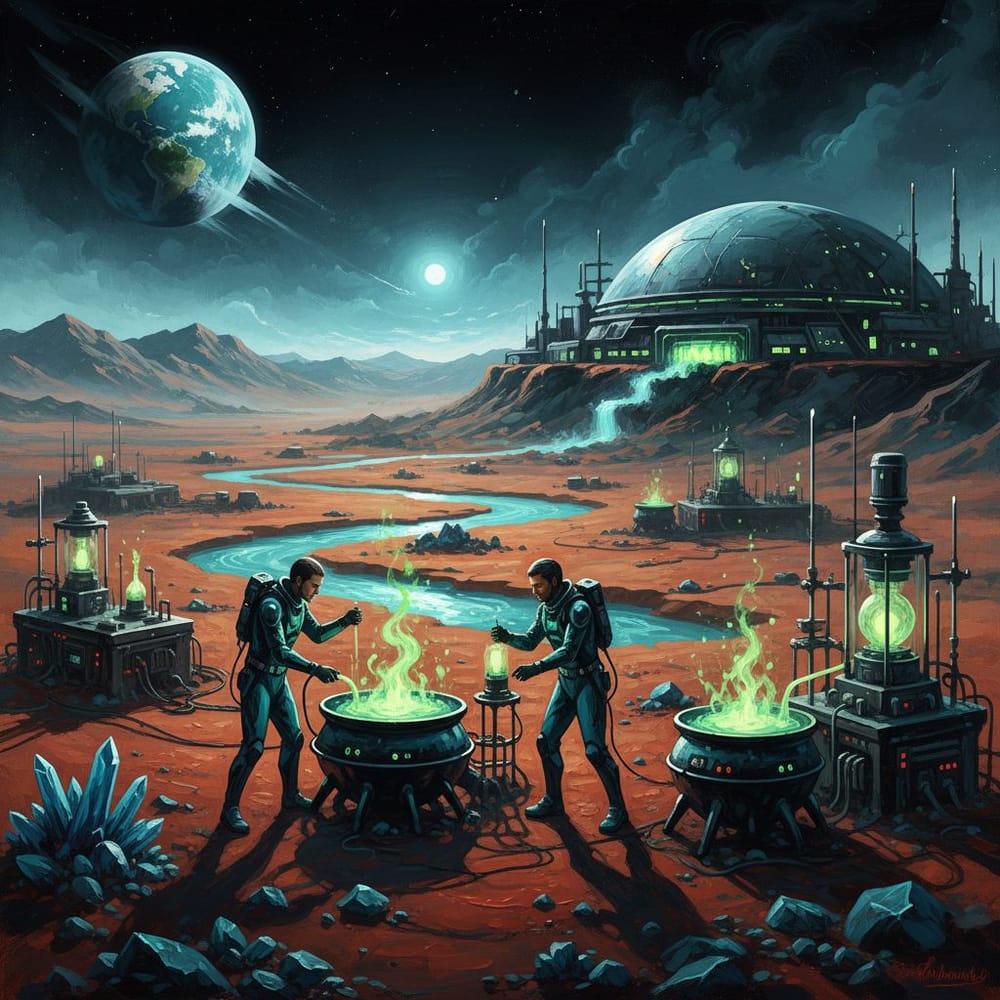
Twenty-one organic molecules detected in a Martian rock sample 3.5 billion years old, seven of which have never before been observed on Mars. This discovery by Amy Williams’ team at the University of Florida, published in Nature Communications, fundamentally reshapes our understanding of Martian prebiotic chemistry.
Among these molecules is a nitrogen-containing heterocycle, a structure considered a precursor to RNA and DNA, the two key nucleic acids of genetic information. More than just a scientific discovery, this Curiosity rover mission reveals that Mars can preserve biosignatures for billions of years despite exposure to space radiation.
A First Experiment in Wet Chemistry on Another Planet
After years of laboratory work, the results are clear: a rock that NASA’s Curiosity rover drilled and analyzed in 2020 contains the most diverse collection of organic molecules ever found on the red planet. The experiment was conducted in the Glen Torridon region of Gale Crater, an area rich in clay minerals that indicate the region once contained water.
The SAM (Sample Analysis at Mars) instrument used TMAH, a highly toxic and corrosive chemical used on Earth in semiconductor manufacturing. This highly alkaline chemical can break down what is called macromolecular carbon, complex aromatic materials of very large size.
This wet chemistry technique made it possible to release molecules preserved in the ancient macromolecular organic matter of the Martian rock substrate despite approximately 3.5 billion years of diagenesis and radiation exposure. The experiment represents the first time a new type of chemical experiment has been performed on another planet.
Precursors of Life Detected for the First Time
“This detection is quite profound because these structures can be chemical precursors of more complex molecules containing nitrogen,” explains Amy Williams, lead author of the study. “Nitrogen-containing heterocycles have never been found before on the Martian surface or confirmed in Martian meteorites.”
Benzothiophene ranks among the most intriguing molecules discovered. It is a two-ring molecule containing carbon and nitrogen. Benzothiophene forms in the interstellar medium, on meteorites. If this molecule did indeed arrive on Mars via meteorites, it could represent some of the oldest organic molecules formed in the solar system and preserved in these rocks.
Curiosity also found a chemical compound named methyl benzoate. This complex molecule possesses both an aromatic ring and an ester group. It can have a biotic or abiotic source, but its presence shows that Mars has preserved more complex or “mature” organic chemicals than what had been previously confirmed.
Mars’ Preservation Capacity Revealed
The fact that methyl benzoate survived approximately 3.5 billion years on Mars’ radiation-bombarded surface is significant and shows that the planet can preserve complex organic molecules. This suggests that even more compelling organic molecules such as amino acids could also be preserved.
This discovery contrasts with previous estimates of organic degradation. The Radiation Assessment Detector (RAD) instrument aboard Curiosity revealed that the measured absorbed dose is 76 mGy/year at the surface, and that “ionizing radiation strongly influences chemical compositions and structures, especially for water, salts, and components sensitive to redox reactions such as organic molecules.”
Mars lacks a global magnetic field that would protect the planet from potentially lethal cosmic and solar radiation. Scientists speculate that the absence of magnetic protection helped solar wind strip away much of the Martian atmosphere over several billion years. As a result, the planet has been vulnerable to space radiation for approximately 4 billion years.
The Geopolitical Stakes of Astrobiology
Curiosity’s discovery transforms the landscape of global space exploration. This prioritization is reflected in the 2023-2032 decadal survey on planetary science and astrobiology by the National Academies of Sciences, Engineering, and Medicine, which highlights Enceladus in the list of destinations for a NASA New Frontiers-class mission and recommends an Enceladus Orbilander mission as the second priority flagship mission.
The implications extend beyond the Martian framework. Today, two ice moons—Europa, orbiting Jupiter, and Enceladus, orbiting Saturn—have emerged as the most promising destinations in the search for extraterrestrial life. This is the result of a series of discoveries that have revealed these frozen worlds are surprisingly active, warm, and potentially habitable beneath their icy shells.
The proposed orbiter-lander mission would launch around 2042 and arrive in the Saturnian system in 2053. This TMAH technology tested on Mars will be aboard these future missions, notably the Rosalind Franklin mission to Mars and the Dragonfly expedition to Titan, Saturn’s moon.
Terrestrial Applications
The research conducted by the Curiosity team finds direct applications in understanding the evolution of life on Earth. The automation of scientific discovery is already transforming research methods, but this Martian discovery offers a unique natural laboratory.
Sedimentary deposits on Mars dating back more than 3.5 billion years could contain biosignatures or remnants of prebiotic processes that have long since been erased from Earth. On Mars, similar deposits dating back more than 3.5 billion years could contain biosignatures or remnants of prebiotic processes that have long since been erased from Earth.
Taxonomically identifiable DNA can be recovered from terrestrial rocks containing as little as 182 ppm of total organic carbon after exposure to radiation equivalent to 136 million years on Mars. Despite fragmentation, 1.48 to 8.45% of sequences remain taxonomically identifiable, demonstrating that DNA fragments can persist in rocks for more than 100 million years.
Mars Redefines Global Astrobiology
Scientists have no way of knowing whether these organic molecules were created by biological or geological processes—both pathways are possible—but their discovery once again confirms that ancient Mars had the appropriate chemistry to support life.
“We think we are looking at organic matter that has been preserved on Mars for 3.5 billion years,” explains Williams. “It is really helpful to have the proof that ancient organic matter is preserved, because it is a way to assess the habitability of an environment. And if we want to search for evidence of life in the form of preserved organic carbon, this demonstrates that it is possible.”
This discovery comes as humanoid robots arrive in factories and artificial intelligence transforms our methods of space exploration. “This is Curiosity and our team at their best. It took dozens of scientists and engineers to locate this site, drill the sample, and make these discoveries with our fantastic robot. This collection of organic molecules once again increases the prospect that Mars offered a home for life in the ancient past.”
Mars is establishing itself as the most accessible laboratory for prebiotic chemistry. The 21 molecules detected in 3.5-billion-year-old sediments prove that the signatures of life can survive the most extreme conditions. This revelation now guides all astrobiology missions, from Europa Clipper to future crewed expeditions to the red planet.