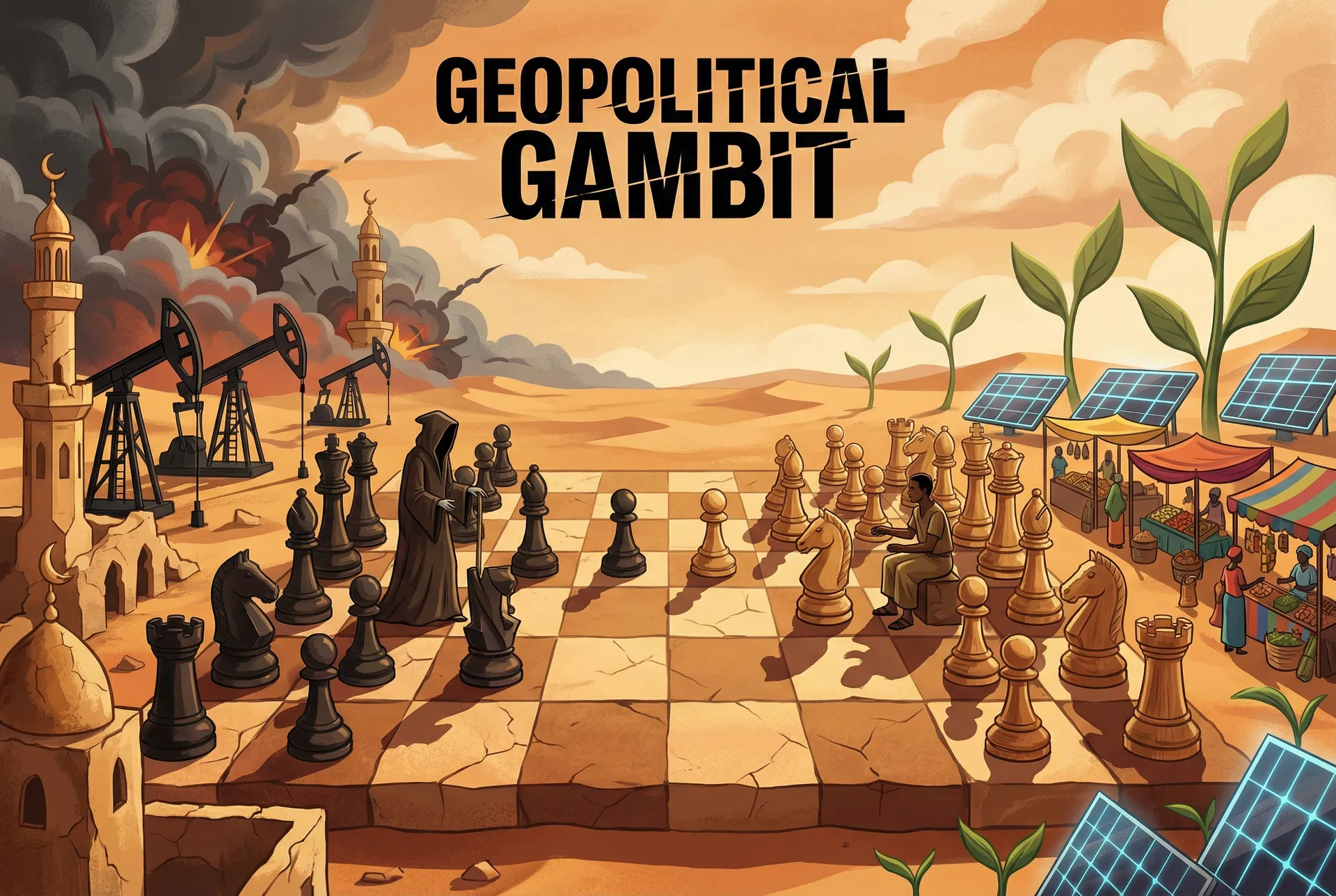
The post-pandemic economic recovery in sub-Saharan Africa, already fragile, faces a new zone of turbulence. The escalation of tensions in the Middle East, crystallized by the conflict in Gaza and the regional instability that follows, acts as a risk multiplier for the continent. This external shock spreads through financial, commercial and energy channels, threatening to slow growth that was showing encouraging signs of consolidation, while highlighting the urgent need for the continent to accelerate its structural transformation.
The year 2024 had ended on a note of measured optimism for sub-Saharan Africa. The International Monetary Fund (IMF), in its April 2025 report, observed 4% growth, higher than initial forecasts [1]. Macroeconomic indicators seemed to be improving: median inflation had fallen back to 4.5% in early 2025 and the median public debt burden had stabilized below the 60% of GDP threshold [1]. This positive dynamic raised hopes for consolidation of the recovery after the shocks of the COVID-19 pandemic, which had caused the region’s first recession in 25 years, and the initial repercussions of the war in Ukraine.
However, this improvement remained precarious and heterogeneous. The IMF itself described this recovery as “interrupted,” emphasizing the region’s vulnerability to “yet another shock, in the form of a sudden transformation of the external economic landscape” [1]. The African Development Bank (ADB) shared this nuanced diagnosis. Its May 2025 report praised the “remarkable resilience” of African economies but warned of the persistence of “economic and political headwinds on a global scale” [3]. Concretely, fifteen countries on the continent were still fighting double-digit inflation, and debt service absorbed an increasingly heavy share of state revenues, rising from 19% in 2019 to 27.5% in 2025 [3]. Countries like Ghana had to restructure their debt, and others, like Nigeria, had undertaken bold but socially costly reforms, such as the removal of fuel subsidies. It was in this context of economic convalescence, where foundations remained fragile, that shock waves from the Middle East began to spread.
The impact of the Middle Eastern crisis on sub-Saharan Africa is articulated mainly around three interconnected vectors: energy market volatility, trade disruptions, and tightening global financial conditions.
The first channel, and the most immediate, is energy prices. A substantial portion of global oil and natural gas trade transits through the Strait of Hormuz, an area at the heart of geopolitical tensions. Any disruption, even anticipated, of this vital logistical flow leads to a surge in global prices. For the vast majority of sub-Saharan African countries, which are net importers of petroleum products, this increase directly impacts their energy bill. The effect is systemic: transportation costs increase, industrial production costs follow, and general inflation accelerates, eroding household purchasing power and business competitiveness. Governments then find themselves facing a complex trade-off: subsidize pump prices to preserve social peace, at the risk of burdening an already substantial budget deficit, or let prices rise and face popular discontent. Conversely, the minority of African oil-exporting countries (such as Nigeria, Angola, or Gabon) could benefit in the short term from higher revenues. However, this windfall is often volatile and can be offset by overall macroeconomic instability and declining long-term demand if the crisis were to persist.
The second channel concerns supply chains. Instability in the Red Sea and Gulf of Aden, due to attacks on commercial vessels, has forced many shipping companies to reroute their container ships. Going around Africa via the Cape of Good Hope extends delivery times by several weeks and causes freight costs and insurance premiums to explode. For African economies heavily integrated into global trade, both for importing capital goods and food products and for exporting raw materials, these disruptions have direct consequences. They result in delivery delays, increased prices for imported products, and loss of competitiveness for exported products. For example, horticultural product exporters from Kenya to Europe have seen their logistical costs increase and their delivery times lengthen, threatening their market share.
Finally, the third channel is financial. Rising global geopolitical uncertainty encourages international investors to greater risk aversion. This phenomenon often manifests through capital reallocation from emerging markets, deemed riskier, toward safe haven assets like US Treasury bonds. For Africa, this could mean a slowdown in foreign direct investment (FDI), which is fundamental for financing infrastructure, industry and services development. Moreover, Gulf countries, which have become leading investors on the continent in recent years, particularly in telecommunications, finance and logistics sectors, could be led to redirect their capital toward domestic security priorities or regional reconstruction. The IMF also notes that official development assistance, already under pressure, risks declining while donor countries themselves face budgetary and security constraints [1].
As a direct consequence of these headwinds, major international financial institutions have begun adjusting their growth projections for the continent. The IMF thus lowered its forecast for 2025 by 0.4 percentage points, bringing it to 3.8%, due to “global economic turbulence” [1]. The ADB, while maintaining a slightly more optimistic forecast of 3.9% for 2025, acknowledges the impact of “rising geopolitical uncertainties” [3]. The World Bank, in its October 2025 analysis focused on the Middle East and North Africa (MENA) region, projects modest growth of 2.6% for this zone, illustrating the direct impact of the conflict on neighboring economies [2].
Institution 2025 Growth Forecast 2026 Growth Forecast Source IMF (Sub-Saharan Africa) 3.8% 4.2% [1] ADB (Africa) 3.9% 4.0% [3] World Bank (MENA) 2.6% - [2] The impact is not uniform across the continent, however. The ADB anticipates very contrasted growth. East Africa should display the most robust performance with expected growth of 5.9%, driven by the dynamism of countries like Ethiopia and Rwanda, whose economies are more diversified and less dependent on raw material exports. In contrast, Southern Africa should experience much weaker growth, at 2.2%, slowed by the structural difficulties of its most important economy, South Africa, which faces a persistent energy crisis and low productivity growth [3]. This heterogeneity underlines the differences in solidity and economic structure between the continent’s sub-regions.
Beyond conjunctural analysis, this new external crisis starkly highlights the structural vulnerabilities of many African economies. Heavy dependence on imports of basic products, particularly food and energy, and dependence on external financing (development aid, foreign investment, diaspora remittances) make the continent particularly sensitive to global shocks. Faced with this observation, awareness seems to be emerging within African development institutions.
The call for a model change is increasingly urgent. Kevin Urama, the ADB’s chief economist, summarizes this new orientation: “Africa must now rise to the challenge and turn to itself to mobilize the resources necessary to finance its own development in the coming years” [3]. This declaration marks a desire to break with the dependency model. The ADB report goes further by quantifying untapped potential. It estimates that the continent could mobilize up to $1,430 billion in additional internal resources. This effort would involve better efficiency of tax administrations, rationalization of public spending, but above all a determined fight against capital flight.
These illicit financial flows, which include multinational tax evasion, corruption and undeclared money transfers, represent a colossal loss for African states. The ADB evaluates them at $587 billion per year [3]. Mobilizing even a portion of these sums could transform the continent’s development trajectory, by financing infrastructure, health and education systems, and supporting innovation and industrialization. This external crisis could thus act as a catalyst, accelerating a strategic transition toward greater financial autonomy and more endogenous growth, driven by the continent’s own resources and markets.
Faced with global environment volatility, strengthening regional economic integration appears as a key strategy to enhance the continent’s economic stability. The African Continental Free Trade Area (AfCFTA), which entered into force in 2021, represents a historic opportunity in this regard. By dismantling tariff and non-tariff barriers between African countries, the AfCFTA aims to stimulate intra-African trade, which currently represents only about 15% of the continent’s total trade, compared to more than 60% in Europe and Asia.
A more integrated African market would allow the creation of regional value chains, reducing dependence on extra-continental suppliers and making economies less vulnerable to global supply chain disruptions. For example, instead of exporting raw cocoa and importing chocolate, West Africa could develop a regional processing industry, creating added value and jobs on the continent. Similarly, developing regional fertilizer production could reduce dependence on imports from Russia or the Middle East, thus protecting the continent’s food security. The current crisis could therefore serve as a wake-up call to accelerate the effective implementation of the AfCFTA, by overcoming the political and logistical obstacles that still hinder its full deployment.
The Middle East crisis, through its economic repercussions, acts as a stress test for sub-Saharan Africa. It slows a recovery that was already uncertain and exposes the continent’s structural fragilities. While growth prospects for 2025-2026 remain positive, they are now overshadowed by considerable uncertainty. More than a simple external shock, this situation highlights the imperative for African nations to strengthen their regional integration, diversify their economies to reduce their dependence on raw materials, and above all, accelerate the mobilization of their immense internal capital. It is on this condition that the continent will be able to transform external shocks into opportunities to forge a more sovereign and sustainable development model.
[1] International Monetary Fund. (April 2025). Regional Economic Outlook: Sub-Saharan Africa — An Interrupted Recovery. https://www.imf.org/-/media/Files/Publications/REO/AFR/2025/April/French/text.pdf
[2] World Bank. (October 2025). MENAAP Economic Update. https://www.worldbank.org/en/region/mena/publication/mena-economic-monitor
[3] African Development Bank. (May 2025). African Economic Outlook 2025 Report. https://afdb.africa-newsroom.com/press/african-economic-outlook-2025africas-shortterm-outlook-resilient-despite-global-economic-and-political-headwinds?lang=fr
Receive the Journal’s analyses directly in your inbox.
Also Read
China’s CO2 emissions have stagnated for 21 months: structural peak or cyclical accident?
China’s CO2 emissions fell by 0.3% in 2025. It’s a modest figure. But it extends a trend that has lasted 21 consecutive months: since March 2024, emissions from the world’s largest polluter have been “stable or declining.”

AI and employment: two March 2026 studies reveal -13% of automatable offers and +20% of augmented roles
Does AI destroy jobs? Two studies published in March 2026 — one by Harvard Business School, the other by Anthropic — provide the first solid empirical data. And the answer is more nuanced than public debate suggests.
The malaria vaccine in Nigeria: 200,000 children vaccinated and a 50% drop in cases in Kebbi State
Malaria killed 608,000 people in 2022, 95% of them in sub-Saharan Africa and 78% children under five. And for the first time, a vaccine deployed on a large scale shows measurable results in the field.