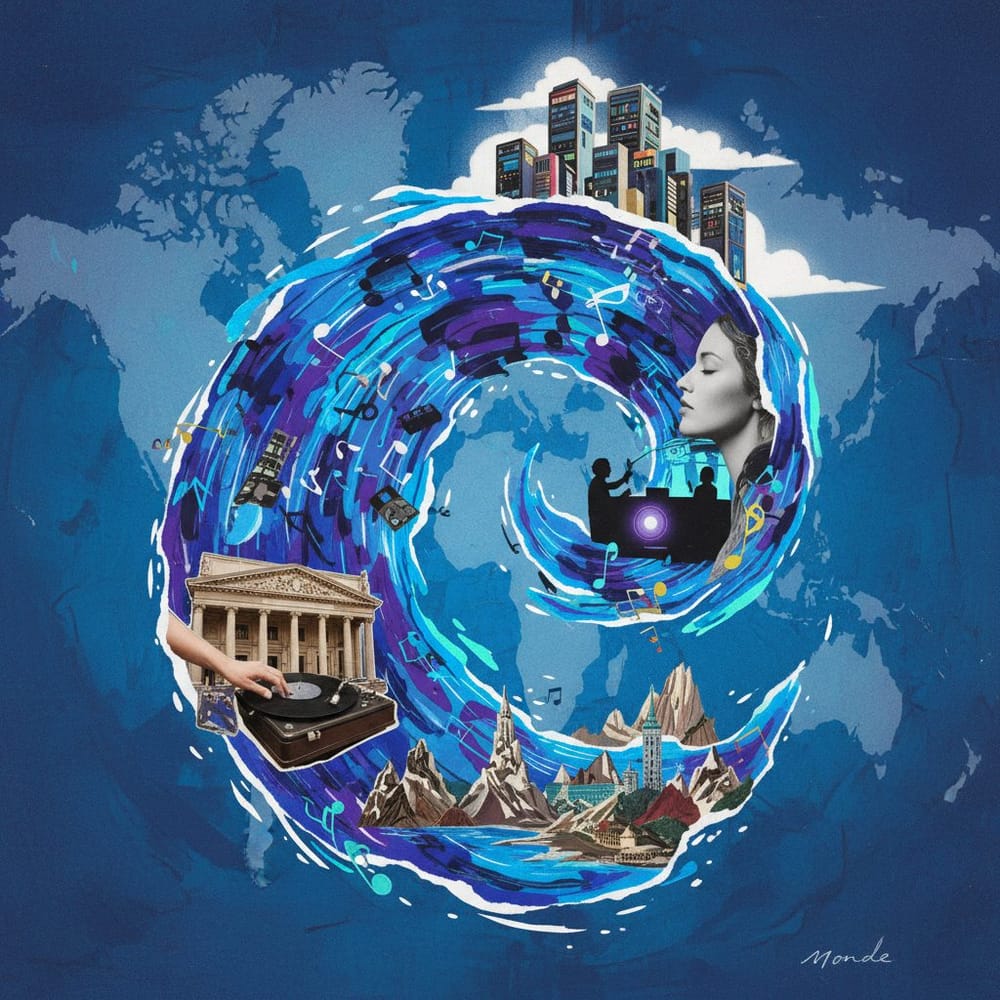
100,000 AI-generated tracks are pouring onto global streaming platforms daily. Facing this tidal wave, the music industry is building for the first time a unified transparency standard: the DDEX protocol, which aims to distinguish human music from AI-generated music.
The AI Tsunami Redefines the Music Economy
Deezer receives 60,000 fully AI-generated tracks daily. Given simultaneous distribution across all platforms, experts estimate Spotify exceeds 100,000 daily uploads. This volume represents 34% of all new tracks submitted to platforms.
Deezer has seen AI uploads explode: 10,000 tracks daily in January 2025, 20,000 in April, 30,000 in September, then 50,000 in November—a 400% increase in ten months. The economic balance of streaming is being shaken.
Beatdapp, a fraud detection specialist, estimates that fraudulent streams divert 2 billion dollars in royalties annually. Each percentage point of market share represents several hundred million dollars. The industry loses at minimum one billion dollars annually drawn from the finite pool of royalties.
The situation is worsening. Spotify removed 75 million fraudulent tracks in twelve months—a figure that shows the scale of the problem. Deezer filters up to 70% of listens from fully AI-generated tracks as fraudulent, even though this content represents only 0.5% of total streams.
The DDEX Protocol Unifies Detection and Labeling
The industry is responding through standardization. Spotify supports the new DDEX standard for AI disclosures in music credits. This system ensures that listeners see the same information regardless of which streaming service they use.
The DDEX system allows labels, distributors, and music partners to submit standardized AI disclosures. It provides precise details: AI-generated vocals, instrumentation, specific instruments, or AI-assisted post-production like mixing or mastering.
Sam Duboff, Spotify’s Head of Marketing and Policy, explains: “AI usage will be a spectrum, with artists and producers integrating AI into various parts of their creative workflow. This industry standard will enable more precise and nuanced disclosures. It won’t impose a false binary on tracks where a song should be categorically AI or not AI at all.”
Fifteen labels and distributors have committed to adopting this technology. Universal Music Group supports these “AI protections as important steps consistent with our long-standing Artist Centric principles.”
Anti-Spam Filters Protect Musicians’ Revenue
Spotify is deploying a new music anti-spam filter that identifies questionable tactics, labels them, and then stops recommending these tracks to users. The system detects massive duplications, SEO piracy, artificially short tracks, and content farm spam, then stops recommending these uploads.
The financial stakes justify this technical battle. The “pro rata” royalty model pools subscription revenue and then distributes it according to the percentage of total streams. This incentivizes fraudsters to artificially inflate counts to capture a larger share of the revenue pool, independent of actual human listeners.
The case of Michael Smith, a musician from North Carolina, illustrates these new frauds. He reportedly extracted over 10 million dollars in royalties through hundreds of thousands of AI songs and bots to listen to them a small number of times each.
Spotify’s new anti-spam filter will protect against such behavior and prevent spammers from generating royalties that should be distributed to professional artists and songwriters.
Transparency Becomes Mandatory, Not Prohibition
The industry favors transparency over prohibition. Spotify does not ban AI. The platform focuses on transparency and preventing abuses like identity spoofing or massive spam uploads.
If a track includes AI vocals, AI instrumentation, a specific AI-generated instrument, or AI-assisted post-production like mixing or mastering, this information can be displayed in Spotify credits or any other service using the standard.
The approach is nuanced: AI can amplify the creative process without replacing the artist, as is already the case in other fields.
Polls reveal consensus: 80% of respondents want 100% AI music to be clearly labeled, 73% want to know if their platform recommends “synthetic” tracks, and 70% believe fully AI music threatens current and future musicians’ income.
Artificial Intelligence Remains Undetectable for 97% of Listeners
The technical challenge is considerable. The Deezer-Ipsos study reveals that 97% of people cannot distinguish fully AI-generated tracks from human music in blind listening tests. More than half (52%) feel uncomfortable with this inability.
Deezer detects 100% AI music from the most prolific generative models—such as Suno and Udio—with the possibility of adding detection for practically any other similar tool as long as there is access to relevant example data.
In fact, 60% of independent music creators use AI tools to write lyrics or produce beats for streaming. The question is no longer whether AI will be used, but how to regulate its use.
The main challenge is that AI usage often falls on a spectrum, from subtle production assistance to fully generated songs, making a simple “AI or not AI” label too limiting.
Europe Imposes Regulation, America Favors Self-Regulation
Geographic approaches differ. Europe is developing digital regulation as a tool of sovereignty, while the United States favors industry self-regulation.
In March 2026, the European Parliament adopted a resolution on generative AI and copyright, calling for more transparency in training data, fair compensation for rights holders, and more control over the use of creative works.
A CISAC-PMP Strategy study with participation from key players (including Deezer) estimates that nearly 25% of creators’ revenues are at risk by 2028, potentially representing 4 billion euros. Hence the regulatory urgency felt in Europe.
The American industry is betting on technical innovation. Tools like Slop Tracker use spectral analysis to examine frequency patterns and temporal analysis to study micro-variations in rhythm unique to human performance. Tracks are then classified as Human Made, Processed AI, or Pure AI.
The DDEX standard is the first industry consensus in response to this daily flow of AI content. Mandatory transparency protects musicians’ revenues without banning the tool. But the fundamental question remains open: who controls music creation when machines produce faster than humans can listen?
Sources
- AI-Generated Music Floods Streaming Platforms Amid Industry Debate
- Spotify Strengthens AI Protections for Artists, Songwriters, and Producers
- Spotify to label AI music, filter spam and more in AI policy change
- Deezer and Ipsos study: AI fools 97% of listeners
- 50,000 AI-music tracks are now uploaded to Deezer every day
- How AI-generated songs are fueling the rise of streaming farms
- Inside the Rise of Bots and Streaming Fraud in Music