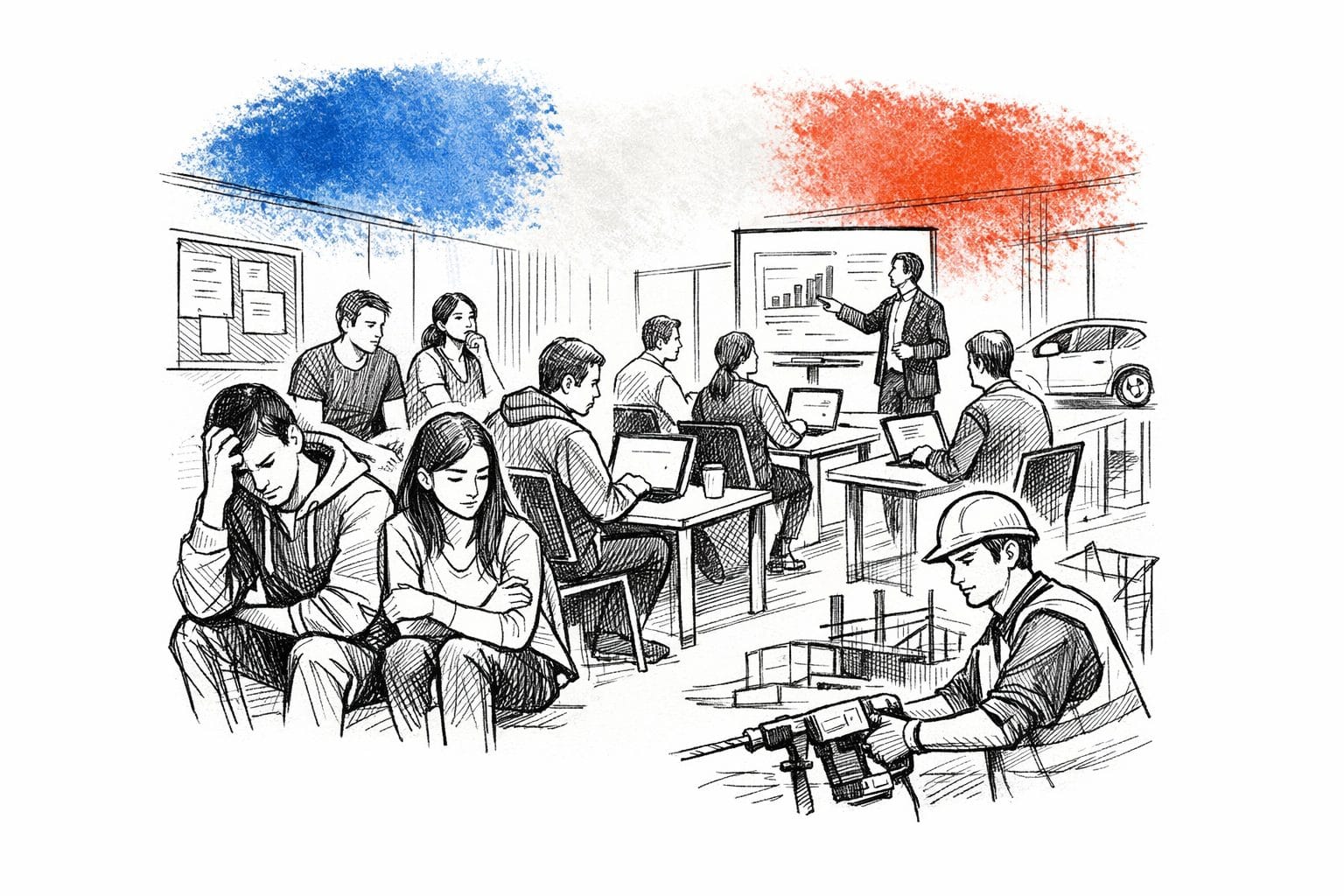
41% of OECD teachers use generative AI in their daily work. This proportion masks significant disparities: 75% in Singapore versus only 14% in France. These figures reveal less a technological revolution than a major pedagogical transformation that only the most agile educational systems manage to orchestrate effectively.
The OECD demonstrates in its Digital Education Outlook 2026 that contrary to replacement fears, generative AI enables teachers to rediscover the essence of their profession. By automating repetitive tasks, it frees up time for human interaction and pedagogical personalization. The challenge is no longer technological but deeply pedagogical: distinguishing collaborative augmentation from passive substitution.
Key Points
- 41% of OECD teachers use AI, with major gaps: 75% in Singapore and the United Arab Emirates versus 14% in France
- British teachers using AI save 25 minutes per week on lesson preparation, a 31% reduction
- 76% of Singaporean teachers received AI training versus 9% in France, showing the direct link between training and adoption
- Research confirms that AI improves tutoring quality for beginning teachers and strengthens professional autonomy
Singapore versus France: Two Visions of Pedagogical Innovation
TALIS 2024 data reveal a striking divide between national approaches. Singapore shows 75% AI adoption by its teachers against an OECD average of 36%, while France stagnates at 14%, at the level of Japan. This disparity does not result from chance but from opposing strategic choices.
Singapore launched a national initiative to develop AI literacy among students and teachers, with mandatory training for all levels by 2026. The Singaporean ministry invests heavily in collaborative research to adapt tools to local pedagogical realities.
Conversely, France illustrates the trap of institutional mistrust. 79% of French teachers claim to lack knowledge to use AI, higher than the OECD average of 75%. More tellingly, 50% cite lack of infrastructure in their establishments versus 37% on average across the OECD. This dual shortage—skills and equipment—reflects systemic delay in modernizing pedagogical practices.
The Liberation Effect: How AI Gives Time Back to Teachers
The most measurable impact of AI concerns the reduction of time spent on administrative tasks. A British study by the Education Endowment Foundation demonstrates that teachers using ChatGPT save an average of 25 minutes per week on lesson preparation, dropping from 81.5 to 56.2 minutes weekly.
These time gains generalize internationally. American teachers using AI on a weekly basis save 5.9 hours per week, equivalent to six additional weeks per school year. More significantly, schools with structured AI policies see their teachers gain 26% additional time, confirming the importance of institutional support.
Europe Reveals Its Pocket-Giant Strategy Against Mega-Funding American AI Rounds demonstrates how coordinated investments amplify technological efficiency. Education reproduces this logic: national initiatives like the Oak National Academy in the United Kingdom report productivity gains of up to five hours per week thanks to integrated planning and quiz-creation tools.
This time liberation qualitatively transforms the teaching profession. Teachers redirect this time toward direct interaction with students and relational work that no AI can replace. The automation of repetitive tasks allows professionals to refocus on their human added value: personalized support, qualitative evaluation, and the development of critical thinking.
Training: Cornerstone of Successful Adoption
The gap between Singapore and France is largely explained by their opposing approaches to training. 76% of Singaporean teachers benefited from AI training versus only 9% of French teachers. This direct correlation between training and usage confirms that technological adoption results from structured learning, not spontaneous appropriation.
American data reinforce this analysis. 47% of American teachers received at least one AI training in 2024, marking significant progress, but these trainings generally remain punctual rather than continuous. This limitation explains why 43% of British teachers rate their AI confidence at only 3 out of 10, despite a usage rate of 60%.
Innovative approaches are emerging in several systems. American leaders favor voluntary and modular trainings rather than mandatory ones, adopting a logic of progressive incentives. This strategy combines intensive sessions, “bite-sized” learning via newsletters, and integration into existing trainings.
Research confirms the effectiveness of targeted trainings. The OECD observes that inexperienced tutors assisted by AI significantly improve their pedagogical strategies and their students’ learning outcomes. Many international studies show that AI trainings generate significant improvement in pedagogical quality, with notable progress in applying evidence-based strategies.
From Substitution to Augmentation: Rethinking the Teacher’s Role
The OECD establishes a crucial distinction between three models of AI integration: replacement, complementarity, and augmentation. This typology does not concern technological support but the position of professional judgment: does AI substitute for teaching decisions, leave them unchanged, or transform them positively?
The augmentation model transforms professional identity without denying it. Educational AI augments human teaching while preserving professional autonomy. Co-design involving teachers and developers ensures that these technologies amplify professional expertise rather than substitute for it.
This evolution translates concretely into practices. 59% of American teachers state that AI enables them to provide more personalized instruction, with particularly intense usage in high school (69%) versus 42% in primary school. Tools gradually adapt to disciplinary and generational specificities.
The French example illustrates resistances to this transformation. Only 18% of French teachers believe AI improves their lesson plans, versus 87% in the United Arab Emirates and 91% in Vietnam. This divergence reveals less a technological lag than a different cultural approach to pedagogical innovation.
Persistent Challenges: Ethics and Pedagogical Quality
Widespread AI adoption raises legitimate concerns about academic integrity and pedagogical quality. Approximately one-third of teachers use AI, but 70% worry it facilitates cheating and plagiarism. This tension reveals the need for simultaneous evolution in assessment methods.
China Redraws AI Geopolitical Balance by Exporting Open Source as New Technological Diplomacy illustrates how technological innovation redistributes educational power dynamics. Research cited in the OECD report shows that students using AI perform 48% better on immediate tasks, but their performance drops 17% when AI assistance is withdrawn.
This duality imposes a transformation of assessment practices. The OECD recommends “process-oriented evaluation”: rather than grading the finished product, teachers should evaluate how students interact with AI, critique its results, and refine their ideas.
The challenge transcends technique to touch educational philosophy. The OECD report emphasizes the need for teachers to develop professional criteria to adjust AI usage when it begins harming authentic learning. This responsibility redefines teaching expertise around technological regulation serving pedagogical objectives.
Toward Professionalization of Educational AI
The future takes shape around specialized tools. General-purpose AI is not designed to help students learn but to accomplish tasks on their behalf. They write, solve, and translate, naturally generating concerns about cheating and academic integrity.
This limitation justifies the emergence of specialized AI. The 2026 OECD recommends moving beyond general tools to develop educational AIs designed to produce sustained learning gains rather than mere performance improvements. These systems integrate pedagogical principles from their design.
Professionalization is accelerating in several countries. South Korea invests heavily in student preparation with AI courses in the national curriculum by 2025, supported by extensive teacher trainings via the Keris unit of the ministry. This systemic approach coordinates technological innovation and pedagogical transformation.
The effectiveness of this professionalization is already measurable. In Singapore, 82% of teachers believe AI improves their lesson plans versus 53% on average across the OECD, while 74% find it useful for other pedagogical aspects. These results confirm that investment in training translates into qualitative appropriation of tools.
Generative AI does not replace teachers but redefines their profession around their irreplaceable human added value. Educational systems that simultaneously invest in training and support transform this technological disruption into a pedagogical opportunity. Others risk seeing their teachers suffer rather than master a revolution they will not have anticipated.