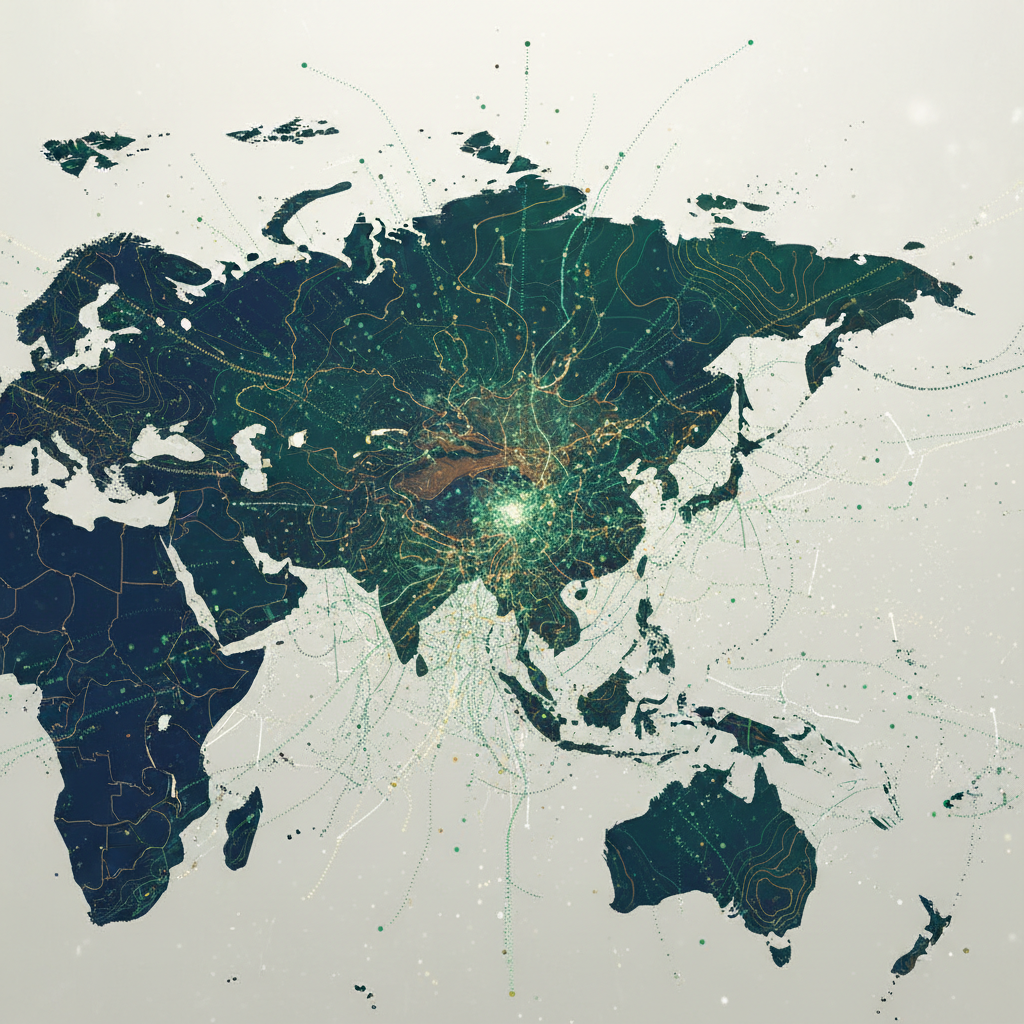
60% of global economic growth comes from a single region: the Asia-Pacific. This unprecedented concentration reveals an economic polarization where Asian emerging markets compensate for the stagnation of developed countries. The phenomenon raises questions of geopolitical stability in the face of growing trade tensions.
China, the lone engine of a quarter of global growth
Asian dominance crystallizes around one main actor. China alone represents 26.6% of global real GDP growth in 2026, according to IMF data. This percentage equals the combined contribution of the United States (15.2%) and the European Union (11.4%).
This asymmetry reveals a structural shift. Where the global economy relied primarily on the United States-Europe-Japan triad, it now rests on the expansion of emerging markets led by Beijing. Massive Chinese investment in digital and energy infrastructure generates spillover effects that irrigate the entire region.
India completes this picture with 7.8% of global growth, outpacing Germany (6.2%) and Japan (5.1%). The technological acceleration experienced by Southeast Asia in sectors like digital health illustrates this innovation dynamic that goes beyond simple economic catch-up.
Developed countries show structural slowdown
Faced with this Asian surge, Western economies display predominantly low growth rates. The United States expects 2.1% expansion in 2026, Germany 1.3%, France 1.2%. These figures contrast with the 5.2% expected in China and 6.8% in India.
This divergence doesn’t merely reflect an economic maturity gap. It reflects different structural choices. While Europe and the United States prioritize fiscal consolidation and financial regulation, Asia focuses on massive public investment and credit expansion.
Demographic aging amplifies this gap. Europe counts 201 million people over 65 versus 178 million in East Asia, despite a population three times larger. This demographic inversion weighs on European domestic consumption while Asia still benefits from its demographic dividend.
Asian regional integration challenges Western blocs
ASEAN represents 4.2% of global growth, a level higher than the United Kingdom (3.8%). This performance is explained by accelerated economic integration that transcends geopolitical divisions. Vietnam, Malaysia, and Thailand capture Chinese industrial relocations while maintaining their exchanges with Beijing.
This fluidity contrasts with the fragmentation of Western value chains. Sanctions against Russia cost the European Union 0.3 percentage points of annual growth according to the European Central Bank. Meanwhile, Asia develops alternative financial circuits that reduce its dependence on the dollar and Western banking system.
The Comprehensive and Progressive Agreement for Trans-Pacific Partnership (CPTPP) unites 11 countries representing 13% of global GDP. This commercial architecture directly competes with American influence in the region, creating an autonomous growth pole that escapes geopolitical confrontation logic.
Trade tensions reveal the fragility of this concentration
This Asian hyper-concentration generates systemic vulnerabilities. American tariffs on Chinese products affect $370 billion in annual trade. Each 10% tariff escalation reduces global growth by 0.2 percentage points according to the World Trade Organization.
Technological dependence aggravates these risks. American restrictions on semiconductors force China to invest massively in technological self-sufficiency, creating costly industrial duplications that reduce global efficiency.
This fragmentation threatens the optimization of global value chains. Taiwan produces 63% of global electronic chips. A conflict in the Taiwan Strait would paralyze the global automotive and electronics industry, instantly canceling Asian growth gains.
The battle for raw materials reshapes trade flows
The Asia-Pacific consumes 65% of global lithium but produces only 12% of global extraction. This asymmetry creates strategic dependence on Latin America and Australia. The battle for control of lithium value chains illustrates how the energy transition redefines geoeconomic balances.
This thirst for resources pushes Asia toward new partnerships. Indonesia bans raw nickel exports to force Chinese industrial investments. The result: $18 billion in battery factories implanted in the archipelago in three years.
Africa becomes a crucial influence terrain. China finances 156 infrastructure projects for $128 billion via the New Silk Roads. These investments secure supply of Congolese cobalt and African rare earths, consolidating Asian industrial dominance.
The emergence of a post-Western growth model
This Asian concentration marks the emergence of state capitalism driven by public investment and technological planning. China devotes 2.4% of its GDP to research and development versus 3.5% in the United States, but catches up the gap through absolute volume: $378 billion annually.
This approach generates different returns from those of the Western model. Where the United States prioritizes breakthrough innovation and immediate profitability, Asia focuses on incremental improvement and scale effects. The result: manufacturing dominance that transforms Western innovations into accessible mass products.
Asian finance develops its own capital allocation criteria. Chinese public banks grant $4.2 trillion in annual credit, twice that of the American banking system. This liquidity fuels extensive growth that challenges Western equilibrium models based on capital profitability.
This economic asymmetry transforms a geographical imbalance into a geopolitical issue. The West’s ability to maintain its influence in the face of this Asian concentration will depend on its capacity for adaptation rather than resistance. The data reveals a shift already accomplished: what remains is to build tomorrow’s balances.
Sources