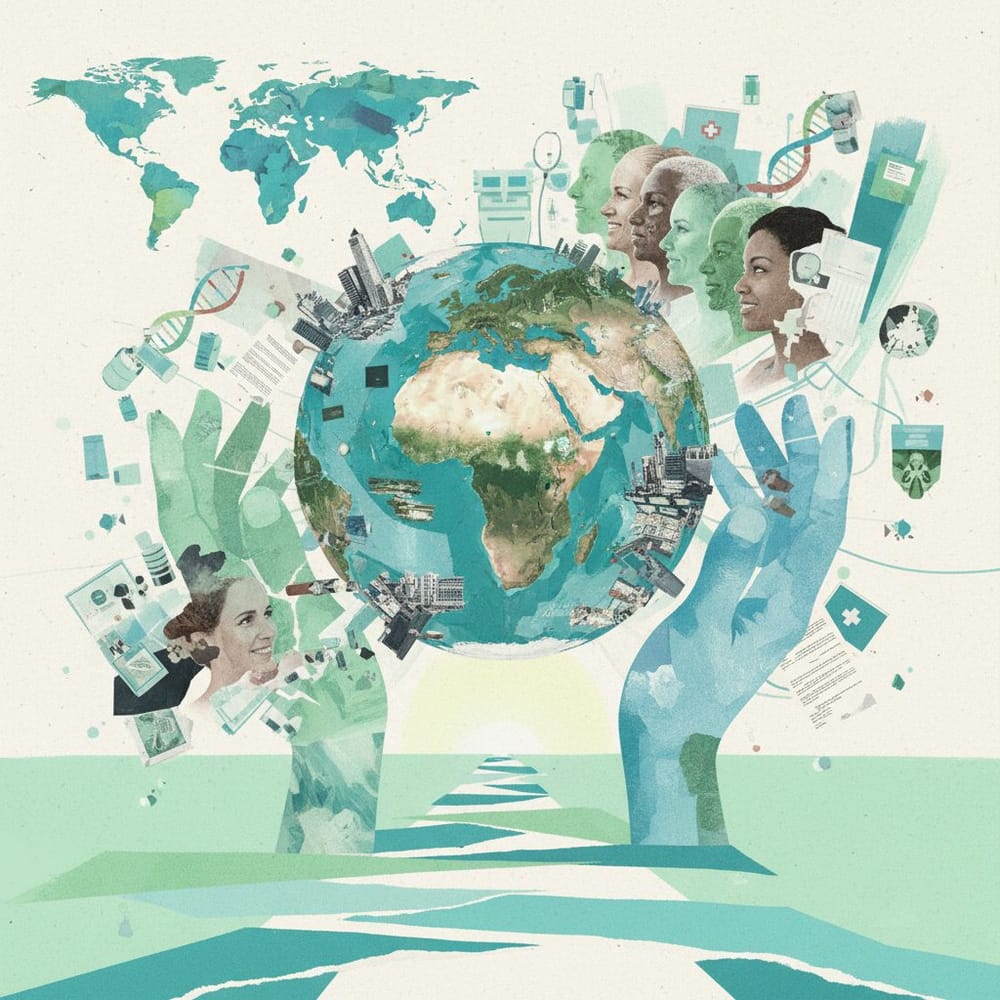
Health aid is expected to fall by 35 to 40 percent this year compared to 2023, representing 10 billion dollars less, according to the WHO. This budgetary hemorrhage is hitting hard a sector that was nevertheless recording remarkable successes: 1.4 billion additional people are living in better health today than in 2019. This achievement exceeds the initial target of 1 billion set by the WHO in its Thirteenth General Programme of Work. Progress in health improvement has been supported by the decline in smoking as well as by improvements in air quality and access to water and sanitation and hygiene facilities.
Yet this success masks a concerning paradox: global health progress is slowing dangerously, and the sharp fall in international aid now threatens the achievements of two decades.
Health progress is slowing. “Countries have reported disruptions to services at levels never seen since the peak of the COVID-19 pandemic,” the WHO warns in its latest report. This stagnation comes after a decade of unprecedented setbacks caused by COVID-19, which reduced global life expectancy by 1.8 years between 2019 and 2021, erasing ten years of progress.
A Financing Collapse That Threatens Health Achievements
Foreign aid for health is expected to decrease by 30 to 40 percent in 2025 compared to 2023, down from a historic peak of 80 billion dollars in 2021. This fall is hitting the most vulnerable countries hard.
The United States bears heavy responsibility for this crisis. Following this, the American president announced the suspension for 90 days of all foreign aid, including health assistance. In January 2025, American President Donald Trump signed an executive order suspending approximately 44 billion dollars of foreign aid and assistance, disrupting the allocation of an estimated 12.4 billion dollars to addressing urgent health crises worldwide. In less than three months, the new administration in place suspended more than 80 percent of the funding of the United States Agency for International Development (USAID), the world’s largest humanitarian funder which represented more than 40 percent of global aid in 2024.
This decision is compounded by reductions already announced by other major donors, notably France, which plans to cut its contribution to the Global Fund to Fight AIDS, Tuberculosis and Malaria by 59 percent. This cut of nearly one billion euros could result in more than 700,000 deaths.
Sub-Saharan Africa is bearing the brunt of these budget cuts. “African governments, at the continental level, spend twice as much servicing their debt (14 percent of their combined GDP) as they do on health,” the WHO notes. American aid represented up to a third of current health spending in countries like Malawi, or a quarter in Mozambique and Zimbabwe. Forecasts estimate a further 7 percent decline in this region over the next five years.
Essential Services at Risk in the Poorest Countries
The consequences of this financial hemorrhage are already translating into major health system dysfunctions. According to data from a WHO survey of 108 low- and lower-middle-income countries conducted in March 2025, the decline in financing has led to a 70 percent reduction in essential services—including maternal care, vaccination, preparedness and response to health emergencies, and disease surveillance—in some countries.
Health workers are paying a heavy price for this crisis. More than 50 countries reported that healthcare workers and care aides lost their jobs and that healthcare worker training programs were severely disrupted. This shortage exacerbates an already critical situation: by 2030, there will be a shortage of 11.1 million healthcare workers, with nearly 70 percent of this deficit affecting the WHO African Region and Eastern Mediterranean Region.
Financing inequalities reveal the scale of the challenge. Annual government and donor health expenditures in 2024 averaged 17 dollars per capita in low-income countries, less than one-third of the estimated minimum of 60 dollars needed to provide a basic package of services. In lower-middle-income countries, this amount was 47 dollars, barely half the benchmark level of 90 dollars.
The Lasting Legacy of COVID-19 Weighs on Progress
The pandemic left profound scars that partially explain the current slowdown. The increase in mental health disorders, particularly anxiety and depression, resulted in a global loss of six weeks of healthy life expectancy. These combined impacts cancel out the progress previously achieved through reductions in deaths caused by non-communicable diseases.
This historical regression affects regions unevenly. The WHO Regions of the Americas and Southeast Asia were hardest hit, with a decline in life expectancy of about 3 years and a decline in healthy life expectancy of 2.5 years between 2019 and 2021, while the Western Pacific Region was little affected during the first two years of the pandemic and lost less than 0.1 years of life expectancy.
The return to normal remains incomplete. The recovery of essential health services remains incomplete, and the report highlights the effects of the health shock but also a structural trend: the slowdown in global health progress had actually begun before 2020 and continues today.
Sustainable Development Goals Compromised
Health objectives from the 2030 Agenda are at risk of not being achieved. Only one-third of SDG 3 targets are on track or progressing moderately. Maternal and child mortality illustrate this concerning stagnation. If no urgent measures are taken to achieve objectives set for 2030, it will be impossible to avoid 700,000 additional maternal deaths and 8 million deaths of children under five globally between 2024 and 2030.
Communicable diseases are on the rise again. Malaria is gaining ground: 263 million cases estimated in 2023 compared to 226 million in 2015. 9.3 million people still did not have access to vital treatments in 2023, with the majority in Africa. The suspension of American aid in January 2025 directly threatens treatment access in 55 countries, mainly African ones.
Long-term projections are alarming. According to a recent study in The Lancet, a sharp decline in global aid could result in 22.6 million additional deaths by 2030 in 93 low- and middle-income countries, including 5.4 million children under five.
Inequalities Widen Access to Essential Care
Universal health care remains a distant horizon for billions of people. 1 in 3 people still lack access to quality care. This figure, from the WHO and World Bank, reveals the scale of the challenge. In 2022, 3 out of 4 among the poorest experienced financial difficulties due to health expenditures, compared to fewer than 1 out of 25 among the richest. Women and people who are poor, living in rural areas, or less educated reported encountering greater difficulties in accessing essential health services.
Debt is strangling national health budgets. In 2022, at least 48 low- and middle-income governments paid more to service debt to foreign creditors than they spent on healthcare for their populations. This financial contradiction illustrates the structural constraints weighing on health policies in the most vulnerable countries.
Dependence on foreign aid creates systemic vulnerability. Funds from foreign governments or intergovernmental agencies such as the World Bank covered more than 20 percent of health spending in 49 countries and were the main financing mechanism in 16 countries, exposing these health systems to geopolitical shocks.
Between Fragile Achievements and Persistent Challenges
Despite these difficulties, some progress deserves to be highlighted. Rates of HIV infection and tuberculosis incidence are declining, and fewer people need treatment for neglected tropical diseases. But malaria has experienced a resurgence since 2015 and antimicrobial resistance remains a public health problem.
Progress toward universal health coverage continues unevenly. Health service coverage, measured by the service coverage index for UHC, increased from 54 to 71 points between 2000 and 2023. However, the global rate of progress has slowed since 2015: only one-third of countries succeed in both expanding health coverage and reducing financial hardship. All WHO Regions have expanded service coverage, but only half have also reduced financial hardship.
The WHO calls for renewed international mobilization. “Together, we can achieve a world where data are more current and more accurate, where programs continuously improve, and where premature deaths become rare. By acting quickly and at scale, and by investing wisely, every country can make measurable progress,” emphasizes Dr. Samira Asma, Assistant Director-General for Data.
The window of opportunity is narrowing. Between the 1.4 billion people already in better health and the millions of others at risk of losing access to care due to lack of funding, humanity faces a challenge of solidarity whose outcome depends on immediate political decisions. “The sudden and unforeseen decline in aid has hit many countries hard, resulted in deaths, and called into question hard-won progress in health,” concludes Dr. Tedros Adhanom Ghebreyesus, WHO Director-General.