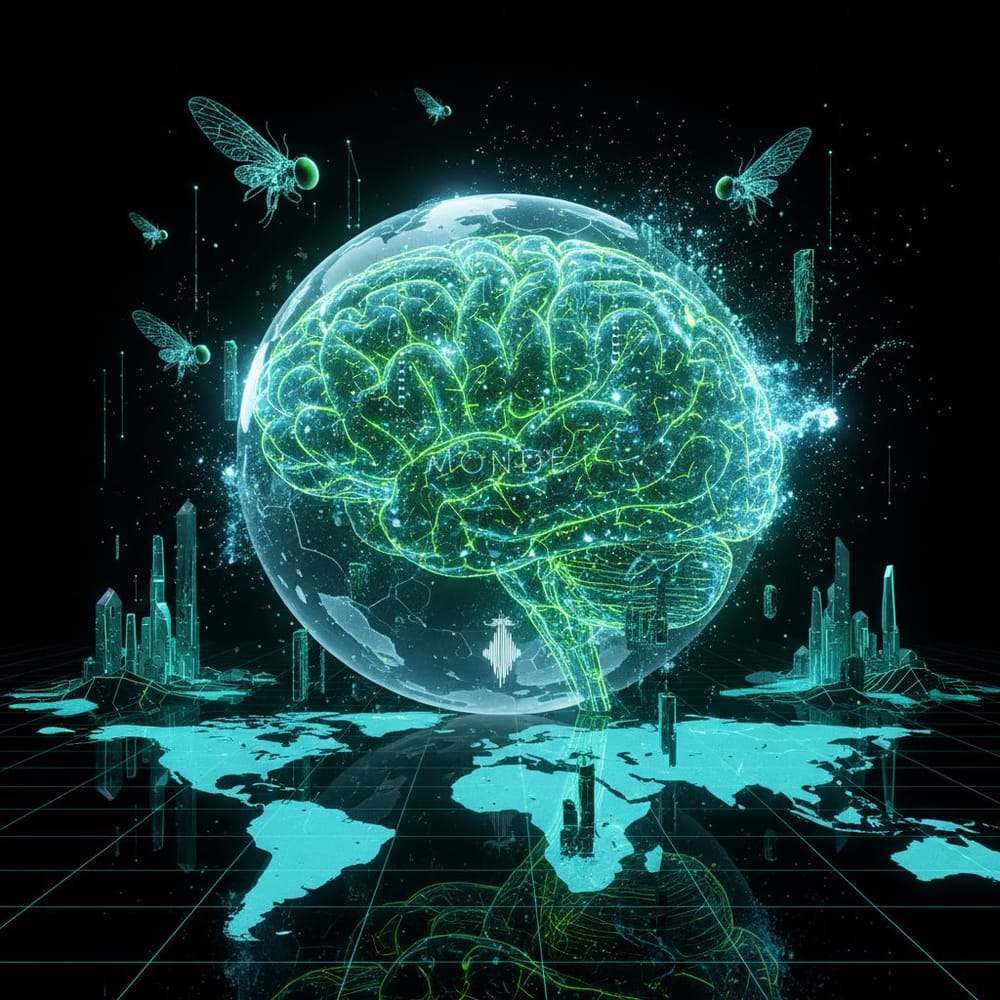
139,255 Neurons and 50 Million Synapses: The First Entire Animal Brain Fully Mapped
The FlyWire Consortium has just completed the comprehensive mapping of the fruit fly brain, mobilizing more than 200 scientists and thousands of citizen volunteers over five years. This first exhaustive neural map of an adult animal brain reveals 4,581 new cell types and demonstrates the unprecedented power of large-scale collaborative science.
The Essentials
- 139,255 neurons and 50 million synapses mapped with nanometer precision
- More than 200 scientists from 76 laboratories across 18 countries collaborated
- 4,581 new cell types identified, multiplying the known typology by 5
- Discovery of neural circuits governing navigation, mate-seeking, and learning
An Unprecedented Scientific Mobilization
Mapping the fruit fly brain required analyzing 21 million electron microscopy images, representing 100 terabytes of raw data. More than 287,000 hours of human labor were devoted to manually tracing neural connections, complementing artificial intelligence algorithms. This mobilization far exceeds the standards of traditional academic research.
The collaborative scope is striking: 76 research laboratories from American, European, and Asian universities coordinated their efforts over five years (2019-2024). Princeton University, Harvard, Cambridge, the Max Planck Institute, and the University of Tokyo are among the flagship institutions. Each team took responsibility for specific brain regions, allowing specialization while maintaining overall coherence.
Citizen participation reached a quantitative milestone. Thousands of volunteers, recruited through dedicated platforms, contributed to tracing the finest neural extensions. This distributed workforce processed connections that artificial intelligence struggled to identify, particularly in areas of complex cellular overlap.
4,581 New Cell Types Reveal Neural Diversity
The inventory exceeded all expectations. Before this project, neuroscientists had identified approximately 800 cell types in the fruit fly brain. The complete mapping reveals 4,581 new types, bringing the total to more than 5,400 distinct categories. This cellular diversity is equivalent to discovering an unexplored neural continent.
Navigation circuits present unexpected complexity. 43 specialized neurons form an internal compass network, integrating visual signals, pheromones, and gravitational cues. These cells communicate via 1,247 precisely located synapses, creating a computational architecture of remarkable sophistication for a brain of 0.1 cubic millimeters.
Mate-seeking mobilizes 187 specialized neuronal types. Males activate 23 distinct circuits to detect receptive females, analyze their genetic compatibility, and adapt their courtship behavior. Females have 34 evaluation circuits for assessing suitors, cross-referencing olfactory, tactile, and behavioral information before acceptance or rejection.
Learning and memory involve 156 interconnected cell types. Dopaminergic neurons, numbering 127, encode rewards and punishments. Mushroom body neurons, grouped into 891 units, store learned associations. This neural architecture explains how a fly remembers dangers, optimizes its routes, and transmits its behavioral knowledge.
Technology at the Service of Nanometer Precision
Automated transmission electron microscopy made this mapping possible. Princeton’s team sliced the brain into 7,062 ultra-thin sections 40 nanometers thick. Each slice was photographed at a resolution of 4 nanometers per pixel, generating images sharp enough to distinguish individual synaptic membranes.
Artificial intelligence processed 90% of the recognition work. Deep learning algorithms, trained on 2.4 million manually annotated images, identified cellular contours and traced neural extensions. These systems achieve 97% accuracy on main structures but struggle with the finest connections where human intervention remains essential.
Cross-validation ensures reliability. Every neural connection was verified by at least three independent annotators. Disagreements, representing 0.3% of cases, were arbitrated by senior experts. This methodology produces an error rate below 0.1%, establishing a quality standard for future connectomes.
Data storage and distribution mobilize dedicated cloud infrastructure. The 100 terabytes of raw images and 15 terabytes of analyzed data are hosted on Amazon Web Services servers. Free access allows researchers worldwide to explore the map without restrictions, accelerating derivative discoveries.
Behavioral Circuits of Unexpected Sophistication
Functional analysis reveals advanced computational mechanisms. The motion detection circuit involves 847 specialized neurons, each sensitive to specific speeds and directions. This architecture allows the fruit fly to distinguish rapid predators from potential mates or static obstacles in less than 50 milliseconds.
Hunger neurons form a network of 234 interconnected cells. These neurons modulate appetite according to energy reserves, circadian rhythm, and food availability. When glucose reserves drop, 67 neurons activate simultaneously to trigger nutritional search behaviors while inhibiting energy-costly reproductive activities.
The reward system surpasses theoretical models. 89 dopaminergic neurons form four distinct circuits: nutritional rewards, reproductive success, danger avoidance, and social learning. Each circuit uses specific combinations of neurotransmitters, creating chemical signatures allowing the brain to distinguish types of satisfaction.
Social behaviors emerge from interaction among 456 specialized neurons. Female fruit flies lay their eggs in groups to optimize larval survival, a behavior directed by 78 neurons sensitive to aggregation pheromones. Males adjust their territorial aggression according to local population density, a mechanism orchestrated by 123 neurons detecting chemical signals.
Medical Applications Transform Neurological Research
This mapping accelerates the identification of therapeutic targets. 67% of fruit fly neuronal genes have direct human equivalents, making the fly a relevant model for studying brain pathologies. Researchers are already identifying dysfunctional circuits in fruit fly models of Parkinson’s, Alzheimer’s, and schizophrenia.
Parkinson’s disease finds striking parallels. The 127 dopaminergic neurons of fruit fly degenerate according to patterns similar to affected human neurons. This homology allows testing neuroprotective therapies over weeks rather than years, accelerating treatment development.
Autism benefits from new insights. 234 genetic mutations associated with autism spectrum disorders in humans affect homologous neural circuits in fruit flies. Precise mapping of these circuits will allow understanding how mutations disrupt neural communication and developing targeted interventions.
Sleep disorders find refined study models. 89 neurons regulate circadian cycles in fruit flies, with molecular mechanisms conserved in humans. This evolutionary conservation validates using flies to test chronotherapies and optimize insomnia treatments.
Collaborative Science Redefines Research Standards
This project establishes a new paradigm for international research. Coordinating 76 laboratories without centralized hierarchy demonstrates that truly collaborative science can surpass traditional approaches. Teams shared data, methodologies, and results in real time, eliminating duplications and accelerating discoveries.
Developed tools transform other projects. Neural tracing algorithms, optimized for fruit flies, now adapt to mouse and primate brains. This technology will fuel larger-scale neural mapping projects.
Citizen participation opens unprecedented perspectives. Volunteers trained on this project develop expertise in computational neuroscience, creating a pool of contributors for future brain mappings. This democratization of research could significantly accelerate the pace of global neuroscientific discoveries.
Data transparency revolutionizes scientific access. The entire mapping is freely accessible via interactive web interfaces. This openness allows laboratories with limited budgets to exploit data as rich as the best-funded institutions, reducing research inequalities between institutions.
The success of this complete connectome validates the technical feasibility of mammalian brain mappings. Teams are already preparing the mouse brain, multiplying neural complexity by 1,000. If this collaborative approach maintains its effectiveness, mapping the human brain could become feasible within fifteen years, ushering in an era of precision neural medicine.