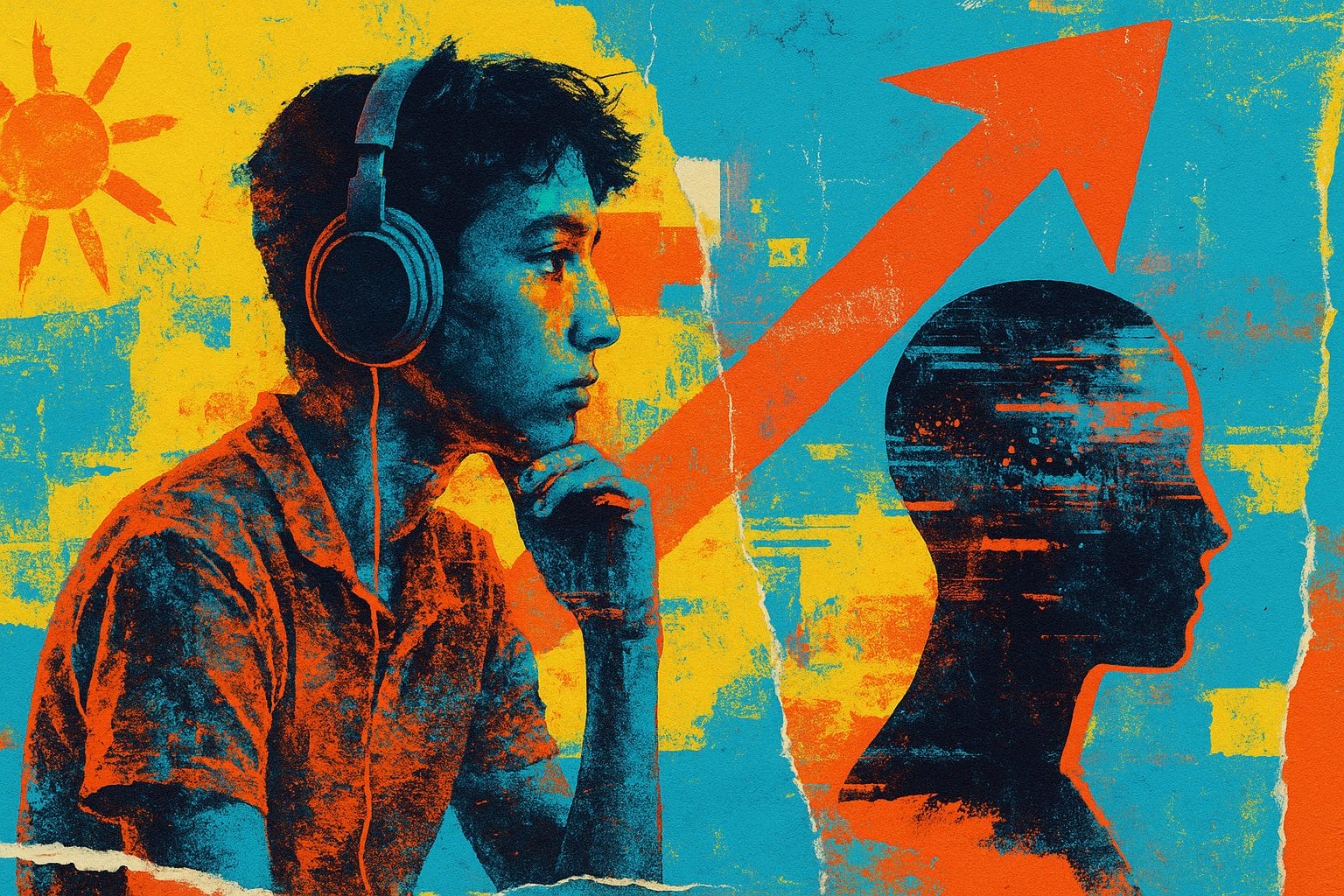
A 10-point average decline in reading comprehension between 2018 and 2022 across OECD countries. This historic collapse—the most brutal drop since PISA testing launched—reveals a cognitive crisis whose consequences extend far beyond education. Andreas Schleicher, OECD’s director of education, states it plainly: the competencies atrophying fastest are precisely those humanity will need most when facing artificial intelligence.
Long-form reading—that capacity to navigate ambiguity and distinguish fact from fiction across multiple pages—becomes a political act in an era of algorithms that pre-digest information. The next PISA results, expected on September 8, 2026, will tell us whether this erosion accelerates or begins to stabilize.
The Essential Points
- Historic 10-point decline in reading comprehension between 2018 and 2022 across the OECD, the steepest drop ever measured
- The decline began between 2012 and 2015, well before the pandemic, affecting most developed nations
- 44% of American adults read no books in 2023, compared to 52.7% of readers in 2017
- Audiobooks are exploding globally: +13% in the United States, 25% annual growth projected for 2022-2032
The Decline Precedes the Pandemic and Touches Every Continent
The collapse in reading competencies did not begin with Covid-19. Analysis of PISA data reveals the deterioration started between 2012 and 2015 in most OECD countries. Finland, long the world’s educational model, lost 21 points in reading between 2009 and 2022. Australia, New Zealand, and Iceland follow with declines of 15 to 18 points over the same period.
This universal quality of the phenomenon rules out national explanations. Neither specific pedagogical reforms nor local budget cuts can explain a movement so synchronized. The common factor: the massive arrival of smartphones and social networks in adolescents’ daily lives between 2010 and 2015.
Andreas Schleicher clarifies that students are losing their capacity to process long and complex texts above all. “Young people still read, but they read differently,” he explains. “They skim, they scan, they search for quick answers. They’re losing the habit of immersing themselves in reasoning that unfolds across multiple pages.”
Adults Massively Abandon Book Reading
The American Time Use Survey documents the scale of the shift among American adults. In 2017, 52.7% of Americans had read at least one book during the year. Six years later, the figure reverses: 44% touched no books in 2023. Daily newspaper reading collapses in parallel, dropping from 16% of the population in 2017 to 8% in 2023.
This disaffection crosses all social groups but hits particularly hard those aged 18-29. Only 31% of young adults still read books, compared to 48% in 2017. Higher education graduates resist better—67% still read—but their reading rate also declines by 7 points over six years.
The freed-up time doesn’t shift to other cultural activities. It migrates to screens: video streaming, social networks, video games. Average daily screen time for Americans reached 7 hours 4 minutes in 2023, a progression of 86 minutes since 2017. The inefficiency of Western educational systems already revealed this unfair competition between sustained learning and immediate gratification.
Audiobooks Explode While the Written Word Erodes
Apparent paradox: while reading collapses, audiobooks experience spectacular growth. The American market advances 13% in 2023, reaching 2 billion dollars. Globally, analysts forecast 25% annual growth between 2022 and 2032, taking the market from 6.8 to 67 billion dollars.
This explosion masks a profound cognitive transformation. Listening mobilizes different neural circuits from visual reading. It privileges linearity at the expense of exploration, passive absorption over critical analysis. The listener cannot easily go back, highlight, annotate, compare distant passages.
Neuroscience confirms these differences. Visual reading powerfully activates the prefrontal cortex, the brain region associated with complex reasoning and planning. Listening engages auditory areas and sequential memory more. Ruth Ozeki, novelist and neurologist, summarizes: “Listening to a book is submitting to a story. Reading it is constructing it.”
Audiobook platforms encourage this passivity. Amazon’s Audible offers 20-minute summaries for 300-page works. Blinkist chops non-fiction books into 15-minute “blinks.” These services transform reading into rapid consumption of pre-digested ideas.
Critical Thinking Atrophies Against Algorithms
Andreas Schleicher identifies three rapidly declining competencies that concern the OECD: the capacity to evaluate a source’s credibility, the ability to recognize an author’s biases, and the endurance needed to follow complex reasoning across multiple chapters.
These capacities become crucial in the era of generative AI. ChatGPT, Gemini, and their competitors produce fluent but potentially erroneous texts. They blend verified facts and hallucinations with equal confidence. Only an exercised reader can detect inconsistencies, verify sources, question assumptions.
The example of AI-industrialized disinformation illustrates the urgency. Automated content farms produce millions of articles daily. They exploit precisely the weakening of cognitive defenses documented by PISA: inability to verify a source, tendency to accept information confirming one’s biases.
The 2022 PISA tests reveal that 75% of 15-year-olds cannot distinguish a fact from an opinion in an argumentative text. This percentage rises to 85% when the text mixes verified information and unsourced assertions. “We are training a generation incapable of resisting algorithmic manipulation,” Schleicher warns.
The Attention Economy Destroys Deep Reading
The collapse of long-form reading reflects a broader reorganization of the attention economy. Digital platforms optimize their algorithms to maximize engagement time, privileging short and stimulating content. TikTok limits videos to 10 minutes. Twitter reduces messages to 280 characters. Instagram favors images over text.
This economic logic shapes cognitive habits. The brain adapts to frequent and immediate rewards. It progressively loses its capacity to tolerate the sustained and deferred effort that long-form reading demands. Neuroscientists speak of “addiction to micro-dopamines”: each like, each notification, each new piece of content releases a small dopamine hit that creates dependence on rapid stimulation.
Nicholas Carr, author of “The Shallows,” has documented this transformation since 2010: “The Internet is transforming our brains into surfing machines rather than deep-diving tools.” Brain MRI scans confirm his intuitions. In heavy internet users, zones associated with sustained attention show reduced activity, while circuits for compulsive searching hypertrophy.
Publishers adapt to this evolution. Books are shortening: the average length of a commercial novel drops from 120,000 words in 2000 to 80,000 in 2023. Publishing houses develop “quick reading” collections and multiply practical guides structured around key points. Malcolm Gladwell, master of accessible non-fiction, sells 2 million copies per title while academic essays struggle to exceed 5,000 sales.
Citizens Lose Critical Reading Skills
This cognitive crisis profoundly transforms citizens’ relationship with complex information. The capacity to analyze multifactorial issues, weigh contradictory arguments, resist excessive simplification erodes with the abandonment of long-form reading.
Recent political history illustrates the consequences of this evolution. The British Brexit played out through 3-word slogans (“Take Back Control”) against 400-page economic analyses that no one read. The election of Donald Trump in 2016 and 2024 privileged punchy tweets over detailed programs. In France, public debates increasingly reduce to 30-second talking points adapted to television constraints.
Polls confirm this simplification of public debate. A growing share of Americans declares forming their political opinions principally through social networks, while a minority still relies on reading newspapers or books. This proportion marks a complete reversal compared to habits from the early 2000s.
Germany and Scandinavian countries resist better thanks to their reading traditions and robust public media. But even there, young voters show signs of disengagement. In Germany, 43% of 18-25-year-olds declare never reading press articles longer than 500 words.
2026 Will Tell If the Trend Accelerates or Stabilizes
The next PISA results, published September 8, 2026, will constitute a major test. They will measure the full impact of smartphone generalization and generative AI on reading competencies. Andreas Schleicher anticipates three scenarios.
The first, pessimistic, sees the collapse accelerating. Students born after 2008, who have never known a world without smartphones, could show even more marked deficits. Generative AI, democratized since 2022, could have finished absolving students from the effort of reading and analysis.
The second scenario, more optimistic, bets on adaptation. Certain educational systems would have integrated digital tools without abandoning long-form reading. South Korea and Singapore are testing hybrid approaches: using AI to personalize learning, while maintaining strong requirements in critical reading.
The third scenario bets on awakening. Facing the drifts of disinformation and polarization, parents and teachers would have rediscovered the importance of deep reading. Some signals are emerging: paperback book sales resist in the United States, “digital detoxes” multiply, certain schools ban smartphones.
The stakes extend beyond education. They concern societies’ capacity to maintain rational public debate in the AI era. Algorithms can optimize information production, but only exercised citizen-readers can distinguish knowledge from manipulation, nuance from propaganda. Without this competency, societies risk sinking into algorithmic post-truth.