Introduction
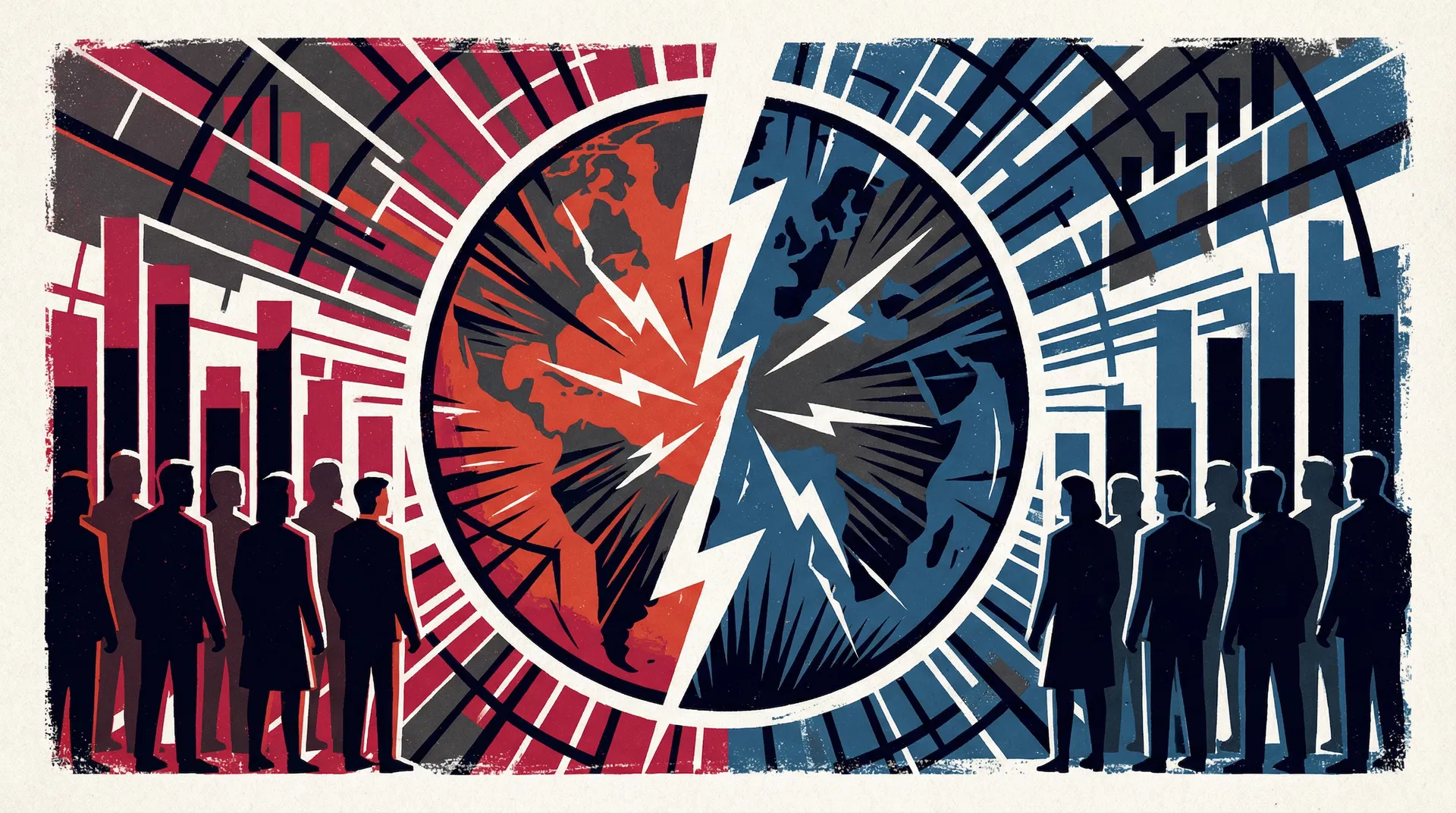
Liberal democracy is going through a profound crisis. According to the 2025 report from the V-Dem Institute (Varieties of Democracy), based at the University of Gothenburg, the level of democracy has been declining worldwide for the seventh consecutive year, returning to its 1986 level. For the first time in two decades, there are more closed autocracies (33) than liberal democracies (32). At the heart of this wave of autocratization, a particularly corrosive phenomenon is eating away at societies from within: toxic political polarization. This is no longer the healthy confrontation of ideas that animates democratic debate, but a deep division of society into hostile camps, where the perception of the other shifts from adversary to enemy. This dynamic, fueled by social, media, and economic mechanisms, paralyzes public action, erodes trust in institutions, and paves the way for authoritarian regimes. The V-Dem 2025 report highlights the extent of this trend, with established democracies like the United States reaching levels of polarization deemed critical. Faced with this observation, this article aims to analyze the mechanisms of this fragmentation, study the strategies of countries that, like Portugal, New Zealand, or Finland, have managed to reverse the trend, and examine concrete institutional solutions to rebuild constructive political dialogue.
Polarization in figures: a global rise with striking examples
V-Dem's political polarization index, which measures society's division into hostile political camps, reveals a global trend toward worsening. The United States displays a score of 2.3 in 2025, a level deemed critical and unprecedented for an established democracy. This value reflects a society where political debate has given way to deep animosity, where the opposition is perceived as an enemy to be defeated rather than a legitimate adversary. France, with an index of 1.43, is also in a zone of high polarization, witnessing a growing fragmentation of its political and social landscape. These figures are not mere abstractions; they embody tangible realities: increasingly acrimonious public debates, a loss of trust in institutions, and increased difficulty in forming consensus to respond to collective challenges.
The engines of division: autopsy of polarization mechanisms
The echo chambers of social networks
The very design of social media platforms, optimized to maximize user engagement, is a powerful accelerator of polarization. Recommendation algorithms, which personalize content feeds, create "filter bubbles" and "echo chambers" by privileging information that reinforces users' preexisting opinions. A Pew Research Center study showed that social media users are less likely to be exposed to political opinions different from their own. This selective and repeated exposure to a single type of discourse not only reinforces convictions but can also lead to a caricatured and hostile view of divergent opinions. The speed and virality of information on these networks, where emotional, shocking, or outrageous content is more likely to be shared, favors the spread of disinformation and hate speech, at the expense of factual and nuanced analysis. The design of these platforms, by encouraging quick and affective reactions (likes, shares) rather than reflection, contributes to transforming public debate into an arena of sterile confrontations.
Media fragmentation and the rise of partisan media
The transformation of the traditional media landscape has also played a major role. The erosion of the press's economic model, based on mass advertising, and audience fragmentation have pushed many media outlets to position themselves in ideological niches to retain a specific audience. In the United States, the rise of openly partisan continuous news channels like Fox News and MSNBC has created parallel and hermetic information ecosystems. A Stanford University study revealed that Americans who primarily get their news from just one of these channels have a much more negative view of the opposing party. This phenomenon of "selective sorting" of information, where citizens choose sources that confirm their biases, is aggravated by the disappearance of major unifying media that once offered a common foundation of information. In France, although the phenomenon is less pronounced, the rise of opinion channels and "re-information" sites also contributes to this fragmentation of the public space and the consolidation of exclusive political identities.
Economic inequality, breeding ground for political discord
Rising income and wealth inequality constitutes a powerful driver of polarization. When entire segments of the population feel declassed, excluded from the fruits of growth and deprived of future prospects, a sense of injustice and resentment sets in. This fertile ground is exploited by populist political entrepreneurs who designate scapegoats (elites, immigrants, minorities) and stoke divisions. Competition for resources perceived as scarce exacerbates identity and cultural tensions, which overlap with economic divisions. Polarization then becomes the political expression of a society fractured on the socio-economic level, where the feeling of downward mobility fuels mistrust toward institutions and adherence to radical discourse.
The counter-models: these countries that reverse the trend
The case of Portugal
While many democracies sink deeper into polarization, Portugal offers a notable counter-example. After the 2011 financial crisis and the austerity cure imposed by the troika, the country experienced a strong rise in social and political tensions. However, from 2015, the formation of a left-wing government supported by an unprecedented parliamentary alliance (the "geringonça") managed to reverse the trend. This coalition implemented redistribution policies, salary and pension revaluation, and restoration of public services. These measures, combined with political discourse focused on compromise and inclusion, helped reduce the feeling of declassification and appease public debate. Portugal shows that a political response focused on reducing inequalities and cooperation can be an effective antidote to polarization.
The case of New Zealand
New Zealand, under Jacinda Ardern's leadership, also offered an example of political management aimed at reducing social fractures. Faced with major crises like the 2019 Christchurch attack and the Covid-19 pandemic, the Prime Minister adopted a communication style based on empathy, compassion, and calls for unity. Her "They are us" speech after the attack made an impression by refusing division and affirming the Muslim community's belonging to the New Zealand nation. This approach, called the "politics of kindness," sought to depolarize public debate by focusing on common values and solidarity. While polarization has not disappeared, this leadership style showed that it was possible to manage crises without stoking hatred and while strengthening social cohesion.
The case of Finland
Finland, recognized for the robustness of its education system, has bet on media and information literacy to strengthen its resilience against polarization and disinformation. Aware that media literacy is an essential civic skill in the 21st century, the country has integrated this teaching at all levels of the school curriculum, from kindergarten to high school. The objective is to train critical citizens, capable of deconstructing media messages, identifying reliable sources, spotting manipulation attempts, and understanding online communication mechanisms. This proactive approach, which aims to "vaccinate" the population against fake news, is considered a model on an international scale. By investing in the cognitive capital of its citizens, Finland is betting that a better-informed and more critical population is less likely to fall into the traps of polarization.
Toward institutional solutions: rebuilding dialogue
Beyond conjunctural political responses and educational initiatives, fundamental institutional reforms can help reduce structural polarization. These solutions aim to modify the rules of the political game to encourage compromise, representation of diverse opinions, and more peaceful public debate.
Reforming electoral systems to encourage consensus
The majoritarian voting system, in effect in countries like the United States or the United Kingdom, tends to exacerbate polarization by creating a two-party system where competition is a zero-sum game. Conversely, proportional representation systems, by allowing a greater diversity of parties to be represented in parliament, favor coalition formation and a culture of compromise. Reforms like introducing a dose of proportionality or ranked-choice voting, which allows voters to rank candidates in order of preference, can encourage candidates to seek support beyond their electoral base and moderate their discourse.
Developing deliberative democracy to recreate connections
Faced with mistrust toward representative institutions, deliberative democracy mechanisms, such as citizens' conventions or citizens' juries, offer a promising path. By bringing together a representative sample of the population to deliberate on a complex subject after hearing experts and stakeholders, these devices allow for recreating a space of respectful and informed dialogue. Experience shows that citizens with initially opposing opinions can evolve their viewpoints and reach enlightened consensus. These processes do not replace representative democracy, but they can usefully complement it, particularly on divisive subjects, and contribute to restoring trust.
Regulating digital platforms for a healthier public space
Letting digital giants dictate the rules of public debate is no longer tenable. Stricter regulation of platforms is essential to limit the spread of disinformation and hate speech, and to reduce the opacity of recommendation algorithms. Regulatory avenues include mandatory transparency on algorithm functioning, independent auditing of their impacts on society, and greater platform responsibility for the content they host and promote. The objective is not to censure, but to create a digital environment that favors quality public debate and protects democracy.
Conclusion
Political polarization is not inevitable. While the current trend, illustrated by the alarming figures from the V-Dem report, is cause for concern, the examples of Portugal, New Zealand, or Finland prove that solutions exist. These counter-models, each in their own way, show that the fight against polarization requires resolute action on several fronts: reducing socio-economic inequalities, political leadership that prioritizes unity over division, and massive investment in education and critical thinking. Institutional solutions, whether reforming voting methods, developing deliberative democracy, or regulating digital space, are also powerful levers for rebuilding peaceful dialogue and a culture of compromise. Emerging from the era of polarization requires collective awareness and commitment from all actors: governments, political parties, media, digital platforms, and citizens. It is at this price that our democracies will be able to overcome one of the most serious threats weighing on them.
References
-
- V-Dem Institute, Democracy Report 2025
-
- Pew Research Center, "Social Media and News Fact Sheet"
-
- Stanford University, "Polarization, Partisanship, and Voter-Media Relations"
-
- SGI 2024 | New Zealand | Consensus-Building
-
- EAVI, "Finnish National Curriculum on Media Literacy: A Global Best Practice"
- Receive Journal analyses directly in your mailbox.
- China's CO2 emissions fell by 0.3% in 2025. It's a modest figure. But it extends a trend that has lasted 21 consecutive months: since March 2024, emissions from the world's largest polluter have been "stable or declining."
- Does AI destroy jobs? Two studies published in March 2026 — one by Harvard Business School, the other by Anthropic — provide the first solid empirical data. And the answer is more nuanced than public debate suggests.
- Malaria killed 608,000 people in 2022, 95% of them in sub-Saharan Africa and 78% children under five. And for the first time, a vaccine deployed on a large scale shows measurable results in the field.
- Having the desire to be 20 years old today. An independent media that documents progress with rigor, without naivety or catastrophism.
- Structured reading sheets: central thesis, key arguments, limitations, and verdict.
- JdP is an independent editorial project based on data, counter-narratives, and lucid optimism. Each article is sourced, nuanced, and open to discussion.
- Le Journal d'un Progressiste uses cookies to improve the reading experience and understand how the site is used. No data is collected for commercial, advertising, or resale purposes. Cookies necessary for site operation are always active. Optional cookies are only activated with your explicit consent, in accordance with GDPR.