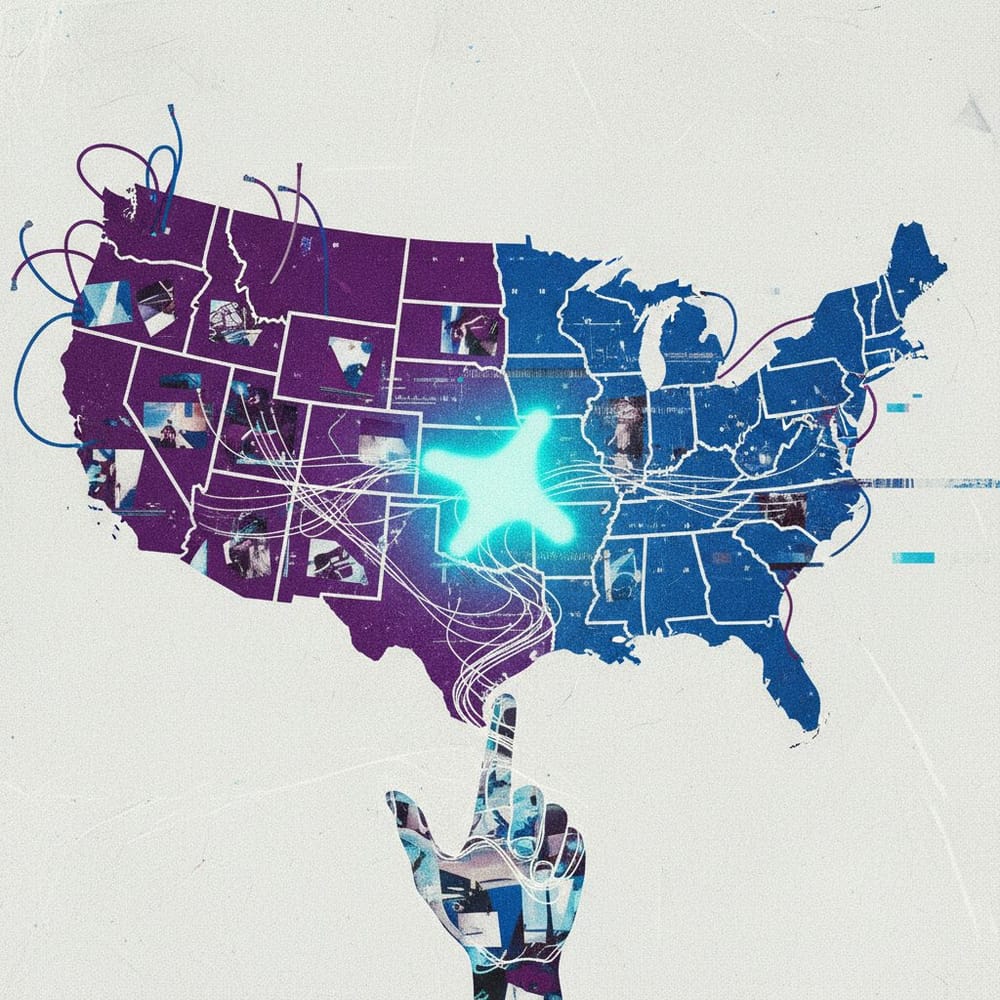
On December 11, 2025, the Trump administration signed an executive order creating a federal task force dedicated to challenging laws from the 50 American states considered obstacles to artificial intelligence development. This centralization comes after a record year in which states introduced 1,208 bills related to AI, with 145 adopted. The federal offensive aims to unify AI regulation but raises major constitutional tensions over the division of powers.
The Federal Task Force Mobilizes the Department of Justice
The Attorney General has 30 days to establish an “AI Litigation Task Force” whose sole responsibility will be to challenge state AI laws deemed incompatible with federal policy. This task force will focus on laws estimated to be unconstitutional regarding interstate commerce, preempted by existing federal regulations, or otherwise illegal. It could challenge laws banning algorithmic bias on First Amendment grounds, arguing that AI model outputs constitute protected expression.
The Secretary of Commerce must publish within 90 days an assessment of existing state laws, identifying those deemed “burdensome” and in conflict with national policy, particularly those that require models to alter their truthful results or impose disclosures violating the Constitution. This assessment will flag specific laws for referral to the Department of Justice’s task force.
Colorado and California in the Federal Crosshairs
The executive order explicitly cites Colorado, stating that its law “banning ‘algorithmic discrimination’ may even force AI models to produce false results to avoid ‘differential treatment or impact’ on protected groups.” Colorado’s law, which takes effect June 30, 2026, requires developers to use reasonable care to protect consumers against known risks of algorithmic discrimination. The law establishes a rebuttable presumption of reasonable care when specified practices are followed.
Colorado defines algorithmic discrimination as any condition where the use of an AI system results in differential treatment of an individual based on age, color, disability, ethnic origin, genetic information, limited English proficiency, national origin, race, religion, reproductive health, sex, veteran status, or any other protected classification. Violations are punishable by fines up to $20,000 per violation.
California also adopted SB 53 in September 2025, a scaled-back version of the previously vetoed SB 1047 law. This “Frontier Artificial Intelligence Transparency Law” shifts the emphasis from strict safety requirements to greater transparency, requiring developers to publicly share their security protocols. Governor Gavin Newsom signed a set of 18 AI laws, making California the first U.S. state to establish comprehensive AI governance.
Federal Funding as Leverage
The executive order uses federal funding levers to influence states’ regulatory choices. States with “burdensome” AI laws identified in the Commerce Department’s assessment will be ineligible for remaining non-deployment funds from the BEAD (Broadband Equity, Access, and Deployment) program to the maximum extent permitted by federal law.
The executive order directs all executive departments and agencies to determine whether they can condition discretionary grant programs on states not adopting or enforcing AI laws deemed inconsistent with federal policy. This financial approach recalls federal tactics used to influence other state policy areas.
The Legislative Explosion at the State Level Defies Centralization
State legislative activism has intensified dramatically: fewer than 200 AI bills in 2023, over 600 in 2024 with nearly 100 adopted, and 1,208 bills introduced across the 50 states in 2025. In 2025, for the first time, every state introduced at least one AI-related bill.
Data from the National Conference of State Legislatures (NCSL) confirms that 38 states adopted or enacted approximately 100 AI-related measures in 2025. California remains the most active state in AI regulation, enacting 24 AI-related laws during the 2024 and 2025 legislative sessions.
Between 2023 and 2025, the Future of Privacy Forum identified 27 AI laws enacted in 14 states that impose obligations on private sector AI developers or deployers, covering frontier model transparency, algorithmic discrimination, employment, health, and deepfakes. Only a few, notably in Colorado, California, Texas, New York, and Utah, constitute broad cross-sector AI governance frameworks.
European Companies Show an Alternative Path
Paradoxically, European companies that adopt AI hire more according to the ECB, suggesting that strict regulation does not necessarily hinder innovation. This European dynamic offers a counterexample to the Trump administration’s arguments that state regulations paralyze technological development.
The executive order’s directives raise complex constitutional questions that will likely lead to prolonged litigation and uncertainty for market actors. The executive order’s reliance on federal agencies to establish standards aimed at preempting state law raises questions about whether there is sufficient statutory authority for such preemption, and whether the executive branch is overstepping its constitutional role.
Companies must continue to comply with state AI laws until there is more clarity. The governors of California, Colorado, and New York have issued statements indicating that the executive order will not prevent them from enforcing their AI statutes. This state resistance signals a major federalist conflict that will play out in courts over the coming years.