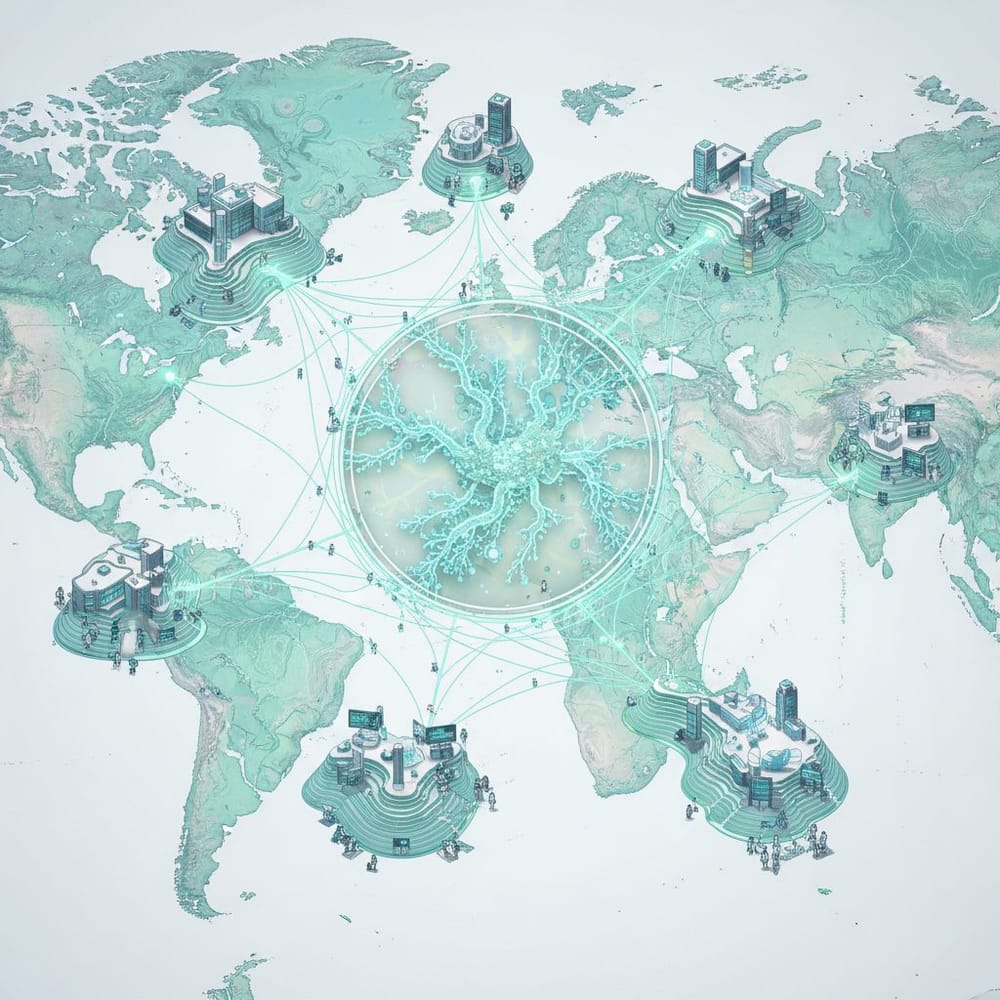
600 emergency health experts from 26 countries and territories gathered on April 22 and 23 for Exercise Polaris II, a two-day simulation centered on an epidemic of a fictional bacterium spreading worldwide. This exercise reveals a shift in global health preparedness: following the failures of Covid-19, the WHO is betting on a collaborative and decentralized approach rather than centralized authority. This comes at a time of urgency, as one in six bacterial infections now resists standard antibiotics and resistance is intensifying.
The exercise concretely tested whether countries can coordinate their responses to a bacterial pandemic. Antimicrobial resistance directly kills 1.27 million people annually and contributes to 4.95 million additional deaths worldwide.
The WHO Abandons Centralized Authority for Horizontal Collaboration
Exercise Polaris II demonstrated what coordinated preparedness looks like between countries ready to act together, according to Dr. Chikwe Ihekweazu, executive director of WHO’s Health Emergencies Program. This approach reflects the spirit of the Global Health Emergency Corps: an organized, trained, coordinated and connected emergency workforce, ready to intervene where and when necessary.
This strategy marks a departure from the failures of Covid-19. The pandemic revealed troubling deficiencies in multilateral arrangements for global health security, notably a lack of coordination between nations and a breakdown in compliance with established norms and international agreements. This pandemic was characterized by a mosaic of inadequate national responses and a disastrous lack of cooperation and coordination between nations.
The Global Health Emergency Corps was created by the WHO in 2023 in response to the gaps and challenges identified during the Covid-19 response. It supports countries facing public health emergencies by assessing the capacities of their emergency personnel, rapidly deploying additional support, and creating a network of emergency leaders from multiple countries to share best practices and coordinate responses.
A Fictional Bacterium to Test Real Mechanisms
Building on the success of Polaris I held in April 2025 and centered on a fictional virus, each participating country activated its emergency coordination structure and worked under real conditions to share information, align policies, and mobilize personnel.
The simulation put into practice two key WHO frameworks: the Global Health Emergency Corps framework and the national framework for health emergency alert and response. The GHEC framework, published in June 2025, provides guidance on how countries can strengthen their health workforce to respond to emergencies based on the principles of sovereignty, equity, and solidarity.
Edenilo Filho, director of the public health emergencies department at Brazil’s Ministry of Health, emphasizes that simulating the spread of a dangerous pathogen under real conditions helped transform existing plans into action. It is not enough to have plans on paper; what matters is their performance in practice.
Antimicrobial Resistance Transforms the Pandemic Equation
The choice of a fictional bacterium is not insignificant. 39 million people are projected to die from antimicrobial resistance between 2025 and 2050, or three deaths per minute according to projections based on 204 countries and territories. Deaths related to antimicrobial resistance are expected to increase by nearly 70% by 2050 compared to 2022, continuing to disproportionately affect older people.
Antimicrobial resistance is truly one of the most urgent, complex, and frightening health challenges of our time. In the Western Pacific region, up to 5.2 million people could die from resistant bacterial infections between 2020 and 2030. Globally, nearly five million deaths in 2019 were associated with bacterial resistance, with almost 1.3 million deaths directly attributed to resistant infections.
The findings reveal growing resistance to antimicrobials of critical importance, with all key pathogens except one classified by the WHO as the most difficult to treat, causing more deaths in 2022 than in 1990. Deaths from methicillin-resistant Staphylococcus aureus (MRSA) have increased the most globally, directly causing 130,000 deaths in 2021, more than double the 57,200 in 1990.
This situation challenges traditional pandemic preparedness strategies, which still largely focus on viruses. While current national and global attention concentrates on the ongoing management of Covid-19 and preparedness for the possibility of another viral pandemic, the next large-scale epidemic or pandemic could be caused by a resistant bacterial pathogen. Historically, bacteria have been responsible for some of the deadliest pandemics.
25 Partner Organizations Test Multilateral Coordination
The exercise strengthened coordinated technical support from more than 25 health organizations at different levels, including the African Centers for Disease Control and Prevention, the International Federation of Red Cross and Red Crescent Societies, Médecins Sans Frontières, the Robert Koch Institute, UK-Med, and UNICEF. Others include emergency networks such as the Global Outbreak Alert and Response Network and the Emergency Medical Teams initiative.
The second edition of the exercise saw a larger number of countries participate and collaborate through new networks such as the recently launched Health Emergency Leaders Network for Africa and the Eastern Mediterranean. This expansion responds to deficiencies observed in preparedness for other global health threats.
WHO Director-General Tedros Ghebreyesus stated that the exercise demonstrates the power of collective action. He said that global cooperation is not optional, it is essential. This is the purpose of the Global Health Emergency Corps: coordination, strengthening trust, stronger connections, and united work across borders.
Mixed Results Six Years After Covid-19
Six years after the declaration of a health emergency for Covid-19, the WHO poses the question: is the world better prepared for the next pandemic? The answer is yes and no. Yes, in many respects, the world is better prepared because concrete and significant measures have been taken to strengthen preparedness. However, no, because progress made is fragile and uneven, and much more remains to be done to safeguard humanity.
Progress remains uneven. Recent responses to Ebola and Marburg epidemics demonstrate how these investments translate into concrete impact. Compared to past epidemics, recent epidemics were detected earlier, contained faster, and resulted in fewer deaths, largely thanks to stronger national leadership supported by the WHO and its partners.
Several countries that played a leading role in implementing the Global Health Security Agenda, notably Finland, South Korea, and Uganda, are among the nations that responded most effectively to the coronavirus pandemic. These examples illustrate that upstream preparedness makes a difference, unlike the failures observed in other contexts.
The Future Depends on Continuity of Effort
Exercise Polaris II is part of HorizonX, the WHO’s forward-looking and multi-year simulation exercise program. It provides a vital platform for operationalizing and practicing emergency frameworks under real conditions, ensuring that collective preparedness is not a periodic effort, but a continuous investment in global health security.
The WHO warns that these gains are in danger. Shifting political priorities and declining health funding threaten the sustainability of preparedness systems, despite the fact that pandemics pose obvious national security risks. The WHO calls on governments and partners to maintain momentum, continuously invest in prevention and preparedness, and strengthen global cooperation.
Exercise Polaris II reveals that the question is no longer whether a bacterial pandemic will strike, but when and with what magnitude. Pathogens do not respect borders. No country can prevent or manage a pandemic alone. Global health security requires collaboration across sectors, between governments, and across regions. Between fragmented investments and systemic cooperation, the choice will determine whether humanity can confront the next major health crisis.