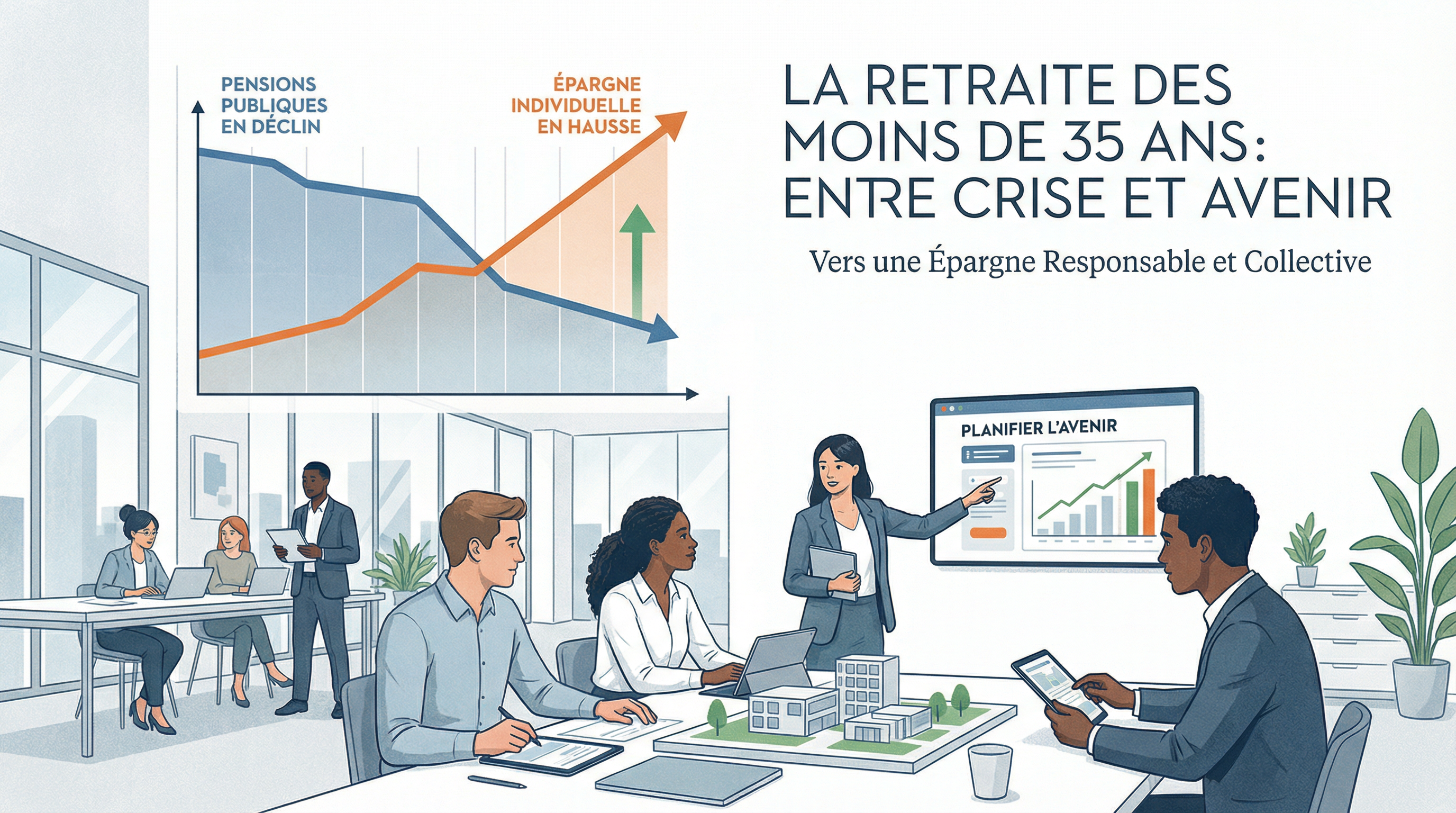
Under 35, Prepare Your Retirement—The State Won't Do It for You
Lead: The pay-as-you-go pension system faces demographic aging, declining birth rates, and structural deficits. For those under 35, the pension paid by the state will be insufficient to maintain their standard of living at the end of their working life. Projections from the Pension Advisory Council (COR) and INSEE document this phenomenon. Analyzing demographic and financial data allows us to measure the scale of the deficit. Understanding this mechanism enables organizing one's financial future through individual capitalization and savings.
The Demographic Equation
The pay-as-you-go pension system was designed after World War II, in a context of high birth rates and shorter life expectancy. This model relied on a broad base of active workers to finance retiree pensions. INSEE data published in January 2026 shows a major demographic paradigm shift [1]. For the first time since 1945, France recorded a negative natural balance: the number of deaths exceeds the number of births on national territory.
In 2025, 645,000 births were recorded, a 24% decrease compared to 2010. The fertility rate stands at 1.56 children per woman, its lowest level in a century [1]. This demographic evolution structurally modifies the age pyramid. The current decline in births mathematically reduces the number of future contributors. The RSVP podcast, in the episode "You Won't Have a Retirement (Politicians Are Lying to You)," indicates that declining birth rates, increasing numbers of retirees, and rising life expectancy exert direct pressure on the system's financial balance [2].
Life expectancy reaches 85.9 years for women and 80.3 years for men [1]. Retirees receive their pension for a longer duration. The average retirement duration increased from 15 years in the 1970s to over 25 years today. The extension of life expectancy at 60 is continuous: a 60-year-old woman today has a life expectancy of 27.5 years, and a man 23.2 years. This extension increases the overall cost of the pension system. In parallel, young people's later entry into the job market, due to extended studies, delays the start of contributions. The average age of first stable employment now stands beyond 23 years. The contribution period contracts while the pension reception period extends. The accounting imbalance intensifies at both ends of working life.
These two factors, declining birth rates and rising life expectancy, modify the demographic dependency ratio. In 1960, the system counted 4 contributors for one retiree [3]. In 2023, this ratio stands at 1.8 contributors per retiree, with 30.4 million contributors for 17.2 million retirees. The Pension Advisory Council (COR) projects a ratio of 1.4 contributors for one retiree in 2050 [4]. The financial burden per active worker mechanically increases as the ratio deteriorates. To compensate for this deterioration, the system requires either increased revenue or decreased expenses.
Reforms and Persistent Deficit
Governments have conducted several reforms over thirty years to adjust system parameters. From the Balladur reform of 1993 to the Borne reform of 2023, the method has consisted of extending contribution duration and postponing the legal retirement age [5].
The Balladur reform based the reference salary calculation on the 25 best years, compared to 10 previously. This mathematical modification lowers the average salary retained, since less well-paid years are integrated into the calculation. It also indexed pensions on price evolution rather than salary evolution. Since salaries generally progress faster than inflation, this de-indexation reduces retirees' purchasing power relative to active workers. The Fillon reform of 2003 aligned civil servants' contribution duration with that of the private sector (from 37.5 years to 40 years) and extended the overall contribution duration toward 41 years. It also created penalty and bonus mechanisms. The Woerth reform of 2010 pushed back the legal retirement age from 60 to 62 years and the automatic full-rate age (without quarter conditions) from 65 to 67 years. The Touraine reform of 2014 enacted the progressive transition to 43 contribution years (172 quarters) for generations born after 1973. The 2023 reform provides for a progressive transition of the legal age to 64 years (at a rate of three months per year) and accelerates the extension of contribution duration to 43 years starting with the 1965 generation (in 2027). The long-career scheme was adjusted with the addition of new age thresholds.
The social security financing law for 2026 suspended application of the Borne reform until the 2027 presidential election, allowing generations born between 1964 and 1968 to retire one quarter earlier than planned [5]. This suspension modifies short-term financial projections for the pension system.
The COR report of June 2025 projects a persistent system deficit until 2070. Valued at 1.7 billion euros in 2024, this deficit could reach 1.4 GDP points in 2070 according to modeling [4]. In February 2026, the COR announced a deterioration of its forecasts following the continued decline in births [6]. Pension expenses, which represent 13.9% of GDP in 2024, would reach 14.2% of GDP in 2070. This differential between revenue and expenses must be financed by borrowing or other tax resources.
The system costs nearly 370 billion euros per year, about 14% of French GDP [2] [4]. It's the largest public expenditure item. The OECD indicates that the mandatory levy rate for pensions in France approaches 28% in the private sector (combined employee and employer contributions), compared to an average of 19% for all member countries of the organization [7]. An increase in contributions would reduce active workers' disposable income. The RSVP podcast specifies that the real return of pay-as-you-go pensions is close to zero [2]. Current active workers contribute high amounts for a low return on investment compared to what previous generations received.
Declining Pensions for Young Workers
The state will continue to pay pensions. The change lies in the declining replacement rate. This rate measures the relationship between the amount of the first retirement pension and the last working salary. In 2023, gross retirement pensions represented 54.3% of gross working income [4].
COR projections, analyzed by AGIPI, indicate that a non-executive employee born in 2000 will have a replacement rate of 67%, compared to 77% for the generation born in 1940. For executives, this rate will drop from 55% for the 1940 generation to 45% for the 2000 generation [8]. The 10 percentage point difference represents a significant income loss at retirement. An executive earning 4,000 euros net at career end will see their pension set at 1,800 euros net, compared to 2,200 euros for previous generations. The income shock at activity cessation requires compensation through personal savings to maintain living standards and face aging-related expenses (health, dependency).
Source: COR / AGIPI, 2025 projections. Complete career assumption.
These calculations are based on a complete career of 43 years. Current professional paths integrate short-term contracts, unemployment periods, part-time work, and independent work [9]. Accumulating 172 quarters becomes more complex for young generations. Incomplete insurance duration results in applying a definitive penalty to the pension amount. This penalty adds to the structural decline in replacement rate.
The complementary Agirc-Arrco pension, which represents 30% of non-executives' pension and up to 60% of executives' pension, sees its return diminish. The point purchase value increases faster than its service value [8]. This partial de-indexation mechanism reduces complementary pensions' purchasing power over time. For civil servants, bonuses, which can reach 30% of total compensation, are only partially taken into account in retirement calculation via the Public Service Additional Pension (RAFP). The basic indexed treatment, on which the main pension is calculated, represents a decreasing share of overall compensation.
The Savings Circle indicates that 62% of 18-34 year-olds believe their pension will be insufficient [10]. According to Ouest-France, 65% of those under 50 say they are insufficiently informed to prepare their retirement [9]. A 42-year-old employee can thus discover late the real amount of their future rights. French people obtain an average score of 12.8 out of 20 in financial literacy during evaluations [11]. The study shows that 73% of respondents believe they lack knowledge to invest well. This ignorance of financial mechanisms limits young workers' anticipation and action capacity. The information deficit delays implementing appropriate savings strategies, thereby reducing investment horizon and compound interest efficiency.
Individual Savings and Capitalization
Individual capitalization supplements the pay-as-you-go system. In France, capitalization represents 2% of pensions paid, compared to 18% on average in OECD countries [12]. The French model relies almost exclusively on pay-as-you-go distribution. The RSVP podcast proposes defining an action plan based on individual savings and investment [2].
Early savings uses the compound interest mechanism: interest generated by invested capital in turn produces new interest in subsequent years. This mathematical process accelerates capital growth over the long term. The RSVP podcast suggests generating 20 to 30% monthly savings capacity by rationalizing current expenses [2]. Analyzing expense categories (housing, transport, food, leisure) allows identifying room for maneuver.
Compound interest simulation. 7% return.
The recommended method includes prior constitution of an emergency fund. This fund should cover three to six months of essential expenses and be placed in liquid support, like the Livret A or Sustainable Development Savings Book (LDDS) [2]. This precautionary savings allows facing unexpected events (job loss, repairs) without having to disinvest long-term investments. Then, regular investment in long-term supports takes over for retirement preparation.
Several tax envelopes exist in France. The Retirement Savings Plan (PER) allows deducting voluntary payments from the current year's taxable income. This tax advantage is proportional to the contributor's Marginal Tax Rate (TMI). Savings are blocked until retirement age, except for early release cases provided by law (purchase of main residence, disability, unemployment benefit expiration, spouse's death). Upon exit, capital and capital gains are taxed.
Life insurance offers specific taxation after eight years of holding, with an annual allowance on withdrawn capital gains. It allows distributing funds between secured supports (euro funds, whose capital is guaranteed by the insurer) and supports invested in financial markets (unit-linked, which present capital loss risk but higher expected return). The Stock Savings Plan (PEA) exempts income tax on capital gains realized after five years of holding, with social levies (17.2%) remaining due. The PEA allows investing in European company stocks or index funds (ETFs) replicating stock market performance. The RSVP podcast emphasizes the importance of asset diversification between stocks, bonds, and real estate to optimize the return/risk couple [2].
Social Model Evolution
The transition to a mixed system combines a pay-as-you-go base and a capitalization tier. Sweden, the Netherlands, and Canada use this mixed model. In these countries, capitalization, often managed by professional or sectoral pension funds, complements the basic pension paid by the state. This system allows diversifying financing sources and reducing exclusive dependence on demographics.
Capitalization development requires financial education. Understanding budget management, inflation's impact on purchasing power, and compound interest functioning is necessary to optimize long-term savings. Inflation erodes money value over time; an investment must therefore generate return superior to inflation to maintain capital purchasing power.
Other adjustment parameters exist: expanding the contribution base to other income (such as capital income or rental income), implementing notional accounts (where contributions are recorded in an individual account and annually revalued according to a return rate defined by economic growth), or extending effective contribution duration via increasing senior employment rates. In France, the 55-64 age group employment rate remains below the European average, limiting pension system revenue.
Those under 35 finance current pensions through their social contributions and must build capital for their own retirement. Financial anticipation and regular investment determine available capital at working life's end. The RSVP podcast concludes: "No one will prepare your retirement for you" [2]. Forty years of monthly savings modify available retirement capital thanks to financial return multiplier effect. Building personal financial wealth becomes a central element of end-of-career planning.
References
- [1] INSEE. (2026). Demographic review 2025. Insee Première n°2087. https://www.insee.fr/fr/statistiques/8719824
- [2] RSVP Podcast. (2025). You won't have a retirement (politicians are lying to you). Spotify. https://open.spotify.com/episode/0yqg1pB5O9upaDXCuSOnyk
- [3] INSEE. (2025). Contributors, retirees and demographic ratio all schemes. https://www.insee.fr/fr/statistiques/2415121
- [4] Pension Advisory Council. (2025). Pension evolution and prospects in France, annual report. https://www.cor-retraites.fr/sites/default/files/2025-06/RA_2025_def_publi.pdf
- [5] Vie Publique. (2026). Pensions: the different reforms from 1993 to 2023. https://www.vie-publique.fr/eclairage/20111-retraites-les-differentes-reformes-de-1993-2023
- [6] BFM TV. (2025). The birth rate collapse risks worsening the pension deficit by 30 billion euros. https://www.bfmtv.com/economie/patrimoine/retraite/une-degradation-de-60-a-horizon-2070-la-chute-des-naissances-risque-d-aggraver-le-deficit-des-retraites-de-30-milliards-d-euros_AN-202511010163.html
- [7] OECD. (2025). Pensions at a Glance 2025: France profile. https://www.oecd.org/fr/publications/panorama-des-pensions-2025_d7beb441-fr/france_334f8035-fr.html
- [8] AGIPI / COR. (2025). Young generations will receive less in retirement. https://www.agipi.com/actualites/les-jeunes-generations-toucheront-moins-a-la-retraite/
- [9] Ouest-France. (2026). Retirement worries well before 50. https://www.ouest-france.fr/economie/retraites/la-retraite-inquiete-bien-avant-50-ans-au-cur-du-debat-public-mais-encore-hors-de-portee-pour-beaucoup-5badc7bc-211d-11f1-9955-6d8ac04e7ab9
- [10] Savings Circle / AEF Info. (2024). Those under 35 worried about their retirement.
- [11] Boursorama. (2026). 12.82 out of 20: why French people have a modest level in financial education. https://www.boursorama.com/budget/actualites-amp/12-82-sur-20-pourquoi-les-francais-ont-un-niveau-modeste-en-education-financiere-47a9af1dd69bf0754edd7abeb9755480
- [12] Fipeco. (2026). Funded pensions. https://fipeco.fr/commentaire/Les%20retraites%20par%20capitalisation
- Receive Journal analyses directly in your mailbox.
- China's CO2 emissions decreased by 0.3% in 2025. It's a modest figure. But it extends a trend that has lasted 21 consecutive months: since March 2024, emissions from the world's largest polluter have been "stable or declining."
- Does AI destroy jobs? Two studies published in March 2026 — one by Harvard Business School, the other by Anthropic — provide the first solid empirical data. And the answer is more nuanced than public debate suggests.
- Malaria killed 608,000 people in 2022, 95% of them in sub-Saharan Africa and 78% children under five. And for the first time, a vaccine deployed at large scale shows measurable results in the field.
- Wanting to be 20 today. An independent media that documents progress with rigor, without naivety or catastrophism.
- Structured reading sheets: central thesis, key arguments, limits, and verdict.
- JdP is an independent editorial project based on data, counter-narratives, and lucid optimism. Each article is sourced, nuanced, and open to discussion.
- The Journal d'un Progressiste uses cookies to improve the reading experience and understand how the site is used. No data is collected for commercial, advertising, or resale purposes. Cookies necessary for site operation are always active. Optional cookies are only activated with your explicit consent, in accordance with GDPR.