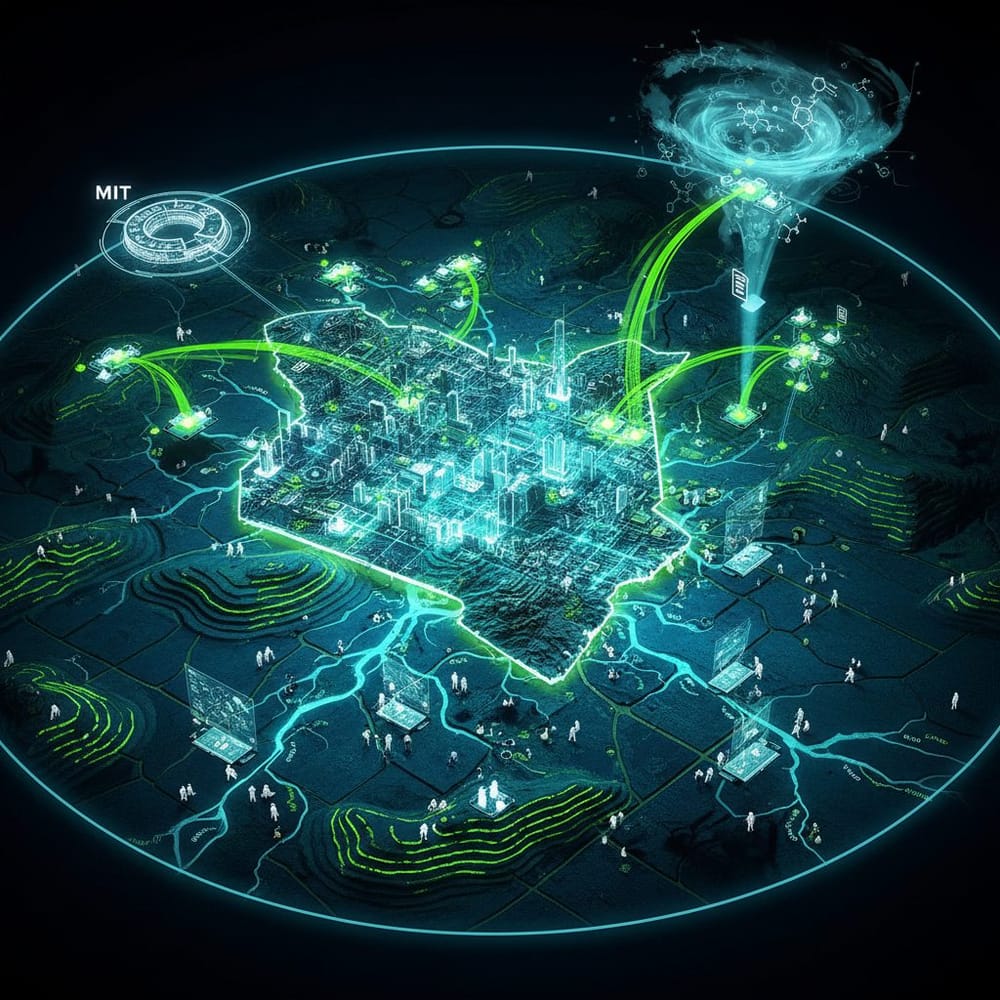
In Kenya, an AI laboratory now rivals MIT. At $15 per complete scientific article, the automation of research is reshuffling the global deck. The Data Science and Artificial Intelligence Center at Dedan Kimathi University develops advanced machine learning methods to address challenges in environmental conservation, health, and agriculture, focusing on probabilistic models such as Gaussian processes, graph neural networks, and large language models. Meanwhile, The AI Scientist from Sakana AI produces a complete scientific manuscript for just $15, radically transforming the economics of global research.
The Silent Redistribution of Scientific Maps
84% of researchers now use AI for their work, compared to 57% the previous year. The adoption does not impact all continents equally. The most notable impact is emerging in Global South countries, where language barriers historically hindered access to international publications.
In Kenya, Yuri Njathi and Lorna Mugambi from Dedan Kimathi University present their research results to AI and ecology experts at the University of Leeds, illustrating how knowledge now crosses borders to change the world. Their work on machine learning methods for exploring large-scale camera trap data, notably for detecting the endangered Grevy’s zebra, demonstrates that scientific excellence emerges wherever AI provides access to research tools.
The productivity increase is particularly marked for scientists who write in English as a second language. A growing number of researchers affiliated with Asian institutions publish additional articles following LLM adoption. AI systems offer consistent evaluation criteria that transcend language barriers, allowing scientific merit to be assessed independently of English proficiency.
Complete Automation Arrives: $15 Per Article
The AI Scientist automates the entire research cycle, from generating novel ideas to writing the final manuscript, including code writing, experiment execution, and results visualization. A threshold has been crossed: the manuscript generated by this AI system passed the first peer review evaluation of a leading machine learning conference workshop.
Analyses indicate that a complete research article can be generated for $6 to $15 with only 3.5 hours of human involvement. A ratio that disrupts research economics and opens new prospects for institutions with limited budgets.
Quality remains variable. The current level resembles that of an unmotivated undergraduate student rushing to meet a deadline, but this autonomy in research generation represents a substantial milestone. The capacity to produce articles at $15 each and near-human performance in peer review of articles are particularly impressive characteristics.
Small Laboratories Challenge the Giants
The global scientific geography is being reshuffled. The DSAIL Center at Dedan Kimathi University positions itself as a leading center for solving real-world problems using cutting-edge technologies: AI and IoT. The Kenya Medical Research Institute is investing in a computational laboratory with three high-performance computers installed with drug design software and predictive computational modeling, rivaling the traditional infrastructure of Western universities.
Chinese researchers see their output surge thanks to AI that overcomes their difficulties with English expression, challenging the traditional Western dominance in scientific publication. Pilot programs suggest significant improvement in acceptance rates for articles from developing countries when evaluated by AI systems rather than by the traditional process.
By significantly reducing the cost and time necessary for scientific discovery, the AI Scientist could enable more individuals and organizations to contribute to scientific progress. African universities are becoming direct competitors to Western institutions.
Massive Adoption Despite Persistent Challenges
Paradoxically, massive AI adoption is accompanied by reinforced distrust. Concerns about potential inaccuracies and hallucinations are more likely to be cited as barriers this year (64%) compared to last year (51%). 87% of researchers consider these concerns an obstacle to using AI in their work.
As AI use has exploded, researchers are significantly reducing their expectations. Last year, they believed AI already surpassed humans in more than half of use cases. This year, that proportion falls to less than one-third.
63% of researchers identify the lack of clear guidelines and training as the main obstacle to broader AI adoption. Fewer than half (40%) of researchers believe their organization provides them access to the necessary AI tools and models.
The Challenge of Sorting Between Scientific Value and Automated Production
The explosion of AI-assisted production creates a new challenge for scientific evaluation. Generated manuscripts are poorly substantiated, with a median of only five citations per article, most outdated. 42% of experiments fail due to coding errors, while others produce deficient or misleading results. Code modifications are minimal, representing on average 8% of additional characters per iteration.
Well-written articles likely generated by LLMs are less likely to be accepted, suggesting that despite convincing language, evaluators judge that many of these articles have little scientific value. The disconnect between writing quality and scientific quality complicates traditional evaluation.
The system modifies experimental code minimally, with each iteration adding only 8% additional characters on average. A limitation that marks the current constraints of scientific automation.
The Redistributed Future of Global Research
The AI Scientist can function in an open loop, using its previous ideas and feedback to improve the next generation of ideas, thus emulating the human scientific community. The capacity for self-improvement suggests future acceleration of scientific productivity.
The ability to generate and test hypotheses at scale could lead to faster breakthroughs in various fields, particularly in machine learning and AI. The AI Scientist framework could potentially be adapted to other scientific disciplines such as biology, physics, or chemistry.
The scientific community has not yet established clear standards for disclosure and evaluation of entirely automated research. Developing these standards constitutes a critical step to ensure that these systems serve to advance, not compromise, scientific integrity.
A clear trend emerges: once a new capacity begins to function, even with obvious limitations, it becomes superhuman quickly. Scale and better base models rapidly propel performance beyond human levels.
Between expanded access and diluted quality, between productive efficiency and loss of critical thinking, AI is reshaping the contours of a scientific world where a Kenyan laboratory can now rival Harvard or MIT. The criterion is no longer the wealth of the institution, but the intelligence of its use of scientific automation tools.