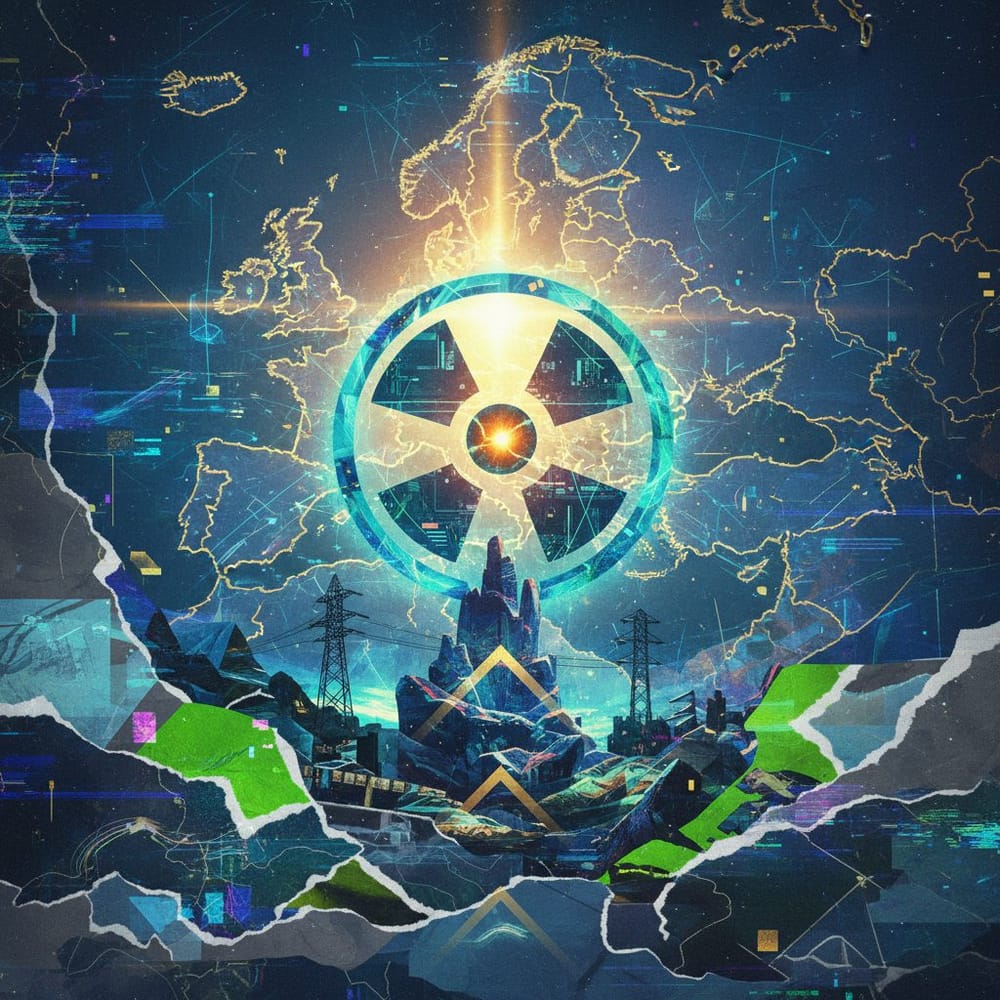
38 countries commit to tripling global nuclear capacity by 2050. This declaration now brings together thirty-eight signatory countries, moving from the objective of tripling global nuclear capacity by 2050 initially adopted at COP28 to a genuine roadmap. The French summit in March 2026 marks a turning point: for the first time since Fukushima, nuclear energy is recovering its climate legitimacy.
France organized the second summit on nuclear energy, in partnership with the International Atomic Energy Agency (IAEA). This summit brought together all sector actors to discuss the revival of civil nuclear power and establish a roadmap for 2050. This emerging consensus occurs at a time when artificial intelligence is multiplying energy needs and dependence on Russian uranium is revealing gaps in European sovereignty.
Artificial Intelligence Drives Europe Toward the Atom
With AI and cryptocurrencies, their consumption reached 460 TWh in 2022 (or 2% of global production), and could reach 1,000 TWh in 2026 (equivalent to Japan’s electrical consumption). This explosion is redefining European energy challenges. Each query to a generative AI consumes, on average, ten times more energy than a Google search.
Several large technology companies operating data centers have already signed Power Purchase Agreements (PPAs), allowing mobilization of approximately 27 GW of nuclear capacity from new reactors. This demand is transforming nuclear energy into a strategic asset. Emmanuel Macron reaffirmed this at the World Nuclear Energy Summit in Paris in March 2026: France exported 90 terawatt-hours (TWh) of decarbonized electricity in 2025, positioning the country as the natural energy supplier for AI infrastructure in Europe.
As demand for computing power for artificial intelligence explodes — AI data centers require between 10 and 100 times more energy than traditional data centers — the country possesses an asset that few competitors can match: massively decarbonized and abundant electrical production thanks to its nuclear fleet.
New Adherents Change Geopolitical Dynamics
Following the recent commitment of South Africa and China, Belgium, Brazil, and Italy endorsed at the Nuclear Energy Summit the joint declaration aiming for triple nuclear capacity worldwide by 2050. China’s adherence particularly disrupts the atom’s geopolitical balance. According to the IAEA, 38 States have already endorsed this ambition, with the most recent entries: China, Brazil, Italy, and Belgium.
This Chinese alignment goes beyond symbolism. Beijing already controls the nuclear industrialization that Europe struggles to recover. Countries with uninterrupted civil nuclear programs (China, Russia, or South Korea) have experienced far less cost overruns. While the Flamanville EPR accumulates 12 years of delay and a 300% cost overrun, the Taishan reactors in China were built in 110 and 113 months, representing a five-year overrun from initially announced timelines, at a cost of approximately 95 billion yuan (12.2 billion euros), or 60% more than the planned budget.
GIFEN (the French industrial grouping for nuclear energy) has united 25 international associations (including World Nuclear Association, Nucleareurope, NIA UK, and CNEA China) around a joint declaration calling for tripling global nuclear capacity by 2050 to achieve carbon neutrality. The declaration emphasizes that low-carbon and controllable nuclear power is essential for reducing fossil fuel dependence and guaranteeing global energy security.
Russian Dependence Undermines European Nuclear Sovereignty
Parallel to this diplomatic renaissance, Europe discovers its vulnerability. In 2022, 67% of enriched uranium imported into France came from Russia. This share fell to 24% in 2024, according to customs records cited by the newspaper. Despite this decline, 18% of enriched uranium imported into France still came from Russia at the end of September 2025.
This dependence reveals a major strategic contradiction. Even as the European Union discusses a roadmap to end Russian energy imports, Paris actively works in Brussels to protect this sector from sanctions. In this context, French companies EDF, Orano, and Framatome continue their industrial and commercial cooperation with Rosatom.
A process that only Russia is currently capable of performing. In 2018, France had indeed signed a contract with the Russians to benefit from this service. For reprocessed uranium, France remains completely dependent on Russia for the use of its reprocessed uranium, also called URT.
This technical dependence explains why the EU’s 20th sanctions package adopted in February 2026 focused mainly on prohibiting maritime services for Russian crude oil and other banking measures — a ban on Russian uranium imports or an explicit prohibition of new contracts with Rosatom and its subsidiaries was again not adopted. Across the entire EU, member states imported Russian uranium products worth more than 700 million euros in 2024, according to a joint study by the Kiev think tank DiXi Group and the Brussels economic institute Bruegel based on Eurostat data.
Construction Timelines Test European Ambition
The objective of tripling nuclear capacity by 2050 confronts European industrial realities. It amounts to 72.8 billion euros in 2020 value, or approximately 83 billion euros in 2025. This is 40% more than the first estimate of 2021, which was 51.7 billion euros in 2020 and 8% higher than an intermediate estimate of 2024. In France, the six planned EPR2 reactors show constant cost overruns.
In France, the Flamanville EPR construction site (for which EDF is the project manager) encountered major difficulties: it was supposed to be operational in 2012 according to the initial schedule, but experienced numerous setbacks resulting in nearly 12 years of delay. The project’s construction cost increased from 3 to over 12 billion euros (19.1 billion euros for total investment cost).
For the first EPR2 at Penly, the first concrete is scheduled for March 2029. Optimization work with suppliers, particularly in civil engineering, also made it possible to reduce construction timelines “by 8 months” for the first EPR2, to “less than 90 months” compared to 96 initially planned. Even optimized, these timelines place the first operational starts around 2037-2038, or more than ten years away.
This industrial slowness contrasts with climate urgency. The nuclear revival will require more than 100,000 new hires in the coming decade. Across the entire sector, GIFEN points to weaknesses in segments: boilermaking/forgings, electricity/instrumentation, engineering, logistics, testing/inspections, nuclear processes, radiation protection, valves, piping-welding. For these activities, sector companies are not certain they can handle the burden associated with constructing new reactors.
When Geopolitics Catches Up with Climate Ambitions
The Paris summit reveals a European paradox. On one hand, climate urgency and AI needs converge toward nuclear as an unavoidable solution. Emmanuel Macron, like many heads of state, called for new financing to support nuclear programs. In his opening address, the president stated: “I ask all public and private actors to do their part in financing new projects.” He insisted: “Banks and insurance companies must go further toward nuclear,” emphasizing that it was necessary to “wake up” to mobilize private and public capital in favor of nuclear power.
On the other hand, Europe remains hindered by its geopolitical dependencies and industrial weaknesses. The race for energy storage and carbon capture that finally crosses the threshold of commercial viability offer alternatives. But none combines the power, reliability, and decarbonization of nuclear to power Europe’s digital economy.
This renaissance of nuclear power occurs in a tense geopolitical context where sodium batteries allow China to free energy storage from lithium dependence, redefining global energy balances. Europe discovers that its digital transition depends on energy sovereignty it has neglected. The consensus of 38 countries marks the beginning of a race where Europe starts with an industrial handicap against competitors who never stopped building.
Nuclear energy becomes consensual at the moment when Europe realizes it has lost control of its supply and construction. This geopolitical irony could define the coming decade: climate urgency pushes toward nuclear, but the means to deploy it rapidly still largely escape the continent.
Sources