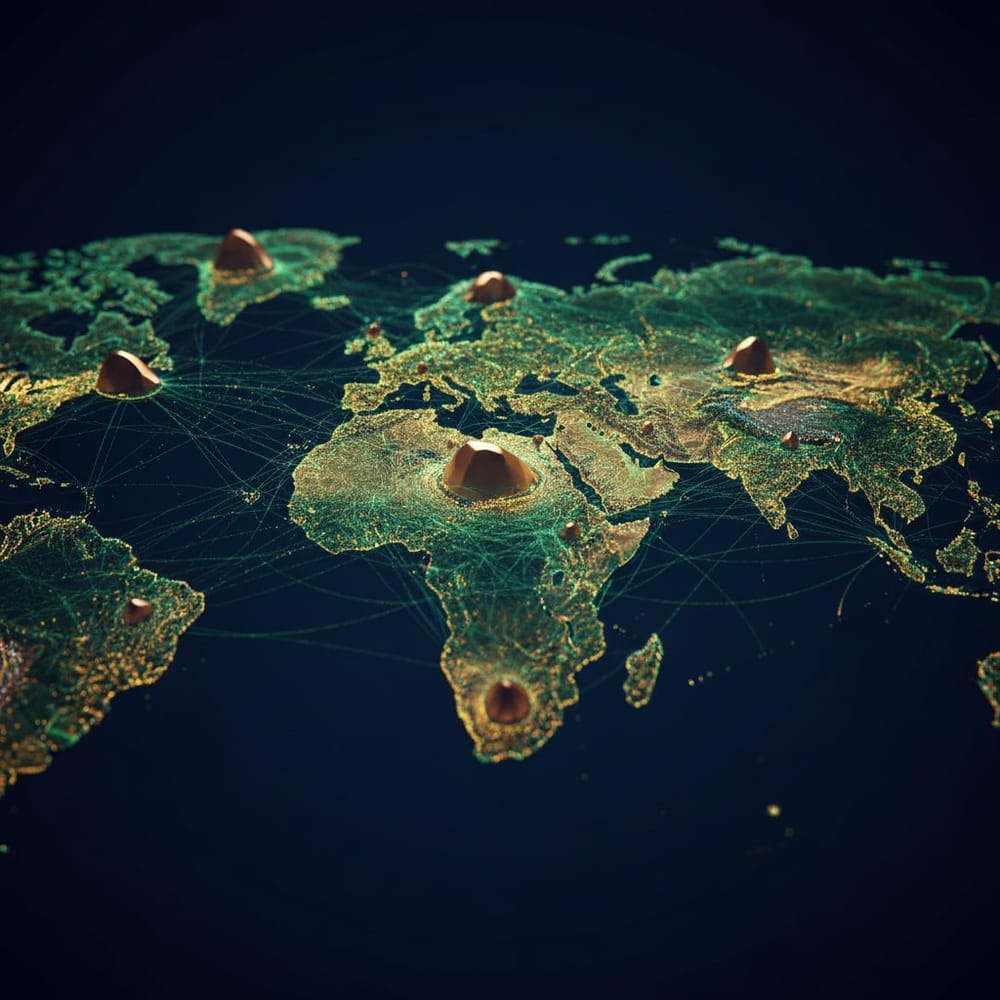
Trade between Southern countries has increased thirteenfold in thirty years, rising from 500 billion dollars in 1995 to 6,800 billion in 2025. This rise in power redraws the geography of the global economy by creating circuits of exchange that escape the developed economies. But this new prosperity remains concentrated: while emerging giants capture the bulk of these flows, the least advanced countries represent only 1.1% of global exports.
A Quarter of Global Trade Now Passes Through the South
UNCTAD figures for 2025 mark a turning point. South-South trade represents 26% of global trade in 2024, compared to 11% in 2000. The annual growth of these exchanges exceeds by 2.3 points that of North-North trade since 2020.
Asia-Pacific leads this transformation. China exchanges 2,100 billion dollars with other Southern countries, India 890 billion. Intra-ASEAN trade is projected at 1,200 billion over the coming decade. Asia-Pacific drives 60% of global growth and now structures its own commercial networks.
Latin America follows with 780 billion dollars of intra-South exchanges, driven by Brazil (340 billion) and Mexico (225 billion). Africa lags behind with 180 billion, but its annual growth of 8.2% since 2019 signals a catching up.
This new geography bypasses traditional hubs. Rotterdam is losing market share to Singapore and Shanghai. Commercial routes are being redrawn: the Asia-Africa corridor via the Indian Ocean is booming, China-Latin America exchanges transit through the Panama Canal rather than through European or North American ports.
Technology Changes the Commercial Game
The rise of South-South trade is based on technological transformation. Digital platforms facilitate exchanges between SMEs from emerging countries. Alibaba handles 670 billion dollars of international B2B transactions, of which 40% are between Southern countries. Amazon Business follows with 180 billion.
Digital payments eliminate Western banking intermediaries. The Chinese UnionPay system covers 180 countries, Indian UPI solutions are being exported to Africa and Southeast Asia. Cryptocurrencies facilitate transfers: Nigeria handles 60% of its exchanges with Asia in digital currencies.
Artificial intelligence optimizes South-South logistics chains. AI saves global trade despite record tariffs, and this efficiency benefits first the new commercial routes, less constrained by inherited infrastructure.
Digital services are exploding in these exchanges. Morocco exported 2.8 billion dollars of digital services and outsourcing in 2024 according to the Office of Exchange. Kenya remains an important regional hub for IT services, although exact figures are difficult to quantify precisely. This tertiarization of South-South exports creates added value and reduces dependence on raw materials.
Raw Materials Feed New Circuits
Trade in natural resources structures a growing part of South-South exchanges. Although specific figures are difficult to verify precisely in the official sources consulted, the general trend of reorienting African exports toward Asia rather than toward Europe and North America is confirmed.
Lithium illustrates this reconfiguration. Chile sells 70% of its production to China, Argentina 85%. These critical metals now transit directly to Asian battery factories, without passing through Western refiners. Added value remains in the South.
Agriculture follows the same movement. Brazil channels 60% of its soy to Asia, Argentina 75% of its beef. These direct producer-consumer flows eliminate European and American intermediaries who captured part of the margin.
Energy strengthens these ties. The United Arab Emirates is developing investments in African solar energy, notably with the IFC which invested 45 million dollars in a specific solar project for African telecommunications in March 2026. These South-South energy partnerships are accompanied by preferential trade agreements, although Africa still possesses only 3.06 GW of installed solar capacity in 2017 and represents less than 1% of global capacity.
But this specialization carries risks. The volatility of commodity prices exposes African and Latin American exporters. Growing dependence on Asia, particularly China, reproduces patterns of economic domination.
Sub-Saharan Africa Remains on the Margins
The boom in South-South trade masks a fracture. Sub-Saharan Africa captures only 3% of these 6,800 billion dollars, or 204 billion. The 46 least advanced countries in the world together represent only 1.1% of global exports, a share that has stagnated for ten years.
This exclusion is explained by structural handicaps. Failing infrastructure increases logistics costs: shipping a container from Lagos to Mumbai costs 40% more than from Shanghai to Mumbai. Customs procedures lengthen delays: 12 days on average to clear customs in West Africa versus 3 days in Southeast Asia.
Access to financing limits export capacity. African firms pay 180 basis points more for their commercial credit than their Asian counterparts. Export guarantees remain insufficient: Africa has only 8 billion dollars of export credit lines, compared to 340 billion for emerging Asia.
Industrial transformation is critically lagging. Africa still exports 70% of raw materials, compared to 30% for emerging Asia. This primary specialization limits integration into South-South value chains, dominated by manufactured products and services.
Conflicts and political instability discourage South-South investors. The Sahel concentrates 40% of global gray zones, Central Africa 25%. These fragilities slow the emergence of industrial champions capable of rivaling on South-South markets.
Toward a New Global Economic Architecture
This redistribution of global trade could accelerate the development of emerging countries through more balanced relationships. Terms of trade improve when Southern countries negotiate among themselves: fewer conditionalities, more flexibility on standards, agreements adapted to local needs.
South-South financial institutions are gaining in power. The Asian Infrastructure Investment Bank has deployed 47 billion dollars since its creation, the New Development Bank of the BRICS 35 billion. These financings escape the conditionalities of the IMF and the World Bank.
Local currencies are gaining ground in these exchanges. 35% of China-Russia trade is conducted in yuan and rubles, 28% of India-UAE exchanges in rupees and dirhams. This partial de-dollarization reduces exchange costs and exposure to Western sanctions.
AI opens new financial pathways for 1.4 billion unbanked, mainly concentrated in Southern countries. This financial inclusion will facilitate the emergence of new commercial actors.
But this shift also creates new imbalances. The concentration of South-South commercial flows around a few Asian giants reproduces relations of dependence. The absence of the least advanced countries from this shared prosperity risks accentuating global inequalities.
The future of this reconfiguration will depend on the capacity of Southern countries to create inclusion mechanisms. Free trade zones in Africa and Latin America could allow smaller countries to integrate into these new circuits. Provided that infrastructure follows and that South-South financing is oriented toward these forgotten economies.
Sources
- South-South Trade 500 billion 1995 to 6,800 billion 2025
- South-South Trade 27% of global trade in 2024
- ASEAN trade 1,300 billion or China-ASEAN 1,000 billion
Sources: