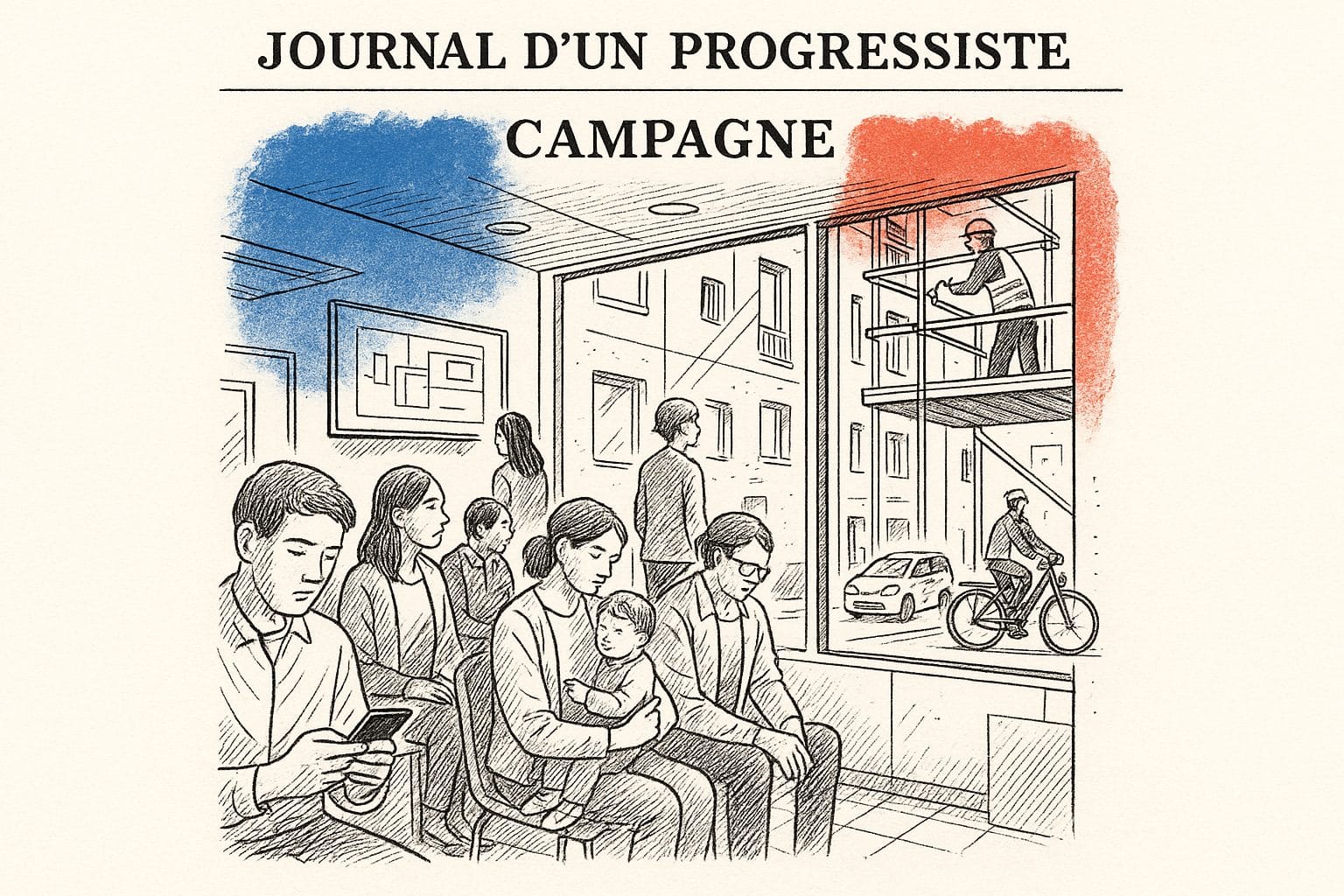
59% of Europeans never felt lonely in 2018. This figure dropped to 51% in 2022. This decline of 8 points in four years masks a historical shift: 16-24 year-olds are now the generation most affected by loneliness, surpassing those over 65 for the first time in 22 OECD countries.
This inversion disrupts 60 years of social policies built around aging. If loneliness primarily strikes the young, Europe’s architecture for combating isolation targets the wrong population. Between connected retirement homes and screen bans in classrooms, the gap widens between yesterday’s solutions and today’s challenges.
The Essentials
- Loneliness now affects 16-24 year-olds more than those over 65 in 22 European OECD countries
- The share of Europeans never feeling lonely fell from 59% to 51% between 2018 and 2022
- Social policies remain massively oriented toward aging despite the generational inversion
- Active use of social networks can strengthen bonds according to the study, questioning digital bans
- Young people’s isolation coincides with difficulties accessing the job market and housing
16-24 Year-Olds Surpass Their Grandparents on the Loneliness Scale
The OECD documents for the first time a generational rupture in the experience of loneliness. According to the organization’s 2025 report on social connections, young adults aged 16 to 24 display the highest loneliness rates among all age groups studied.
This inversion contradicts six decades of sociological research. Since the 1960s, loneliness mechanically increased with age: widowhood, retirement, loss of autonomy, and reduction in social circles explained why those over 65 concentrated the attention of public policies. The phenomenon is now reversing across all developed countries studied.
The data also reveals a recent acceleration of the phenomenon. Between 2018 and 2022, the proportion of Europeans reporting they never feel lonely fell from 59% to 51%, a decline of 8 points in four years. This trend affects all generations but strikes the youngest particularly hard.
The magnitude of the shift surprises demographers. 16-24 year-olds, traditionally protected by the density of their student and family social networks, are becoming the category most vulnerable to social isolation in societies that are nonetheless more connected than ever.
The Growing Inadequacy of European Social Policies
This demographic mutation in loneliness reveals the progressive obsolescence of Europe’s social architecture. Since the 1960s, the European Union and its member states have massively invested in combating isolation among the elderly: retirement homes, local services, adapted transportation, telecare.
The European budget dedicated to aging represents 11.3% of GDP on average, according to Eurostat. This allocation reflects a conception of loneliness as a geriatric problem: the older you get, the more you risk isolation. Youth policies, meanwhile, concentrate on education, training, and professional integration, not on social bonds.
The inversion documented by the OECD questions this resource distribution. If young people are becoming the most isolated population, maintaining policies centered on seniors reveals a temporal gap between social evolution and institutional response.
The consequences exceed budgetary inefficiency. Isolation among young adults affects their professional integration, their capacity to form lasting partnerships, and their mental health. These impacts reverberate across subsequent decades on demographics, productivity, and social cohesion.
The inadequacy also affects measurement tools. European indicators of social well-being primarily monitor isolation among seniors. Surveys on young people’s loneliness remain fragmented, limiting governments’ capacity to calibrate their interventions.
Reconsidering the Link Between Digital Technology and Loneliness
The OECD study also disrupts understanding of the role of digital technologies in social isolation. Contrary to dominant assumptions, active use of social networks can strengthen social bonds rather than deteriorate them. This nuance questions the digital restriction policies adopted in education.
France banned mobile phones in middle schools in 2018; the Netherlands is preparing a similar ban for 2024. These measures assume that technology isolates young people from their peers. The OECD survey suggests a more complex reality: the quality of digital use matters more than its quantity.
Active use of social networks—commenting, exchanging, creating content—correlates with a strengthened sense of social belonging. Conversely, passive use—consulting without interacting, enduring algorithmic content—worsens isolation. This technical distinction escapes general digital bans in school settings.
The data questions the effectiveness of prohibitive approaches. Rather than banning digital tools, public policies would benefit from educating toward socializing uses. Training in constructive digital interactions could better serve the fight against isolation than their removal.
This conceptual revision extends beyond school. It questions the entirety of public health policies that identify digital technology as a factor in isolation. The great hiring freeze is transforming entry into the job market and complicates young adults’ social integration, sometimes making digital bonds essential to maintaining relationships.
Young People’s Isolation Coincides with Economic Precarity
The explosion of loneliness among 16-24 year-olds articulates with the degradation of their economic prospects. Access to housing is becoming more complex: in France, the average age of leaving the family home has retreated from 23.6 years in 2000 to 24.4 years in 2022 according to INSEE. This extended cohabitation limits social autonomy.
The job market aggravates this precarity. The unemployment rate for those under 25 reaches 14.8% in the European Union in 2024, compared to 6% for the overall working population. This professional instability weakens the construction of lasting relationships, both professional and personal.
Employment geography intensifies isolation. Metropolises concentrate qualified job opportunities, forcing young graduates to leave their home regions. This geographic mobility breaks family and friendship networks without guaranteeing their reconstitution in new places of residence.
Average incomes for 18-24 year-olds have stagnated over the past decade in real terms in most European countries. This budget constraint reduces access to collective leisure, cultural outings, and paid social activities that traditionally structure youth sociability.
Student debt amplifies these difficulties in certain countries. In the United Kingdom, average student debt reaches £53,000 for 2024 graduates. This financial burden pushes back the age of economic independence and delays the formation of autonomous households.
The Social Geography of Isolation Is Being Transformed
The generational inversion of loneliness redraws its geographic and social distribution. Urban centers, traditionally associated with dense sociability, are becoming spaces of isolation for young adults. Population density no longer guarantees intensity of social bonds.
Paris, London, Berlin concentrate young graduates but also the highest isolation rates among 20-30 year-olds. Professional competition, intensive work rhythms, and cost of living limit the time and means devoted to friendships. Social life becomes professionalized and commodified.
Rural territories experience opposite trends. The departure of young people toward metropolises ages the population, but preserves intergenerational bonds for those who remain. Local solidarities partially compensate for demographic thinning.
This geographic recomposition of isolation largely escapes local public policies. Town halls invest in facilities for seniors without always anticipating growing isolation among young workers. Community centers, cultural spaces, and sports facilities struggle to reach a generation overinvested in work and budget-constrained.
The digital divide aggravates these territorial inequalities. Poorly connected areas deprive young people of distance socialization tools that partially offset physical isolation. Broadband access becomes a matter of social policy as much as economic policy.
The Urgency of a Conceptual Overhaul of Social Policies
The generational inversion of loneliness requires a complete revision of European priorities regarding social bonds. The OECD recommends reorienting part of social budgets toward 16-30 year-olds without abandoning seniors, but rebalancing resource allocation.
This overhaul goes beyond simple budget reallocation. It requires rethinking intervention tools. Youth centers, leisure facilities, and equipment dedicated to 16-25 year-olds have massively closed since the 1980s in favor of geriatric facilities. Their reconstruction demands time and resources.
Social innovation becomes crucial. Public policies must invent intervention formats adapted to contemporary constraints facing young adults: staggered hours, limited budgets, geographic mobility. Evening and weekend social support offices, free collective activities, support for emerging student associations emerge as priorities.
Coordination between employment, housing, and social bond policies is essential. Young people’s isolation largely results from their economic precarity. Treating loneliness without acting on its structural causes limits intervention effectiveness. The compartmentalized approach of public administrations slows this necessary integration.
Europe has assets for this transformation. Poor countries are organizing their debtor club facing northern creditors shows that international cooperation can solve structural problems. The circulation of best practices among member states accelerates adaptation of social policies to new demographic realities.
The window for action is narrowing. A generation of Europeans is growing up in social isolation at a crucial age for forming their relational skills. This early fragility in social bonds will reverberate on their future capacity to build stable families, solidarity-based communities, and cohesive societies. Between demographic urgency and institutional inertia, Europe must choose.