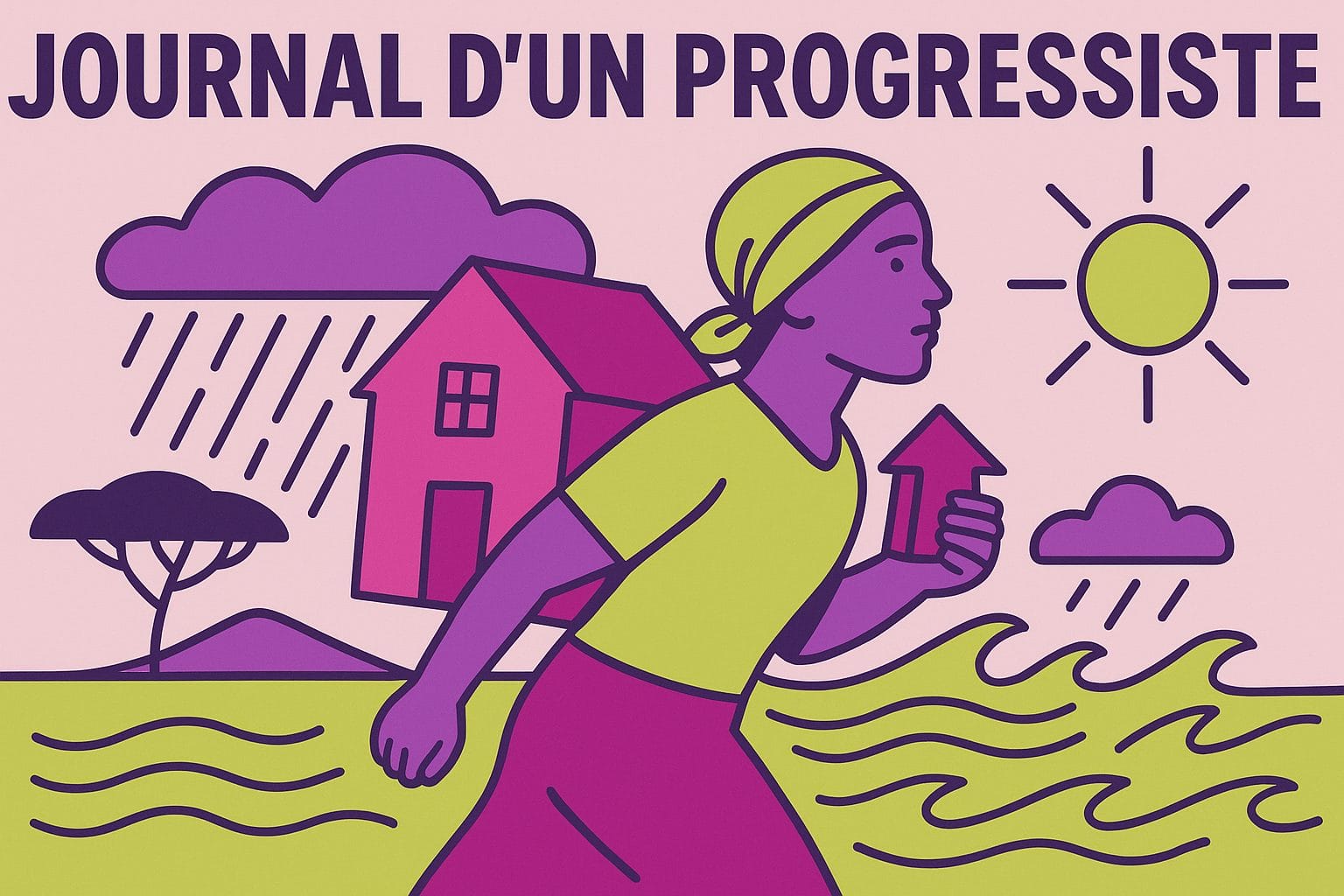
The global real estate market silently sorts households by climate risk level. Poor households are often overrepresented in vulnerable areas, for reasons combining price, shortage of safe housing, informality, and unequal access to land.
According to Climate Central (2019), improved altitude data tripled estimates of people living on land susceptible to annual coastal flooding by 2050, reaching up to 300 million people. This estimate maps potential exposure to coastal flooding according to climate, topographic, and demographic assumptions; it is insufficient to demonstrate widespread urbanization failure.
The Essentials
- 300 million homes threatened by rising waters by 2050, three times previous forecasts, according to the World Resources Institute and Habitat for Humanity (2026).
- Building climate-resilient housing costs 40 to 60% more than standard construction, a surcharge that structurally excludes the poorest households.
- The market sorts by price: flood-prone areas are affordable, poor households settle there, then insurance withdraws when risk materializes.
- 75% of global infrastructure to be built by 2050 does not yet exist, opening a real window to integrate resilience from the design phase onward.
- The Netherlands proves that universal public adaptation is feasible; Brazil shows what programmed abandonment looks like.
Low Price as a Trap
A cheap apartment in a flood-prone area is not a bargain: it is a risk transfer disguised as opportunity. The mechanism is simple and brutal. Land exposed to flooding or submersion is negotiated at a discount because solvent buyers avoid it. Households with no alternative accept this discount without always measuring its climate implications, sometimes because the risk is poorly documented, sometimes because housing urgency outweighs any other calculation.
This segregation by risk is observed in several cities. It follows the same logic everywhere: exposed areas concentrate the lowest incomes, the most fragile constructions, and the most deficient sanitation networks. When a flood strikes, the impact is amplified by the economic vulnerability of residents, far beyond their physical exposure alone.
Insurance worsens the cycle. In areas of growing risk, insurers withdraw or raise premiums to the point of making them inaccessible. In the United States, several coastal states have seen major insurers suspend residential offerings. In Australia, some Queensland municipalities are now practically uninsurable. After an uninsured flood, poor households generally have fewer resources to recover and may remain in or fall back into high-exposure situations.
The cycle begins again.
40 to 60% Surcharge: What This Means Concretely
No general estimate of 40 to 60% attributable to WRI and Habitat for Humanity has been verified.
In high-income countries, the surcharge primarily reflects improved materials, reinforced drainage systems, and foundations adapted to flood-prone soils. In low or middle-income countries, it also reflects the absence of basic infrastructure: a resilient home in a neighborhood without water drainage remains exposed to flooding, regardless of the quality of its individual construction. Resilience is a collective as much as an individual good.
A 50% surcharge becomes prohibitive for low-income households without subsidy or adapted credit. Climate resilience financed solely by households becomes a luxury good: households with resources invest more in adaptation and transfer their losses through insurance, while poor households bear a disproportionate share of damage.
Adaptation policies reproduce or aggravate existing inequalities when not designed equitably. They can also reduce them depending on their architecture and targeting.
This surcharge also structures developers’ decisions. Building cheaper in exposed areas remains profitable in the short term if risk costs are externalized onto occupants and public disaster budgets. The absence of regulation requiring risk to be incorporated into sale or rental prices perpetuates this externalization.
The Netherlands as Exception, Brazil as Rule
The Netherlands became the global reference for climate adaptation in housing out of historical necessity. Approximately 17% of Dutch territory lies below sea level; government sources also use the approximate formulation of a quarter of the country. National survival has depended on collective management of hydraulic risk for centuries, which has built exceptional administrative and fiscal capacity. The Delta Programme integrates adaptation into spatial planning and strengthens flood defenses; it does not constitute an explicitly identified requirement for each building permit. The Dutch system rests on collective protection coupled with a minimal safety level, with reinforced standards according to risk and potential consequences.
But the Netherlands is an exception that illuminates the conditions for success rather than an exportable model as such. Large-scale adaptation requires a tradition of public hydraulic engineering, solid public finances, fine administrative capacity, and sustained political consensus. These conditions are met in few countries.
Brazil illustrates the inverse trajectory. The favelas of Rio de Janeiro, Recife, and São Paulo massively occupy the morros, hills and alluvial plains: exactly the areas exposed to landslides and flooding. The state intervenes unevenly before and after disasters. The Minha Casa Minha Vida program, relaunched since 2023, produces social housing but does not systematically solve the location problem in at-risk areas. Neighborhoods can be rebuilt after floods in the same locations, relocating large populations requiring significant political will and logistical capacity.
Many countries in the Global South face adaptation capacity and financing deficits, but their policies and results differ sharply.
The 75% of Infrastructure to Build Changes the Calculation
The figure is counterintuitive: 75% of global infrastructure needed by 2050 does not yet exist. A substantial portion of the cities, neighborhoods, and homes that will accommodate 2050 populations remain to be built. Principally in sub-Saharan Africa, South Asia, and Southeast Asia, where urban growth is fastest and regulatory capacities most fragile.
This fact opens a real window. Integrating climate resilience from the design phase of a building or neighborhood costs less than adding it afterward. Anti-flood building standards, drainage systems, street orientation relative to prevailing winds: all these decisions are incomparably less costly at the design stage than in renovation. REHOUSE is a real partnership operating in Africa and Asia to promote more equitable and resilient housing and urban services; its exact action on national building codes must be supported country by country.
The window is real but narrow. Urban planning decisions that structure a city for fifty years are being made now, in contexts often dominated by housing urgency, land pressure, and weak local regulators. A developer building quickly and cheaply in an exposed area responds to immediate demand; he creates a vulnerability that will manifest itself at the next flood, in ten or twenty years, when he will have moved on.
The Urban Institute documented coastal risks for affordable housing notably in 2021, and strategies for climate-resilient affordable housing in earlier publications; attribution to April 2025 is erroneous. If American public power cannot achieve this easily, the difficulty faced by African or South Asian states is of another magnitude.
What Happens to Democracies That Let the Market Decide
Housing facing climate risk poses a political question that liberal democracies generally avoid: can social cohesion remain tenable if 30 to 40% of the urban population remains in housing exposed to rising climate risk that the market does not spontaneously correct.
Current data paint a difficult picture. The real estate market, left to itself, concentrates risk exposure on the households least able to absorb it. Insurers, by withdrawing from areas of growing risk, signal what real estate prices do not yet reflect. Public disaster budgets socialize losses after the fact, without reducing structural vulnerability.
The accumulation of market decisions uncompensated by equitable public policies can reinforce segregation of climate risks by income. High-income households generally have more options: relocation, insurance, elevation, or renovation, but their risk responses vary strongly. Housing constraint can lead poor households to reside in more exposed places, but the link between affordability and maximum risk level varies by city. Each disaster can widen the wealth gap between the two groups, as losses are generally more lasting for uninsured, low-resource households, while wealthy households generally have more recovery mechanisms.
Democracies that chose universal adaptation did so through a combination of regulation (resilience requirements in building permits), targeted subsidy (surcharges covered for modest-income households), and public investment in collective infrastructure. Singapore has integrated climate adaptation into its national urban plan since the 2000s. Sweden subsidizes thermal and hydraulic renovation of social housing. These experiences share a characteristic: they treat climate resilience as a public good, not as an individual consumer good.
By 2035, Three Trajectories for the Billion Homes at Risk
Climate housing forecasting is not an exact science, but three trajectories emerge for the next twenty years, without any source guaranteeing their relative probability.
In the first, resilient construction standards gradually become mandatory in rapidly urbanizing emerging countries, driven by international partnerships like REHOUSE and by governments that choose to integrate risk into their building codes before the stock is constituted. This trajectory assumes the window of 75% of infrastructure to be built is seized. It is technically accessible, but it requires coordination between local regulators, international funders, and the private construction sector that few countries have demonstrated at large scale.
In the second, wealthy countries adopt climate risk equalization mechanisms: national guarantee funds, public reinsurance of exposed areas, subsidies for resilience surcharges for modest-income households. This trajectory reduces climate apartheid in advanced economies without solving the question in the Global South, where fiscal capacities are insufficient to finance universal adaptation alone. It assumes a political debate that most liberal democracies have not yet engaged frontally.
In the third, neither standards nor equalization mechanisms generalize in time. Intensification of certain climate hazards increases losses; in several markets, insurance becomes more expensive or less available, while poor households remain particularly inadequately protected. The cycle of vulnerability accumulation continues. This trajectory can significantly increase internal climate migration, including to some urban areas, but the scale and destination of flows depend on contexts and policies. It can also lead to humanitarian crises financed in emergency mode and increase pressure on political systems in affected countries.
The signals that would allow distinguishing between these trajectories are observable right now. The first is the evolution of building codes in rapidly urbanizing countries: if Nigeria, Ethiopia, or Bangladesh integrate resilience standards into their national norms in the next five years, the window is seized. The second is the capacity of international climate finance mechanisms, notably the Green Climate Fund, to direct resources toward climate-resilient affordable housing rather than toward energy infrastructure alone. The third is the decision of liberal democracies to treat the insurability of popular housing as a public policy question rather than as a mere market signal.
Policymakers face a concrete trade-off: beyond a certain threshold, the cost of inaction exceeds that of anticipated adaptation. For exposed households, this threshold may already be crossed. For governments, the answer depends on their time horizon and their capacity to integrate future costs into present decisions. Unregulated real estate markets do not spontaneously produce this integration.
Sources
- World Resources Institute, Climate-Resilient Housing, 2026. https://www.wri.org/insights/climate-resilient-housing-urban-services
- Habitat for Humanity, Climate Adaptation Through Housing, 2026. Available on the Habitat for Humanity International website.
- Urban Institute, Preserving Climate-Resilient Affordable Housing, April 2025. Available on the Urban Institute website.