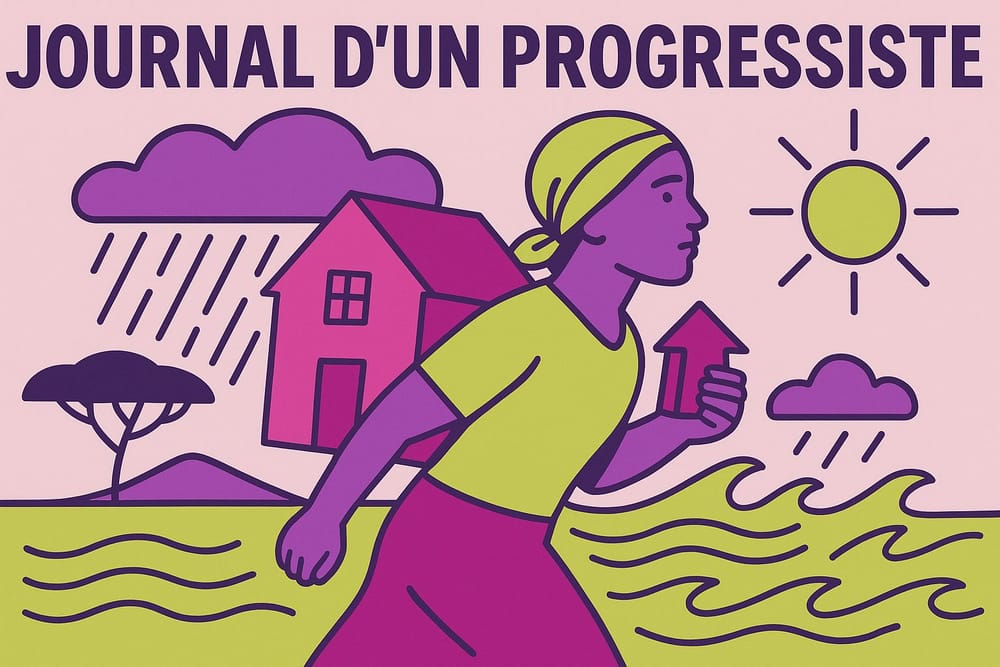
Between December 2025 and March 2026, flooding linked to the La Niña phenomenon displaced a significant number of people from their homes in Southern Africa. The absence of financial preparedness can delay response and recovery after a disaster, without by itself demonstrating a sustained spiral of displacement. The 2021 German floods followed a different reconstruction trajectory, with insurance coverage contributing to the response, among other public, institutional, and material factors.
The Essentials
- A significant number of people were displaced in Southern Africa by La Niña flooding between December 2025 and March 2026.
- Adaptation financing needs for developing countries are estimated at $310 to $365 billion USD per year by 2035; actual flows reached $26 billion in 2023, down from $28 billion in 2022, according to the UNEP Adaptation Gap 2025 report.
- Climate insurance coverage is very unevenly distributed across regions. Insurance is one factor in reconstruction alongside public capacity, governance, infrastructure, and international aid.
- Mechanisms exist—index insurance, African resilience funds, catastrophe bonds—but their deployment remains embryonic relative to the scale of need.
- Access to post-disaster financing in the coming decades could influence the habitability of certain territories and risks of depopulation.
La Niña 2025-2026: A Predictable Shock, an Absent Response
La Niña is a well-documented cyclical phenomenon. African meteorological services had signaled its return as early as autumn 2025. Yet when rains saturated the watersheds of Mozambique, Zimbabwe, Zambia, and Malawi between December and March, displacement was reported in several Southern African countries, notably Mozambique and Zambia, as well as Botswana, Malawi, and Zimbabwe depending on the episode and year considered. Resettlement and compensation mechanisms remain underdeveloped in these contexts.
Climate models had predicted extreme precipitation for the season and local authorities issued alerts. An alert without financial response capacity reduces the effectiveness of prevention. In Mozambique, anticipatory mechanisms had enabled alerts and evacuations, financed by $4.5 million USD from CERF released before the expected impact.
The mismatch between available information and financial response capacity can worsen the impact of a climate shock.
The displaced are concentrated in areas where housing was already precarious, infrastructure insufficient, and family reserves reduced. UN-Habitat has documented for several years that in these contexts, forced displacement extends over much longer periods than in high-income countries. The duration of displacement depends notably on destruction, security, access to services, land rights, and financing for return.
The Contrast with Germany 2021 Says Everything That Needs to Be Said
In July 2021, exceptional flooding devastated mainly the Ahr valley and several watercourses in the Eifel. One hundred eighty-three people died in Germany during the July 2021 floods, thousands of houses were destroyed, entire villages razed. The shock was real. Approximately 90% of insured losses had been settled after three years, without this signifying the overall completion of reconstruction. Today, most affected municipalities have returned to their previous state, sometimes improved.
This trajectory was facilitated by insurance indemnifications and federal emergency funds mobilized within weeks, although national insurance coverage remained partial in 2021. Households received direct indemnifications. Businesses were able to restart. Municipalities accessed credit lines guaranteed by the federal government and the Länder.
Reconstruction was financed before the rubble was even cleared.
In Southern Africa, climate insurance coverage remains far inferior to that in high-income countries outside South Africa. Many affected households lack automatic indemnification mechanisms. They depend largely on international humanitarian aid and family savings, often insufficient after a disaster. In Mozambique, Malawi, and Zambia, between 64% and 81% of the population lives on less than $2.15 USD per day, according to data cited by the World Bank.
Financing systems are one factor among several structural differences between German and Mozambican contexts, which also include institutional capacities, infrastructure, and international aid. A climate hazard can be the immediate trigger, but the scale of displacement and losses also depends on exposure, vulnerability, and response capacities. The absence of a financial safety net increases vulnerability and potentially delays recovery, without constituting the sole cause.
26 Billion Out of 310: A Growing Gap
The UNEP Adaptation Gap Report 2025 estimates adaptation financing needs for developing countries at $310 to $365 billion USD per year by 2035. Actual flows reached $26 billion in 2023, down from $28 billion in 2022. The report emphasizes that international public adaptation flows to developing countries were $26 billion USD in 2023.
This figure aggregates heterogeneous sources: bilateral public aid, multilateral development bank loans, UN climate funds. Part of climate financing finances studies, adaptation plans, and training rather than physical infrastructure or insurance mechanisms directly actionable after a disaster. Mitigation is necessary in the long term. Mitigation, essential in the long term, does not resolve immediate post-disaster response and reconstruction needs.
The geography of financing makes the picture even worse. Sub-Saharan Africa represents less than 5% of cumulative global emissions and receives a disproportionately small fraction of adaptation funds. South Asian and Latin American countries, better connected to international financial circuits, capture a far larger share of available flows. This imbalance is documented by the African Development Bank, which has tracked climate financing flows to the continent for several years and notes that a majority of commitments take the form of loans rather than grants, burdening the debt of the most vulnerable states precisely when their tax revenues collapse after a disaster.
The Mechanisms That Already Exist, and Why They Are Not Yet Sufficient
Social innovation in climate adaptation exists. It is not in the laboratory stage: several mechanisms have proven themselves at small or medium scale.
Index insurance is the most documented. It pays automatic indemnification once an objective indicator—rainfall level, water height, drought index—crosses a predefined threshold, without requiring individual damage assessment. The African Risk Capacity, created under the aegis of the African Union, operates on this model for droughts and cyclones in around twenty member countries. After Cyclone Freddy in 2023, the ARC notably supported Madagascar’s recovery. The intervention timelines for index insurance generally remain shorter than conventional humanitarian aid procedures, which often take months to organize.
But coverage remains limited: premiums are costly for states whose budgets are already under pressure, and the mechanism remains of partial scope: ARC has established operational activity but does not cover all exposed populations.
Catastrophe bonds (cat bonds) constitute another avenue. These financial instruments transfer risk to international capital markets: investors receive a coupon in exchange for a guarantee of absorbing losses if a defined catastrophe occurs. The World Bank has issued them for several Caribbean and Asian countries with encouraging results. Southern Africa remains outside this market, primarily because historical data on local climate risks is insufficient to calibrate the models that interest institutional investors.
The third mechanism is more systemic: the integration of climate resilience into urban planning and housing frameworks. UN-Habitat works with several African cities to map risk zones and condition building permits on seismic and flood-resistance standards. UN-Habitat documents risk reduction and informal settlement improvement projects in Maputo and Lusaka, with promising but embryonic results. These programs work. They remain embryonic relative to needs and depend on external funding that proves unstable from year to year.
Social and financial engineering exists. Solutions are known, tested, and improvable. The major challenges remain the scale and continuity of financing necessary for large-scale deployment.
What Will Be at Stake Between 2030 and 2035: Habitability or Depopulation
The stakes for the coming decade extend beyond the tally of the 2025-2026 floods. Insufficient reconstruction after each climate shock risks affecting the viability of certain territories in Southern Africa.
The IPCC projects an increase in extreme rainfall in certain parts of Southern Africa as warming increases, with significant variations depending on zones and scenarios. Other La Niña episodes will occur. The capacity of financial and institutional systems to absorb these shocks will influence the possibilities for populations to remain durably on their territories.
Two trajectories are emerging according to analysts from the World Economic Forum and UN-Habitat, without either being inevitable.
In the first, existing mechanisms scale up. The African Risk Capacity extends its coverage to households through partnerships with microfinance institutions. Catastrophe bonds could potentially become accessible to African states thanks to partial guarantees from multilateral banks and improved historical data. International donors, notably UN climate funds like the Green Climate Fund, redirect a larger fraction of their commitments toward direct adaptation and insurance mechanisms rather than studies and plans. In this scenario, a disaster-affected community can, within weeks, access partial indemnification that enables reconstruction without losing productive assets, land, livestock, or work tools.
Displacement remains temporary.
In the second trajectory, adaptation financing stagnates or declines, and insurance coverage as well as financial protection of households remain insufficient and very unequally accessible. Declining financing and the absence of household financial protection can increase the risk of distress migration after disasters, without necessarily implying systematic migration to cities. Families may be forced to sell their assets to survive in emergencies, which would limit possibilities of returning to their land after the flood recedes. Repeated displacements could accumulate with each new disaster.
The signals to watch for distinguishing between these two trajectories are concrete. The first is the volume of climate financing in grants, not loans, actually reaching Sub-Saharan Africa by 2027, within the framework of commitments made at COP29 in Baku in 2024. The second is the development of mechanisms reaching households more directly: this scale jump would make the difference between a symbolic safety net and a truly protective mechanism. The third is the emergence of sufficiently reliable local climate data to interest capital markets in African catastrophe bonds, a statistical infrastructure work that the African Development Bank has begun but will take several years.
These signals are observable. None depends on technology that does not yet exist. All depend on political choices and resource allocations that identifiable institutions—donor governments, multilateral banks, the African Union—have the capacity to make.
The La Niña floods of 2025-2026 could join the list of documented disasters without systemic follow-up, or trigger the reorientation of financial flows that reports have been calling for for several years. The early 2026 floods displaced hundreds of thousands of people, primarily in Mozambique, and demand a rapid response.
Sources
- World Economic Forum, March 2026, Why social innovation is key to climate adaptation future in Africa: https://www.weforum.org/stories/2026/03/why-social-innovation-is-key-to-climate-adaptation-future-in-africa/
- UNEP Adaptation Gap Report 2025 (United Nations Environment Programme)
- UN-Habitat, post-disaster displacement monitoring data
- African Development Bank, tracking of climate financing flows to Africa
- African Risk Capacity, operations reports 2023-2024