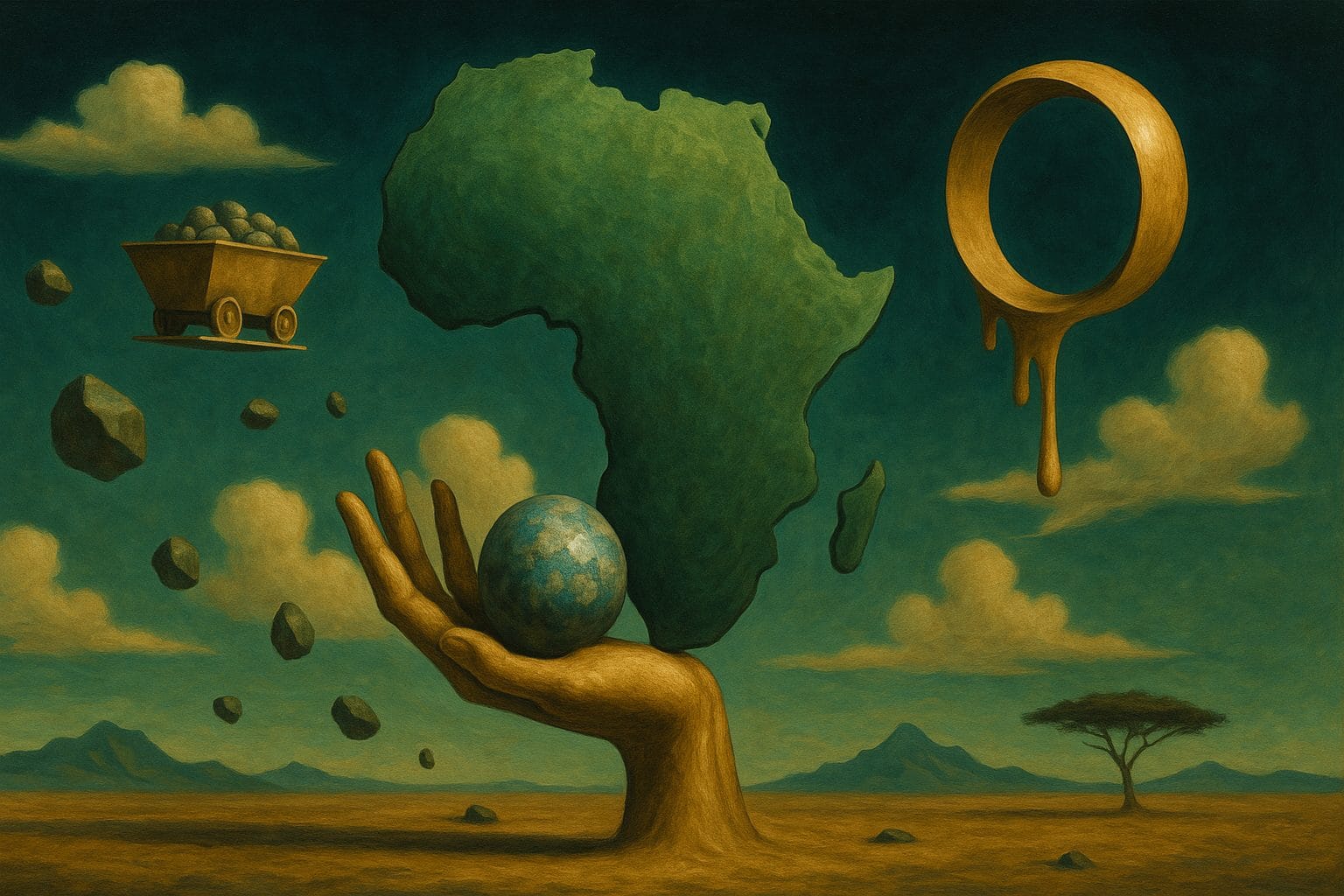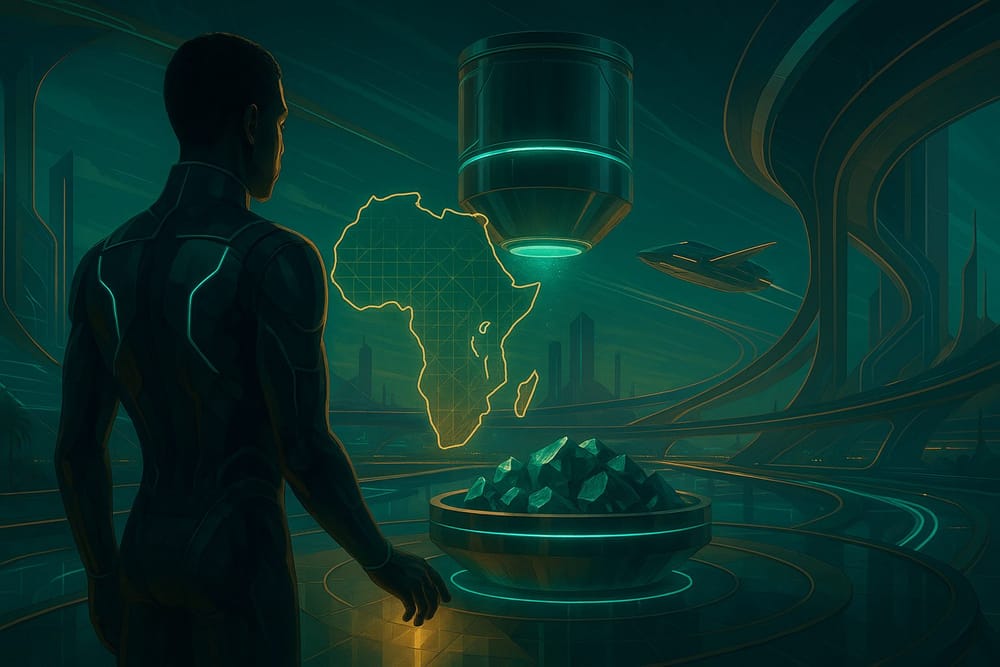
The Democratic Republic of the Congo extracts two-thirds of the cobalt the world consumes, and the value captured per ton of this metal remains far below what is generated by the factory that transforms it into a battery. Transformation can significantly increase locally captured value, without extraction being devoid of added value. The low-carbon transition needs Africa for its minerals, but not yet to manufacture them.
The essentials
- Zimbabwe exports concentrated spodumene; once transformed into battery-grade lithium carbonate, this ore sees its value increase substantially.
- The DRC produces 70% of global cobalt; the value of its cobalt production was approximately $5.1 billion USD in 2023, while the lithium-ion battery market represents several billion dollars annually.
- Value migrates to refining: refining and materials chemistry are major sources of value and market power, among other factors.
- Public and private initiatives seek to reverse this pattern, from Zimbabwe’s ban on raw mineral exports to refining projects in the DRC, but obstacles remain considerable.
- The global energy transition accelerates demand; the window to industrialize the value chain in Africa is closing as refining capacities consolidate elsewhere.
One ton of ore, twenty different prices
Take the best-documented case. Zimbabwe, one of southern Africa’s countries with the best lithium endowments, sold raw spodumene to foreign buyers until 2022. The price of a ton of raw spodumene is lower than that of purified battery-grade lithium carbonate processed in a refinery, creating a marked value gap according to analysts.
Harare responded in December 2022 by banning raw mineral exports. The decision sparked tensions with buyers, primarily Chinese, who control much of the local extraction. But it also signaled something broader: African governments are starting to keep score.
The mechanism is simple to understand. A concentrated ore is sold by weight and grade. An intermediate chemical product is sold by its purity and certifications. A battery cell is sold by its capacity and guaranteed lifespan. Transformation can increase captured value, provided costs, yields, prices, and markets are favorable, and generates margins and skilled jobs.
Africa has mastered the first step for decades. It struggles to reach the second.
The DRC dominates cobalt, not its value
The cobalt case is even more striking. The Democratic Republic of the Congo produces approximately 70% of global cobalt. Congolese cobalt production is geographically extremely concentrated, but it is not without equivalent among industrial metals. Other countries also dominate strategic materials strongly for electrification technologies, notably China in graphite. And yet.
The production value of Congolese cobalt was approximately $5.1 billion USD in 2023. In the same period, the global lithium-ion battery market represents several billion dollars annually. The gap between extracted value and captured value remains substantial, the country accessing only a reduced share of the value chain.
This gap stems from the geography of refining. A large portion of Congolese cobalt leaves the country in the form of concentrate or hydroxide and reaches refineries located in China. The metal is transformed there into cobalt sulfate, then integrated into cathode chemistry, then assembled into cells. A significant share of the value and jobs related to refining is today created outside the DRC, notably in China. This mechanism is documented in: Cobalt, lithium: Africa supplies, China refines.
Obstacles to local refining in Africa
The absence of local refining in Africa stems from several cumulative constraints, which a 2026 SMM analysis documents with precision.
Energy first. Refining lithium or cobalt is electro-intensive. Transformation into high-purity carbonate or hydroxide requires stable, abundant, and cheap electrical supply. In the DRC, approximately 22.5% of the population had access to electricity in 2024. In Zimbabwe, blackouts sometimes last twelve hours a day.
Building a refinery under these conditions requires planning its own power plant, which massively increases investment costs.
Financing next. An industrial-scale cobalt or lithium refinery requires hundreds of millions of dollars in initial investment. African commercial banks do not have the capacity to finance such assets alone, and foreign investors demand guarantees that often-fragile states struggle to provide. The African Development Bank and institutions like the International Finance Corporation are gradually getting involved, but volumes remain insufficient against needs.
Technical skills constitute a third obstacle. Battery metal refining chemistry is a recent discipline, dominated by a few dozen engineers and technicians worldwide, concentrated in China, Japan, and South Korea. Training equivalents in sub-Saharan Africa takes time, requires equipped universities, and industrial partnerships that major Chinese companies have historically not sought to develop.
Finally, trade agreements. Several importing countries impose progressive tariffs based on the level of transformation: raw ore enters freely, refined product bears a tax. This mechanism, called tariff escalation, precisely discourages what producing countries want to do. The OECD identifies it in its 2026 note on critical minerals in Africa as one of the most persistent institutional locks.
Ongoing bets
These obstacles are real. They are not insurmountable, and several actors are attempting to circumvent them.
The African Union adopted in 2023 a critical minerals policy that explicitly sets the objective of transformation on the continent. It is a declaratory framework, but it creates political legitimacy that member states can invoke in their negotiations with investors and buyers.
Zimbabwe has maintained its ban on exporting raw lithium despite pressure. Prospect Lithium Zimbabwe, partner of Zimbabwean public group ZIDA, planned a gradual conversion at its Arcadia/Goromonzi site, notably the transformation of concentrate into sulfate, then potentially into carbonate. The project still depends on stabilizing financing and electrical supply.
In the DRC, Ivanhoe Mines and its partners have mentioned discussions on an integrated refining complex at the Kamoa-Kakula mine, one of the world’s largest copper deposits. The logic is similar: if copper can be transformed into cathode on-site, value remains in Congo.
Further north, Morocco has a notable advantage. Thanks to its mastery of phosphates, another strategic material for lithium iron phosphate batteries, the OCP group is building a position in cathode precursor chemistry. The country neither extracts cobalt nor lithium, but it could become a regional refining hub if the supply chain becomes regionalized. This model relies on transforming ores extracted by neighboring countries, not those from beneath its own soil.
The energy transition’s effects on Africa’s value chain
Demand for battery metals will grow substantially in the coming years. Electrification of transport and renewable energy storage drive demand for battery metals; the International Energy Agency projects marked but differentiated growth by metal, technology, and scenario. Africa holds very large shares of certain battery metal resources, notably cobalt and manganese.
This growing dependence of importing countries confers unprecedented negotiating leverage on African producing states. The energy transition creates real geopolitical tension around raw materials, and states controlling resources are aware of it. The European Union has signed strategic partnerships on critical minerals with Namibia, the DRC, and Zambia. These agreements focus, at least in part, on commitments to local transformation.
But the dynamic has an inertia logic. Chinese refineries are built, equipped, and profitable. China concentrates approximately three-quarters of cobalt refining and nearly 65% of refined lithium, according to 2023 data cited by the IEA. Building significant refining capacities in Africa takes time, requires considerable capital, and demands political stability that not all producing countries can guarantee. The window is open; it is not open indefinitely.
The challenge for 2030-2035 lies precisely there. Without sufficient policies and investments, the geography of value risks remaining concentrated, but it can evolve. This convergence between climate challenge and development challenge—how to rapidly industrialize producing countries in a market consolidating fast—is a tension that international financial architecture is only beginning to take seriously.
Financial architecture as an adjustment variable
Industrializing batteries in Africa requires coordinated public and private investments, as well as public mechanisms for risk reduction. Projects are too risky, too long, and too small for short-term private capital markets. The African Development Bank, the World Bank, and the International Finance Corporation are the natural actors in this de-risking.
Several instruments exist or are in development. First-loss guarantees, where a public institution absorbs the first losses of an investment to make the rest financed by private actors, have proven effective in renewable energy in Africa. The same logic can apply to refining.
Trade agreements must also evolve. If tariff escalation penalizes transformed African products at entry into Europe or the United States, strategic partnerships on critical minerals ring hollow. The European Union has integrated this question into its negotiations, but concrete results remain to come.
There is finally a model of regional aggregation: rather than each country attempting alone to build a national refinery, sub-regional hubs could pool demand. A cobalt-copper refining hub in Zambia, fed by production from the DRC and Zambia, would achieve economies of scale that an isolated national project would not obtain. This is the logic the African Union is pushing in its texts, without yet having implementation mechanisms to make it concrete.
The capacity of African producing states to advance alone remains limited, and the speed at which external partners—Europe, the United States, Japan—will accept financing an industrialization that creates competitors rather than suppliers remains uncertain.
Sources
- SMM Shanghai Metals Market, SMM Analysis: The Real Barriers to Upgrading Africa’s Battery Metals Value Chain (2026): https://news.metal.com/newscontent/103943926-smm-analysis-the-real-barriers-to-upgrading-africas-battery-metals-value-chain
- African Leadership Magazine, data on DRC cobalt revenues and lithium-ion battery market (2026), no verifiable URL
- OECD, Critical Minerals Regional Note: Africa (2026), no verifiable URL
- International Energy Agency, Critical Minerals Market Review (annual editions): https://www.iea.org/reports/critical-minerals-market-review-2023