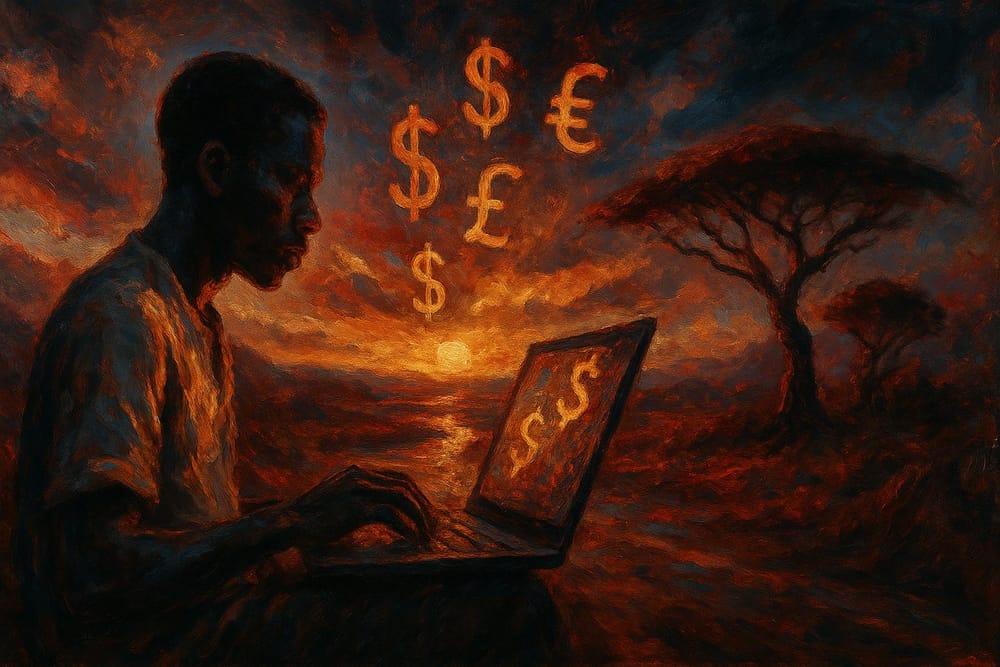
In two years, the number of active African creators has nearly doubled, and revenues come from sources that global platforms had not anticipated. According to Coachli Africa, the continent’s creator economy is experiencing significant growth. The audience base and content quality have not fundamentally changed: local payment infrastructure played a decisive role.
The Essentials
- The base of African creators experienced significant growth between 2022 and 2024.
- The average annual revenue per creator is approximately $2,400, according to Coachli, derived from direct services, training, subscriptions, and consultations, though the breakdown between these sources is not detailed.
- Regional fintechs (Wave, Flutterwave, MoMo) contributed to solving the local payment problem, a major challenge for the creator ecosystem.
- This model relies on a local customer base that pays in local currency.
- Consolidation remains an open challenge: a creator economy dispersed across 54 markets will need to produce regional players capable of standing up to global platforms if those platforms adapt to African realities.
The Problem That Ten Years of Presence Had Not Solved
YouTube arrived in Sub-Saharan Africa with its algorithms, monetization rules, and advertising partners. The problem: advertising investment targeting African audiences remained limited. Compensation gaps between certain African creators and creators from Western markets with equivalent audiences constituted an obstacle. CPM rates, the cost per thousand views paid by advertisers, generally remained lower than on other markets.
The second obstacle was even more concrete: collecting payments. Stripe ignored most of the continent. PayPal functioned in a few countries, poorly. Patreon, the American subscription platform for creators, remains unavailable in many African countries, though it does support several African countries and local currencies, notably in Ghana, Kenya, Mali, Morocco, Nigeria, Senegal, South Africa, Togo, and Tunisia. A creator in Ghana or Senegal could build an audience of one hundred thousand people and find themselves technically unable to collect a single CFA franc from their subscribers.
This infrastructure blockade persisted for a long time. Global platforms did not resolve it because they did not need to: their advertising model functioned without local creators collecting anything significant directly.
Fintechs Built the Infrastructure That Global Platforms Had Neglected
The breakthrough came from elsewhere. Wave in Senegal and Côte d’Ivoire, Flutterwave in Nigeria, MTN Mobile Money, and Orange Money in a dozen countries: these actors built payment rails adapted to local realities. Transfers in local currency, reduced fees, integration with basic phones via USSD, capacity to receive payments without a bank account.
For the creator economy, the effect was immediate. African platforms like Selar in Nigeria or Paystack, acquired by Stripe in 2020 but designed for the local market, integrated these rails to allow creators to sell directly to their audience. A coach based in Lagos can now offer training for 15,000 nairas, collected in seconds via mobile transfer, without going through an international intermediary.
Coachli Africa, a monetization platform for coaches and creators, documents this shift. Among creators with stable revenue, some draw from sources other than advertising. They sell online training, paid newsletters, individual coaching sessions, templates, access to private communities. Coachli reported an average annual revenue of $2,400 without providing verifiable methodology; no robust conclusion about its adequacy relative to per capita GDP can be drawn from it.
This model modifies the relationship between creator and distribution algorithm. A Nigerian YouTuber whose revenue comes from advertising is exposed to changes in Google’s algorithm. A creator who sells training to their WhatsApp community faces a different, lower risk, linked to customer loyalty rather than decisions by a product team in Mountain View.
4.8 Million Creators: Who Are They and Where Do They Emerge From
The significant growth of the creator base between 2022 and 2024 deserves close examination. This figure does not refer solely to YouTube influencers or TikTok stars. It includes a much broader range: professional coaches who sell their services via Instagram, independent musicians who market their instrumentals online, language trainers, graphic designers, developers who monetize tutorials, journalists who launch newsletters.
Nigeria ranks among the major markets, driven by a population of 220 million, a global music industry (Afrobeats), and a dense fintech ecosystem. Kenya, Egypt, Ghana, and South Africa are also significant. Growth is also accelerating in other markets where the combination of an emerging middle class, rising mobile penetration rates, and active fintechs creates conditions for a first-generation creator economy.
The question of data access is a point of attention. Available data rests partly on platform estimates and presents unequal geographic coverage. The reality of the continent is likely more heterogeneous than what available reports allow us to measure.
This context of fragmented data is also the one in which regulation operates. The Abidjan Declaration on Personal Data Processing, adopted by 24 African countries, establishes a data governance framework that directly concerns platforms active in this market. For the creator economy, the question of data sovereignty—who owns a creator’s audience data, who controls recommendation algorithms—is as structuring as the question of payment.
The Revenue Model That Contradicts Global Platforms
Global platforms have slowly adapted their monetization mechanisms to African realities, where banking infrastructure long limited direct payments. Global platforms offered visibility to African creators without comparable monetization possibilities being distributed.
The direct services model can meet the needs of a local audience that wants access to skills, knowledge, community, or support.
The comparison with Latin America is illuminating. Latin American creators followed a partially similar trajectory, also constrained by low CPM rates and unequal banking systems. The development of a regional digital economy in Latin America showed that markets long considered peripheral could generate original economic models, not derived from American platforms. Africa is following an analogous trajectory, with even more recent payment infrastructure.
The risk of the direct services model lies in its dependence on local markets and regional income levels. A creator who sells to $4,200 in median annual revenues lives in an African economy with local revenues, not in a global economy where their audience could come from Berlin or Chicago. Globalizing the audience remains a ceiling difficult to reach without solving problems of language, visibility, and international distribution.
Local Infrastructure Opened a Market That Giants Had Not Developed
The liberal perspective on this story is pertinent to articulate, even briefly. African fintechs focused on payment in local contexts, responding to regional needs that global platforms had underaddressed.
The hypothesis that a distinct and sustainable African creator economy can emerge through regional markets, without waiting for YouTube or Meta to adapt their models, hinges on this condition: that regional fintechs continue to consolidate, and that service sales platforms (Selar, Coachli, Paystack) reach critical mass allowing mid-level creators to live from their activity.
Consolidation remains the challenge. The African creator economy covers the entire continent, that is, 55 member states of the African Union, with regulatory frameworks, dozens of currencies, and highly unequal banking infrastructure. Flutterwave, Wave, and their competitors have reduced certain obstacles, but the challenges of pan-African integration remain. A Senegalese creator who wants to sell to a Kenyan audience still faces cross-border payment obstacles that local actors have not entirely resolved.
Competition from global platforms is also an open variable. If YouTube decides to lower its monetization thresholds for Sub-Saharan Africa, or if Meta creates a subscription product adapted to low-income markets, part of the dynamic described here could be captured or disrupted. Global platforms have the advantage of distribution and audience; African fintechs have the advantage of local knowledge. The question of who will win this competition, if competition there is, remains open for the 2026-2030 period.
Coachli Reported an Announced 128% Increase Between 2022 and 2024 Without Demonstrating That It Is Its Own Estimate or Providing the Source Methodology; This Figure Does Not Demonstrate a Future Trajectory
The increase in the number of creators between 2022 and 2024 suggests an ongoing dynamic. The market will need to produce creators exceeding current average revenues to achieve economic significance at the regional scale.
Some signals point in this direction. The Afrobeats industry has shown that an African creator can reach a global audience and generate international revenues without going through the same mechanisms as Western streaming platforms. Content creators in tech or business, based in Lagos or Nairobi, are beginning to sell training to African diaspora audiences in Europe or the United States, adding a revenue stream in hard currencies to their local revenues.
The challenge of the next ten years will also be that of training. A creator economy based on the sale of training and coaching needs creators trained in pedagogy, sales, and customer management. Actors like Coachli Africa are beginning to fill this role, training trainers, equipping creators to transition from free content to paid products. This is a market in itself, which partly explains the growth of data aggregated by these same actors.
The coming years will determine whether the continent can produce its own distribution platforms or will remain dependent on YouTube, TikTok, and Instagram for visibility, in parallel with the development of its regional monetization rails. Both scenarios are compatible with current growth. The first is more ambitious, more fragile, and would require an accumulation of capital and coordination between markets that the continent has not yet developed to the same level as Western economies.
Sources
- Coachli Africa – Africa’s Creator Economy 2026: Trends and Opportunities
- TechCabal Creator Economy Report 2024-2026 (no guaranteed URL)
- The Creative Brief Africa (no guaranteed URL)