According to the OCDE Digital Education Outlook 2026, students with access to a general-purpose AI tool improve their performance by 48% in the short term, but after removal of GPT Base, students scored 17% lower than the control group without AI. Access remains a factor of inequality, compounded by gaps in teacher support and critical AI literacy.
The essentials
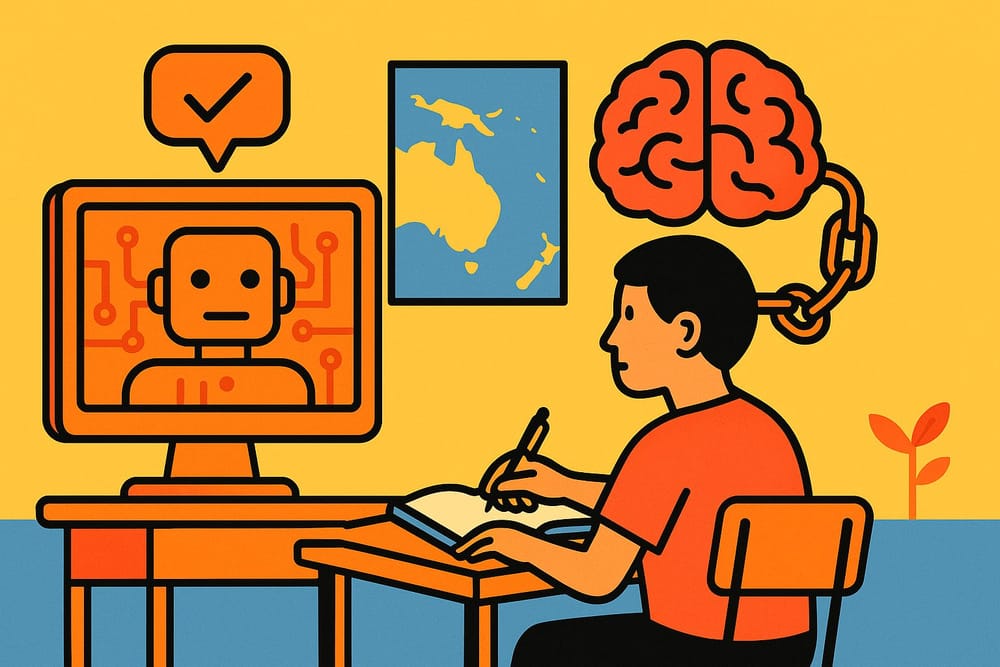
- AI in class improves short-term results by 48%, but produces dependency: without access to the tool during the exam, the GPT Base group scored 17% lower than the control group without AI.
- Access remains a differentiating factor; the quality of pedagogical support and tool design influence the risks of cognitive substitution.
- In several education systems, equipment precedes training, risking adoption through substitution rather than augmentation.
- Two possible trajectories emerge for 2040: a generation performant with the tool but fragile without it, or augmented pedagogy that strengthens cognitive foundations, depending on the structural choices made now.
- Systems that separately measure performance with and without AI, and that train before deploying, appear to distinguish different trajectories.
The gain is real, the trap is too
Forty-eight percent improvement in the short term: the figure is striking. It has fueled budgetary decisions in several Australian and New Zealand states, accelerated tender processes, and provided promoters of these tools with an argument difficult to contest. The OCDE 2026 relays this research result from Bastani et al. It then measures what happens after withdrawal.
What happens after is the problem. During the closed exam immediately after the exercises, with no access to the tool or other resources, the GPT Base group scored 17% lower than the control group. This decline is consistent with reduced skills acquisition in this configuration.
The mechanism is known in cognitive science as cognitive offloading. When a tool accomplishes part of the mental work for the learner, the brain does not mobilize the same resources. Observable performance increases; integrable competence does not follow. Calculators posed the same question in the 1980s, and educational responses varied greatly by country. AI poses the same question at an unprecedented scale and speed.
The trial at the origin of this data was conducted in a Turkish high school; the OCDE 2026 reports the results, which illustrate a documented risk in this deployment configuration, without establishing a universal default trajectory. The tool is available, students use it, results progress, and nothing measures what disappears in the meantime.
The teacher as decisive variable
PISA 2025 observes associations between declared uses, opportunities to evaluate AI, and results, without directly ranking classes according to sustainable learning or dependency. The variable tested in the trial is tool design and its safeguards.
The study compares two distinct tool designs: GPT Base and GPT Tutor, whose instructions and safeguards differ. The first use consists of using GPT Base as a standard chat interface that provides students with complete answers and solutions, without the pedagogical safeguards of the second tool. The second consists of using AI to ask questions that a teacher could not pose to thirty students simultaneously, to personalize learning pace without externalizing reasoning, to make a misunderstanding visible and force the student to explain it themselves.
These two approaches rely on distinct designs and safeguards integrated into the tool, informed notably by teacher input. This pedagogical choice requires training that many teachers deploying these tools have not received.
An ethnographic study from Stanford on the Tutor CoPilot program documents this gap in American classrooms, but the pattern is found in Oceanic data as well. In the trial, the group using GPT Tutor achieved improved performance, while the group using GPT Base experienced regression when the tool was withdrawn. These results establish the effect of tool design; the effect of teacher training must be tested separately. The profile of immediate gain then decline on the autonomous test concerns the group using GPT Base without safeguards.
The educational gap has thus shifted. For ten years, the debate centered on access: disadvantaged students did not have the equipment, connections, or tools. This gap still exists. In systems that have deployed widely, and Australia and New Zealand are among the most advanced in Oceania on this point, pedagogical competence, tool design, and support influence results. A previous article in the journal explored how AI in school can equip students facing overwhelmed teachers: the OCDE 2026 data suggest that teacher preparation and appropriate design influence pedagogical effects.
Education systems equip before they train
The structural problem is documented in multiple systems. Budgetary decisions often place equipment before training.
In Australia, several states announced AI tool deployments in primary and secondary schools between 2024 and 2026. In some cases, tender calls preceded certification training programs for teachers. In New Zealand, the Ministry of Education published general guidance on AI use, but without making prior teacher training mandatory before deployment. The documented risk is that of teachers improvising use tending toward cognitive substitution due to lack of prior training.
This sequencing is observed in multiple education systems. Tool providers push for rapid adoption, school leaders measure immediate results, and teachers receive a tool along with vague instructions to integrate it into their practice. In-depth training in the distinction between cognitive augmentation and substitution is rare before deployment.
The cost of this order of things is not visible in the short term. Results rise, as the OCDE 2026 documents with the 48% gain during the access period.
In this trial, the unfavorable gap for GPT Base is observed on the autonomous exam without the tool, a configuration that few education systems measure systematically.
Current limits of assessments
A blind spot in current debate on AI in education concerns measurement tools. The PISA 2025 standards do not provide a standard protocol comparing separately performance with and without AI access.
This absence limits observation of the gap between assisted performance and autonomous exam documented in some trials. The absence of such national measures makes identifying effects more difficult. Some systems see results rising and consider that deployment is working.
This measurement problem has a direct consequence. Equipment produces measurable short-term results and channels funding toward it. Teacher training, whose effects are harder to measure in the short term, receives less funding. The circle closes.
A few education systems are beginning to break out of this logic. In Estonia, recognized as one of the most advanced systems for digital integration in Europe, the principle of training before deploying is formalized. This approach requires prior teacher certification to access equipment funding. It is costly in the short term, and its long-term effects precisely justify the investment.
Two trajectories for the 2040s
The question posed by the OCDE 2026 goes beyond the current school cycle. It concerns what an entire generation educated in an unmediated relationship with generative AI produces.
Access to GPT Base degraded performance on autonomous exams; analyses suggest that usage consisting of asking for and copying solutions is a primary mechanism. Assistance that replaces cognitive effort can harm acquisition of certain competencies, depending on the tool and context. They are acquired through repeated, often uncomfortable exercise of mobilizing them oneself.
This scenario is not inevitable. It is conditional on choices that education systems make, or do not make, right now. The other possible trajectory rests on an inverse premise: AI can better support learning when the tool includes pedagogical safeguards; the specific effect of teacher training remains to be established. In this trajectory, AI personalizes learning pace, detects misunderstandings, generates adapted exercises, and the teacher ensures the student does the mental work the tool could have done instead.
What distinguishes the two trajectories stems first from tool design. The same base model can produce different effects depending on interface design and its safeguards. Tool design and safeguards are a determining factor in this trial; the effect of teacher training was not tested in this trial and would require separate evaluation. Public funding conditional on prior teacher training would change priority order. The OCDE 2026 calls for rigorous pedagogical integration and evaluation of AI, without formulating this funding condition as a requirement.
The question of teacher training moreover joins broader debates on governance of AI tools in sectors with high public stakes. Autonomous robotics awaits its civil liability framework, and pedagogical AI awaits its cognitive responsibility framework.
Signals that allow distinguishing systems that succeed
Two indicators allow identifying which trajectory an education system is taking.
The first useful indicator is the performance gap between students with and without AI access during standardized assessments. When this gap is measured, published, and integrated into budgetary decisions, the system has the means to correct its trajectory. In the absence of this system-wide measurement, distinction is more difficult, but it is not impossible.
The second: the share of teachers who received prior training before deployment of tools in their school. This data is rarely published. Ministries communicate about the number of equipped schools; they rarely communicate about the rate of prior teacher training. The absence of this indicator in official reports is itself a signal.
Systems that publish these two measures and use them to guide their funding are few in number. They show that mastered augmented pedagogy is practicable: it does not require different technology, but different sequencing and political will to measure what is uncomfortable to measure. Countries that succeeded in avoiding polarization by robots in industry share in common having anticipated effects of substitution before suffering them. The same logic applies to education.
The next edition of the PISA program will integrate elements of AI literacy assessment. If it distinguishes performance with and without tool access, it will provide a comparative international measure of the cognitive gap. This will be the first clear signal on the real scale of the problem, and the first lever to convince systems that have not yet changed sequencing that the cost of inaction will be measured in a decade, not next year.
Sources
- OCDE Digital Education Outlook 2026
- Stanford Tutor CoPilot ethnographic study (Stanford University, no guaranteed URL)
- PISA comparative assessment frameworks (OCDE, no guaranteed URL for current edition)