Only one-third of European education systems integrate AI skills into their curricula, according to the 2026 Eurydice report. Students use the tool en masse and make progress on immediate tasks, but then score 17% lower than the control group that never had access to the tool when evaluated without AI. A trial conducted in a Turkish high school observed a gap between assisted performance and performance without AI.
The essentials
- Only one-third of 38 European education systems integrate AI skills into the curriculum, according to Eurydice 2026.
- With GPT Base, scores during exercises increased by 48% in the trial studied, but students then scored 17% lower than the control group without access to AI.
- Digital literacy remains determined by socioeconomic origin: families with cultural capital guide its use, others submit to it.
- Two trajectories open up for 2030: curricular transformation or equipment deployment without pedagogical reform.
A gap that starts in staff rooms
Before talking about students, we need to talk about their teachers. Only 29.7% of EU teachers surveyed in TALIS 2024 had participated in continuing education related to AI for teaching and learning. Most learned to teach in a world without generative AI, using methods designed to measure work done by a student alone. Today they find themselves evaluating outputs where they cannot always distinguish the human part.
This training gap is not a minor detail. It conditions everything that follows. A teacher who masters the tool can use it to identify struggling students, personalize an exercise, or require the student to explain aloud what the machine produced for them. A teacher who does not master it sees better-presented assignments pass through and checks the completion box. Unguided use can foster dependency, while an AI tutor designed with safeguards can better support learning.
The way AI is used depends partly on teacher training and schools’ capacity to organize its deployment. Schools best equipped—in budget, with proactive pedagogical leadership, with access to continuing education—manage to build coherent practices. Others let practices develop on their own.
The 17% drop and its effects on learning
Cognitive offloading does not produce the same effects depending on how the task is structured. When a student anticipates what they are looking for before using the tool, then compares the result obtained with what they had envisioned, the cognitive circuit remains partially active. Competence can build itself around the tool when the teacher explicitly organizes this moment of confrontation. Without this step, the apparent fluidity of the output masks the absence of deep processing. The effects of AI on learning depend on how the tool is designed and used.
A pedagogical design that exploits the friction between what the student knows and what the machine produces can support learning.
Yet this friction is precisely what most current uses erase, because it slows things down, because it makes the work less polished, and because insufficiently trained teachers do not yet know how to evaluate it. A drop after withdrawal cannot, on this basis alone, be attributed mainly to the absence of active pedagogy; the effects depend on how AI was used.
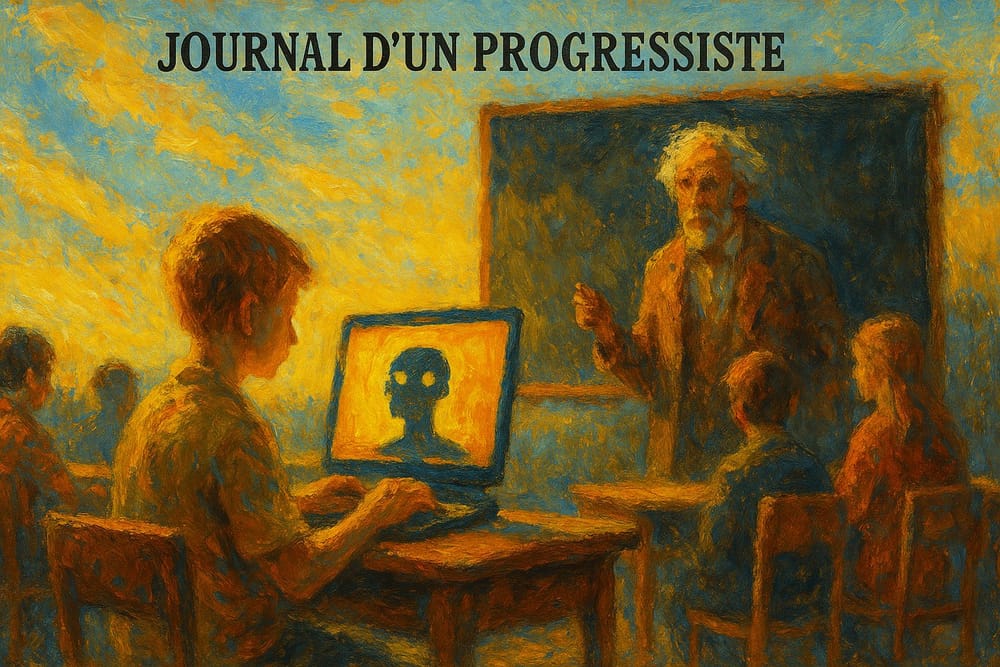
The most striking figure in the Eurydice-OECD corpus is not the equipment rate of schools. It measures what happens when AI disappears. After the phase of exercises with unguided GPT-4, students scored 17% lower on the test without the tool than the control group. This performance gap when the tool is removed says one precise thing: these students learned to delegate part of the reasoning, without acquiring the competence that the task was supposed to develop.
This mechanism is known in cognitive science as cognitive offloading. Cognitive delegation can reduce certain opportunities to practice a mental function, which can limit the learning of that competence. The student moves faster, but on ground that disappears when the tool is absent.
The trial observed an immediate 48% increase in scores during exercises with GPT Base. This immediate improvement is measurable. The student produces more, faster. But if this production is not accompanied by an explicit moment where they reprocess, explain, reformulate without help, the gain remains superficial. Education systems that congratulate themselves on rising completion rates are measuring the tool, not the student.
Cultural capital as invisible infrastructure
Educational digital divides include access to equipment, learning opportunities, skills, and support. Socioeconomic status is strongly associated with digital literacy outcomes.
In households where parents have higher education and familiarity with professional digital tools, the child does not enter alone with ChatGPT. They enter an environment where someone can ask them why they chose that phrasing, what reasoning they followed, what the AI provided that they would not have found alone. This informal guidance supports active learning around the tool.
In households where this cultural capital is lacking, AI is often used as an upgraded search engine or automatic writer, which reduces opportunities for active work and learning. AI’s wage bifurcation follows the same logic among adults: those who know how to direct the tool progress; those who submit to it lose ground.
School is when this bifurcation begins.
The 2018 ICILS results show that students from more advantaged socioeconomic backgrounds score higher on average in computer and information literacy. Without pedagogical safeguards, AI can degrade learning measured without AI; the trial does not demonstrate a persistent amplification of competence inequalities.
Countries making progress on digital competence
One-third of European education systems integrate AI skills into the curriculum. These countries deserve close attention, not as models to copy, but as laboratories whose results are already visible.
The most documented approaches share three characteristics. They explicitly distinguish in curricula the use of AI and critical digital competence—one is a behavior, the other is a transferable skill. They train teachers before deploying tools, rather than letting practices develop empirically. And they evaluate competence without the tool, periodically, to measure what has truly been integrated.
The European Commission launched a review of its guidance on AI in education in 2025, drawing notably on the European Parliament’s work on the digital rights of minors. This review provides practical guidance to educators on responsible AI use and the development of AI literacy. But pushing is not conditioning: European funding for school digital equipment is generally separated from formalized pedagogical requirements.
Equipping is measurable. Transforming pedagogy takes several years, mobilizes teaching unions, and its results do not appear before a full PISA cycle. Governments that must show results within a term prioritize equipment. Countries making progress on competence have accepted a longer horizon than the electoral calendar.
Emerging countries have ten years to avoid robot polarization: in Europe, the timeframe is comparable, and the urgency similar.
Two trajectories for 2030
The opening decade separates two distinct scenarios, and available signals allow us to distinguish them.
In the first, a significant share of European education systems transforms its curricula before 2030. The condition is precise: the curricular reform would aim for skill transfer rather than simple task completion. It is accompanied by initial and continuing teacher training, standardized assessments disaggregated by socioeconomic origin, and an out-of-school support system for students whose families lack digital cultural capital. In this case, a rebalancing of gaps between socioeconomic quartiles by 2035 is possible. Possible, not guaranteed: it depends on implementation quality and periodic evaluation of results.
In the second scenario, equipment continues to deploy without significant pedagogical transformation. Completion rates advance. Ministry dashboards improve. And beneath this surface, performance inferior to AI withdrawal becomes widespread in schools without the means to transform their pedagogical practices. Students whose families have digital cultural capital face a reduced risk.
Others may accumulate a deficit of critical competencies with effects over the long term. What democracy can function without a capable state?, the question applies to education too: without institutions capable of transforming their pedagogy, technical equipment becomes one more inequality.
The signal that would allow us to distinguish the two trajectories is simple to track: the share of European education systems that have integrated AI skills into their curricula, measured by Eurydice every two years, and the performance gap in digital literacy between socioeconomic quartiles, measured by PISA at each cycle. These two indicators, placed side by side, will say whether Europe has chosen to close the gap or manage it.
Possible decisions for Europe
The window for action is short. Students entering primary school today will enter the job market in the 2040s, in a professional environment already structured by AI use skills. What they will have learned, or not, to do with the tool during their schooling will influence their adaptation to an environment structured by digital competencies.
Two levers are available to European decision-makers. The first consists of tying school digital equipment funding to the adoption of an AI skills curriculum, with periodic evaluation. Certification is not a guarantee of pedagogical quality, but it creates an obligation of content that simple material provision does not impose. The second lever concerns students whose families have low digital cultural capital: targeted out-of-school support systems would create outside the home the guidance on tool use that school alone cannot always provide.
Neither of these levers is costly compared to the equipment itself. Materials represent the bulk of school digital budgets. Training, evaluation, and out-of-school support represent the marginal fraction. Changing this proportion is a political choice, not a budget constraint.
The question that European Ministries of Education will have to settle by 2027 is therefore this: do they want to measure the completion rate of homework, or the competence of students when the machine is turned off?
Sources
- Digital Education at School in Europe, Daniel Jeffrey Koch / Eurydice 2026 (substack)
- Eurydice, Digital Education at School in Europe, 2026 report, European Commission
- OECD, Digital Education Outlook 2026
- European Commission, AI in Education Policy Review, 2025
- European Parliament, reports on the digital rights of minors, 2025
- PISA 2025, survey on AI and learning outcomes (OECD)