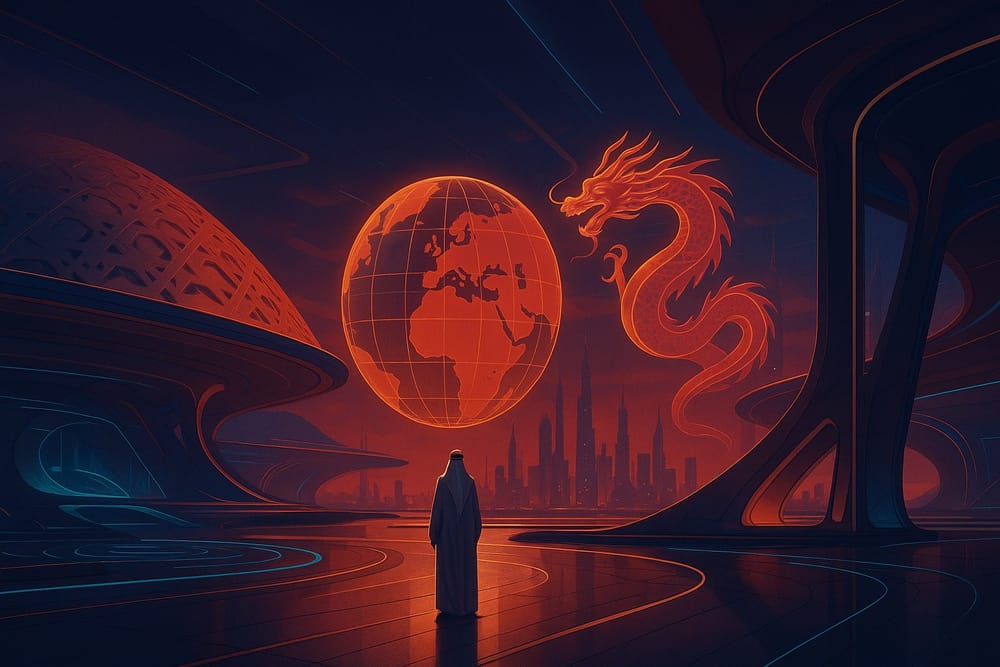
The United Arab Emirates finishes tenth in the Brand Finance Soft Power Index 2025, Saudi Arabia twentieth, Qatar twenty-second—remarkable positions for states that did not exist as cultural powers thirty years ago. Yet China presents infrastructure and non-interference as principles of its cooperation with Arab states, and has listed energy, commerce, investment, finance, technology, and security among its regional sectoral priorities. Respondents from Saudi Arabia and the UAE interviewed in late 2023 expressed generally favorable perceptions of this approach. Multiple logics of influence coexist in the Middle East, and the outcome remains open.
The essentials
- The Gulf relies on cultural institutions and major events developed on different timescales.
- Saudi and Emirati respondents interviewed in 2023-2024 widely perceive China as a partner, while the United States is more closely associated with regional tensions.
- The Chinese model is based on physical assets and infrastructure, while the Gulf mobilizes cultural institutions and narratives.
- The Israeli-Palestinian conflict provided the context for the survey, without the survey alone establishing that it caused a shift toward China.
- Competition between these two models could influence each one’s capacity to set political norms and cultural references in the region.
The Gulf has built an influence machine at accelerated speed
In 2007, France and the UAE signed an agreement providing for a Louvre brand license worth 400 million euros and loans of French artworks. The museum opened in 2017 on Saadiyat Island. In 2024, it welcomed 1,422,021 visitors. The equation is explicit: buy cultural legitimacy that time alone cannot manufacture quickly enough.
Al Jazeera preceded this logic. Launched in 1996 in Doha with funding from Qatar’s emir, the channel enjoys significant audience reach across the Arab world. It covered the Arab Spring from inside the region, something no Western channel could do with the same narrative credibility. The 2022 World Cup amplified the operation with massive infrastructure investments in Qatar, and above all with planetary visibility that classical diplomacy would not have achieved in fifty years.
These instruments are not decorative. They embody an explicit strategy of influence within the region, while China employs other channels.
Gaza changed the emotional grammar of the region
Dominique Moïsi advanced in his work on the geopolitics of emotions a thesis that polling from 2024-2026 in the region renders particularly legible: fear, humiliation, and hope structure alliances well beyond rational calculations. The post-October 7 Middle East provides a direct illustration.
Before October 7, 2023, a partial improvement in the image of the United States was observed in some Arab countries outside the Gulf. Surveys containing observations before and after October 7 can measure the evolution of perceptions, without perfectly isolating all the causes of that evolution. The United States is associated with regional instability according to these surveys. China is perceived as a distinct partner, maintaining limited direct involvement.
This perception should be read for what it is: an emotional movement first and foremost. China took an explicit position in favor of a ceasefire, humanitarian aid, and a two-state solution, while maintaining limited direct involvement. In the economy of humiliation that Moïsi describes, absence can count for as much as action.
Yet a rational counterpoint exists. Some observers note that the perception of an actor as “neutral” or “benevolent” may be related to its level of exposure in the region. China is less visible because it is less involved, which could change rapidly if economic interests drive it to do so. China is present in certain Gulf ports. The accumulation of economic assets can modify the capacity or willingness to maintain a posture of non-interference.
This is precisely where rational interest calculation reasserts itself against emotional dynamics.
Scope and limits of rankings
The Brand Finance Soft Power Index 2025 places the UAE in the global top ten. This ranking aggregates indicators of cultural, diplomatic, economic, and media influence. The Emirates surpass countries like Italy or South Korea—an achievement that, for a state of ten million inhabitants founded in 1971, few observers would have anticipated at the turn of the 2000s.
But the ranking measures global reach, not regional effectiveness. Yet it is at the regional level that the battle is being fought. Al Jazeera enjoys significant audience reach in the Arab world, but limited reach outside that region. The Louvre Abu Dhabi welcomes substantial visitor flows, but origin data indicate diverse composition, including expatriates and Asian tourists.
China, conversely, does not concern itself with its score in these rankings. Its strategy relies on the accumulation of economic assets: port infrastructure, telecom networks, participation in special economic zones. This type of influence is not measured in television viewers or museum visitors. It is measured in contracts, stakes, and levers that can be activated when interests demand. On this terrain, Al Jazeera and the Louvre Abu Dhabi do not operate in the same category.
It is useful to connect this debate to one running through other regions of the world. Korean and Japanese series have shown that cultural soft power can durably modify perceptions, and even consumer behavior, in countries where these states had no prior military or economic foothold. East Asia has demonstrated that narrative can precede capital. The question is whether the Gulf can replicate this dynamic at a broader regional scale, or whether its soft power will remain concentrated in capitals and elites.
The Chinese infrastructural model has its own fragilities
Presenting the Chinese model as uniformly effective would be inaccurate. Several recipient countries of the Belt and Road Initiative have renegotiated or abandoned projects after measuring the conditions of dependence they implied. In 2018, the Mahathir government suspended the ECRL and cancelled two pipeline projects; the ECRL was later renegotiated and relaunched. Sierra Leone, Tanzania, and Bolivia followed similar trajectories on different projects.
In the Middle East, the situation differs: the external financial position varies sharply among Gulf states, several of which also issue external debt. They have the financial capacity to choose their partners and diversify their dependencies. The shift toward China in opinion polling does not necessarily imply a durable strategic alignment.
This nuance is essential for reading the data correctly. Perceptions of China in opinion surveys reflect emotional and political dynamics of the moment. Gulf governments simultaneously maintain security agreements with Washington, economic partnerships with Beijing, and cultural investments that cultivate their own narrative independence.
Trajectories toward 2035
The real uncertainty concerns the longevity of this moment. Two trajectories are plausible, and the data allow examining their conditions without settling arbitrarily.
In the first trajectory, infrastructural soft power prevails durably. It assumes that Western credibility continues to erode in the region, which depends as much on American policy as on the evolution of the Israeli-Palestinian conflict, and that Chinese investments deepen. In this scenario, Al Jazeera remains influential in the Arab world, the Louvre Abu Dhabi retains its prestige, but the physical anchorage that Chinese infrastructure provides would impose limits on them. The Gulf’s cultural soft power would become an instrument of regional autonomy rather than a global counterweight.
In the second trajectory, recipient states gradually perceive the political and economic costs of Chinese infrastructural dependence. Signals already exist: renegotiation of projects in other regions, concerns over data sovereignty in telecom networks, and the rise of a generation of politicians educated in the West who want to diversify partnerships. If this dynamic accelerates, demand for alternative narratives and independent cultural institutions increases, and Gulf instruments, Al Jazeera foremost, become a balancing lever that other countries in the region have reason to support.
The signals to watch are concrete. The evolution of opinion polling following a potential de-escalation in Gaza will tell whether the shift toward China was cyclical. The share of major regional infrastructure projects awarded to non-Chinese companies—European, American, Indian, or from the Gulf itself—will tell whether effective diversification of partnerships is beginning. And the cultural co-production agreements that Gulf states will or will not sign with other Global South countries will indicate whether their cultural soft power seeks to anchor itself beyond passive audience reach.
One avenue deserves attention: conditioning infrastructural partnerships, whether from China or elsewhere, on clauses for local skills transfer reduces dependence and changes the perception of value in public opinion. Several African countries are beginning to impose this requirement. If Gulf states formalize it in their own negotiations, they could create a model that other countries in the region would adopt, and in doing so, reduce the comparative advantage of the pure Chinese non-interference model.
The stakes are who sets the norms
Soft power rankings struggle to grasp an essential dimension: the capacity to set norms, technical standards, cultural references, and governance models that other countries in the region adopt, spontaneously or under constraint. Tourist flows and infrastructure financing volumes do not exhaust this question.
On this terrain, China has clear ambition and a long horizon. It supports university cooperation, Confucius Institutes, and scholarship programs in several Middle Eastern countries. States in the region use Chinese equipment in their infrastructure. These technological choices carry durable political implications that Gulf cultural institutions may struggle to counterbalance.
Yet the Gulf possesses an asset China does not: cultural and linguistic proximity to the rest of the Arab world. Al Jazeera speaks Arabic, not Mandarin. The Louvre Abu Dhabi displays works of Islamic heritage alongside universal collections. These institutions embody a vision of the world that articulates modernity and Arab identity—a message that Beijing cannot carry with the same authenticity.
Competition between these two models of influence, narratives against concrete, values against non-interference, will remain open for a long time yet. What is already established is that the current Middle East has plural options in matters of partnerships and cultural models. It has become terrain where multiple models contend. This plurality of choices is perhaps the most significant datum that surveys and rankings together allow us to read.
Sources
- Brand Finance Soft Power Index 2025, Brand Finance
- IPRC Turkey Soft Power Analysis, Institute for Political Studies and Comparative Relations (cited via Brand Finance)
- Oxford Internet Institute, Public Opinion Surveys KSA/UAE on China and the United States, 2024-2026
- Dominique Moïsi, The Geopolitics of Emotion, Flammarion, 2008
- Al Jazeera Media Network, Official audience data (350M+ viewers)
- Louvre Abu Dhabi, Annual visitor figures (2M visitors)
- Qatar Supreme Committee for Delivery & Legacy, Infrastructure investment figures for 2022 World Cup