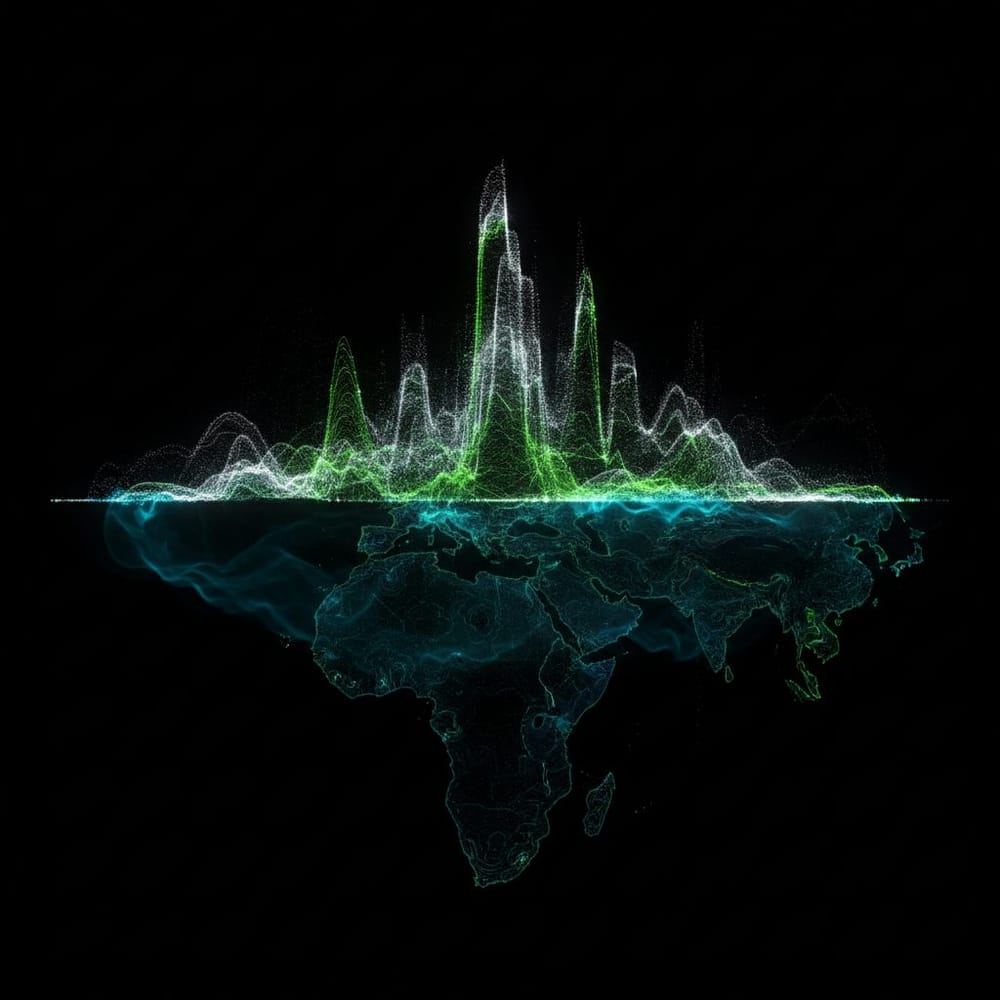
The data that the UNESCO Institute for Statistics publishes in 2026 documents sustained growth in global R&D investments, but also signals persistent inequalities and masks a deeper fracture. East Asia now devotes a significant share of its GDP to research, at a level close to that of Europe and North America, but the race for laboratories says nothing about the capacity to sustain a scientific community. For Middle Eastern countries, which are multiplying ultramodern campuses and billion-dollar announcements, this distinction is not abstract: it determines whether their investments produce science or merely architecture.
The essentials
- East Asia has nearly caught up with Europe in the share of GDP devoted to R&D, according to the UNESCO Institute for Statistics in 2026, even if regional inequalities persist.
- Women remain underrepresented in global research: they represent 31.4% of researchers, a signal that scientific ecosystems structurally exclude a portion of their potential.
- Building infrastructure attracts equipment, not communities: researcher retention depends on stable careers, academic freedoms, and international networks—three conditions that money alone does not guarantee.
- Gulf countries have launched ambitious bets on science as a lever for economic diversification, but researcher density per million inhabitants and the share of international co-publications remain the true indicators to monitor.
- Between 2030 and 2050, two trajectories confront each other: the integrated ecosystem that circulates talent, and the showcase infrastructure that accumulates equipment without retaining minds.
Money is not enough to make science
The growth in figures is real. In one generation, several East Asian economies have multiplied their R&D spending by factors that would have seemed unrealistic in the 1990s. South Korea, Japan, and China have built massive research apparatuses. The gap with Europe and North America has narrowed to an interval that statistics deem almost comparable, even if convergence remains partial and regional inequalities persist.
But the UNESCO Institute for Statistics takes care to distinguish between two quantities that public debate often conflates: gross R&D spending and the human density of research. A laboratory is financed. A scientific community is built. These two processes do not follow the same timeline, nor do they have the same conditions.
The most significant figure from the 2026 data concerns women in research: 31.4% of global researchers. Investment amounts tell us nothing about this reality. A scientific ecosystem that structurally excludes 68% of potentially qualified women operates with only a portion of its available human capital. Countries that make progress on this indicator do so by modifying career conditions, evaluation methods, and reception structures.
This is long institutional work, which resists the logic of the grand inaugural project.
Gulf achievements and open projects
Gulf countries have launched a series of scientific bets that deserve to be taken seriously. Saudi Arabia invested heavily in KAUST, an international research university located on the Red Sea, recruiting researchers from around the world with competitive salaries and world-class equipment. The United Arab Emirates created Mohamed bin Zayed University of Artificial Intelligence, the world’s first university entirely dedicated to AI, and attracted collaborations with institutions like MIT and the Sorbonne. Qatar built Education City, a campus hosting branches of Cornell, Georgetown, and Northwestern.
These strategies have produced measurable results. The region’s scientific publications have increased. International partnerships exist. Foreign doctoral students have come, some have stayed. As noted in the article on the Gulf’s AI bet, these investments fit within a logic of economic diversification that goes beyond simple institutional prestige.
But a tension remains, which UNESCO data allows us to formulate precisely. Investing in infrastructure attracts equipment and researchers on fixed-term contracts. Retaining researchers in the long term, building a critical mass that produces students, ideas, and durable networks, requires something else. This assumes stable careers, sufficient research freedom to take intellectual risks, and integration into international circuits of publication and competitive funding. On these three dimensions, the Middle East presents highly heterogeneous situations from one country to another, and often below what investment announcements suggest.
Technology reduced to showcase
Jean-Noël Missa, a philosopher specializing in transhumanism and the relationship between technology and humanism, has worked on what is produced by thinking that confuses technological deployment with human progress. His reading of Silicon Valley as the geopolitics of technological salvation applies, with important nuances, to Gulf scientific strategies: there is in certain discourses on innovation hubs an implicit idea that building the right infrastructure suffices to make the right community emerge. The human, the concrete researcher, with their career trajectories, family constraints, and needs for academic freedom, remains at the margins of the narrative.
This critique has real force. Announcements of ultramodern campuses and record investments function as signals of modernity, addressed as much to financial markets and foreign partners as to researchers themselves. The risk is that showcase logic ends up substituting communication about science for the practice of science.
But a competing reading deserves to be considered alongside it. Economists who study industrial policy and innovation systems, notably Dani Rodrik, in his work on smart industrial policy, show that public investments in new capacities can create conditions that the market alone would not have produced, provided governments learn from their mistakes and adjust their policies. Gulf campuses are not destined to remain showcases: several have begun producing local graduates, funding researchers from the region, establishing permanent postdoctoral programs. The open question is at what pace and with what depth this transformation consolidates.
UNESCO data does not settle this tension. It poses it.
Female underrepresentation as a maturity test for ecosystems
The 31.4% of women in global research constitutes a global floor, not a target. Some regions perform worse, others substantially better. Latin America and Central Asia present female participation rates in research above the global average, often beyond 40%, without this corresponding to levels of investment equivalent to Europe or East Asia. This decoupling is instructive.
It suggests that women’s representation in science depends less on absolute resource levels than on institutional structures, social norms, and evaluation policies. A country that invests massively in R&D while maintaining informal barriers to women researchers’ careers does more than lose talent: it reveals the structural limits of its ecosystem.
For the Middle East, this indicator is particularly significant. Several countries in the region have increased the number of women in higher education remarkably over the past twenty years. In Saudi Arabia, women today represent a majority of university graduates. But the transition from presence in higher education to active scientific careers remains fraught with practical and cultural obstacles. Building mixed laboratories is not enough to overcome them.
Between 2030 and 2050: two trajectories for Gulf laboratories
The Middle East’s current science investments will, or will not, produce by 2030 to 2050 sustainable scientific ecosystems. The concrete alternative is one of underutilized infrastructure, due to a lack of locally trained researchers capable of building entire careers there.
Two scenarios are emerging, though current data does not allow us to distinguish between them with certainty.
In the first, countries in the region progressively build the conditions for an integrated ecosystem. This requires competitive and open calls for proposals, careers that allow young researchers trained in local universities to remain and advance without having to go into exile, and sufficient regional cooperation to constitute a critical mass that no single country can achieve alone. The indicators to monitor are researcher density per million inhabitants, a structural indicator that UNESCO data documents, and the share of international co-publications, which measures integration into global scientific networks rather than merely local production. Sustained growth in both indicators over a decade would indicate that the transformation is real.
In the second scenario, equipment remains without community. Researchers recruited from abroad depart after their contracts. Brilliant local students defend their theses in Europe or the United States and have insufficient academic reason to return. Laboratories function, but below their potential, like antennas of networks whose heart remains elsewhere. This scenario is not inevitable, but it corresponds to what several emerging countries experienced when they bet on infrastructure before working on institutional conditions.
The difference between the two trajectories hinges on three concrete variables, independent of amounts invested. The first is career structure: a path toward permanent researcher status, with advancement prospects, must exist for someone making their entire career in the region. The second is the space of academic freedoms: researchers must be able to choose their subjects, publish sensitive results, and collaborate freely with foreign partners, including on socially or politically delicate topics.
The third variable is regional cooperation. Laboratories in Riyadh, Abu Dhabi, Doha, and Amman can work together on shared infrastructure, or remain in competition for the same nomadic researchers. This organizational choice conditions the long-term viability of developing ecosystems as much as budgets do.
These questions apply also, with variations, to other emerging regions. Sub-Saharan Africa, South Asia, Latin America: all have laboratories that lack researchers more than they lack equipment. The lesson from UNESCO’s 2026 data may lie there: the growth of R&D investments is good news, but it says nothing about convergence in human capacities to do science. This second convergence is slower, harder to measure, and impossible to decree.
Co-publications, beyond budgets
There is one indicator that debates on R&D investments often neglect: the share of scientific publications produced in international collaboration. This figure measures something that domestic spending does not capture—the integration of a scientific system into global networks of knowledge production.
Countries whose science advances most rapidly are not necessarily those that spend the most. They are often those whose researchers co-publish the most with foreign partners, who participate in major research consortiums, who send their doctoral students on mobility exchanges and host them. This circulation is what transforms a laboratory into a community.
For the Middle East, developing this dimension implies explicit policies: mobility funding, mutual recognition agreements for degrees, integration into major European or American research instruments, participation in international calls for projects. Some countries in the region have begun this work. Others are still at the announcement stage.
The growth in spending figures, documented by UNESCO, is the beginning of a story. Indicators of human circulation and international collaboration are its continuation. They will tell, in ten or twenty years, whether the laboratories built today have become places where science is done, or monuments to the scientific ambition of an era.
Sources
- UNESCO Institute for Statistics, 2026 R&D Data Release
- UNESCO, Science at a turning point, July 13, 2026 (report available on UNESCO’s website)
- The Gulf Bets on AI to Diversify Its Economy, Journal d’un Progressiste
- UNESCO – Science at a turning point (July 13, 2026)
- UNESCO – Status and trends of women in science (March 2025)
- WIPO GII 2025 – Global R&D Spending
- KAUST – Official site
- MBZUAI – Wikipedia
- Sorbonne University Abu Dhabi – Official site
- Qatar Education City – Visit Qatar
- PMC – Research performance of GCC countries
- Wikipedia – Women’s rights in Saudi Arabia