Twelve million French houses rest on clay soils that swell and shrink with droughts. Their owners suffer gaping fissures, subsiding foundations, homes losing their value. The national compensation scheme pays out, premiums rise, and municipalities continue to authorize construction on the same exposed land. This cycle has a name: maladaptation. It is a political choice that can be unmade in 2027.
Twelve million houses on foundations that give way
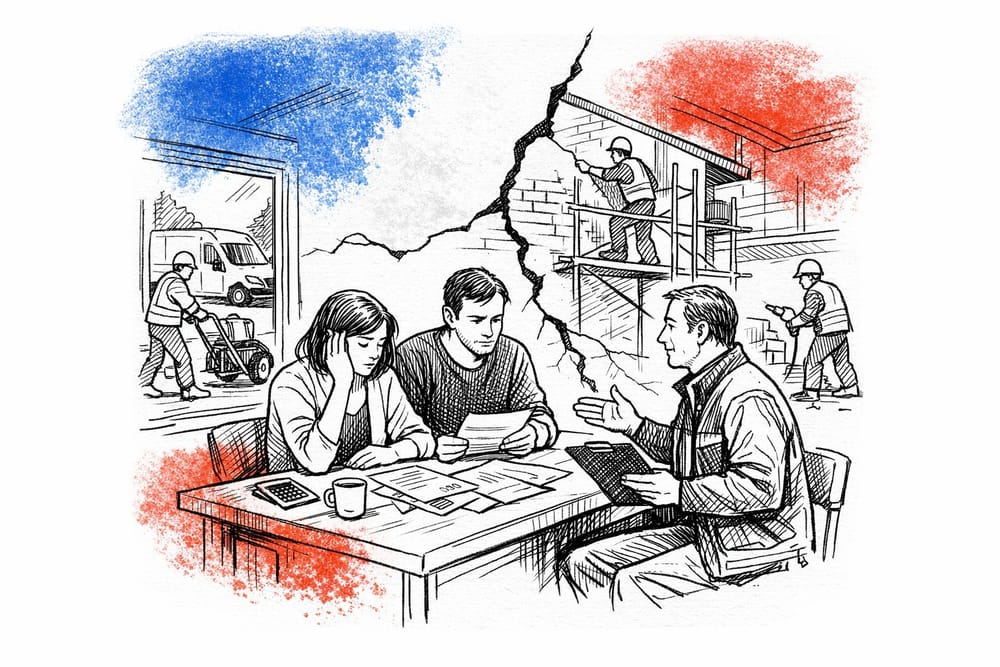
Since a decree of January 9, 2026, 12.1 million individual houses are classified in zones at risk of clay shrinkage-swelling [4]. The mechanism is simple: under the effect of drought, soil shrinks and causes foundation subsidence. When rain returns, it swells. Walls crack, sometimes drastically. Some homes become uninhabitable, unrentable, unsaleable.
Repair costs range, depending on surface area and the extent of damage, between 30,000 and 80,000 euros [2]. The average claim stood at 16,500 euros in 2023 [2]. That is roughly seven and a half months of median net salary: half of private sector employees earn less than 2,190 euros net per month [1]. For a modest homeowner, it is often double or triple what remains after paying their mortgage.
The scale has shifted. Before 2016, the average annual cost of drought remained below 300 million euros. Since then, it regularly exceeds one billion [2].
In 2022, it reached 3.5 billion [2]. Over forty years, flooding represents 24.8 billion euros in insured damages out of 49.9 billion paid for natural disasters between 1982 and 2022 [2]. Over the last decade, clay shrinkage-swelling has become the costliest natural risk: 53 percent of indemnifications paid under this coverage [2].
A compensation scheme calibrated for the old world
The natural disaster compensation system, created in 1982, long functioned as a solid shock absorber. Since its creation, it has made it possible to compensate 3.6 million claims for more than 50 billion euros [14]. But it was calibrated on past loss experience.
The Central Reinsurance Fund estimates that loss frequency should increase by approximately 40 percent by 2050 due to climate change, and by 60 percent when factoring in the evolution of insured assets [3]. To hold, the natural disaster surcharge increased from 12 percent to 20 percent for home insurance policies on January 1, 2025 [14]. The mission on the insurability of climate risks estimates that this rate will need to reach 26 percent by 2050 [14]. The mechanism compensates by charging more to all policyholders, without acting on the causes of accumulation.
An Elabe study from 2023 reveals that nearly one in two French people think they will no longer be able to insure themselves tomorrow against natural disasters [3]. This is not irrational anxiety.
An adaptation plan that constrains nothing
France equipped itself in March 2025 with a third National Plan for Climate Change Adaptation, which officially prepares the country for a warming of 4°C by 2100 [9]. In this scenario, today’s heat waves would be considered normal in a France at 2.7°C by 2050 [12]. Heat waves would be five times more frequent, with temperatures potentially reaching 48°C [12].
Since January 26, 2026, the reference climate trajectory, TRACC, has been inscribed in the Environmental Code [10]. It lacks legislative force, creates no new obligations, and is neither binding on the legislature nor on administrative authorities. A planning document that constrains nothing changes nothing.
The High Council for Climate judges that “the plan is a step forward in its design, but financial resources are manifestly insufficient” [6]. It estimates the need for adaptation investment at 2.3 billion euros per year [6]. That is five times the plan’s actual annual budget. The Green Fund, on which territorial financing largely depends, was reduced from 2.5 to 1.15 billion euros between 2024 and 2025 [7].
The Court of Auditors, in its 2024 annual public report entirely devoted to adaptation, asks the State to quantify the budget efforts necessary in the face of “the wall of investments” to come [5]. It adds that if the 4°C scenario by 2100 is confirmed, the plan’s content should be “substantially different from that of the two previous plans, as should the budgetary effort to be made” [5]. The gap between what is being invested and what would be necessary stems from a question of structure: who decides where one builds, who pays when the house cracks, and who bears the risk of future exposure.
Making TRACC binding or continuing to pay for maladaptation
The mechanism producing the current situation is known. Municipalities authorize construction on risky soils. The State and insurers mutualize damages through the natural disaster system.
No one bears the cost of the urban planning decision at the moment it is made. The natural disaster system, by socializing repair, implicitly finances maladaptation. Tim Lenton, in Positive Tipping Points (2024), describes precisely this type of lock-in: compensation institutions absorb shocks without modifying the behavior that produces them [13].
Each euro invested in adaptation avoids up to 10.5 euros in damages [8]. Investment needs amount to 10.6 billion euros per year through 2050 [7]. In 2025, mobilized public aid reached 1.7 billion euros [7]. The Institute for Sustainable Finance, which calculated this ratio, draws a simple conclusion: increasing credits without changing the rules of the game is not enough [8].
The choice for 2027 consists in inscribing TRACC into urban planning law with binding force. Any permit to build in an exposed zone would then engage the responsibility of the municipality issuing it, rather than transfer the burden to the national system. The High Council for Climate emphasizes that taking TRACC into account as a reference in all territorial planning documents constitutes “a minimum condition to make the implementation of adaptation operational” [6]. Minimum, not sufficient: it assumes the trajectory is binding, not merely advisory.
Concretely, this shift modifies each mayor’s interest in developing exposed zones. A municipality that authorizes a house on clay soil classified as high-risk would bear the burden of future claims not covered by insurance, without transferring it to the national system. Building standards are also lagging: the RE 2020 regulation, in force since 2022, takes the 2003 heat wave as reference for an average climate event in 2050 [9].
Summer 2026, with its 100,000 hectares of forest burned and 0.1 percentage points of GDP lost according to the General Directorate of the Treasury, made visible what annual assessments still concealed [11] [15]. Adaptation is no longer a policy of anticipation. It is already a policy of economic survival. It remains to decide who pays the bill.
Sources
[1] INSEE, “Wages in the Private Sector in 2024,” INSEE Première no. 2079, October 23, 2025, https://www.insee.fr/fr/statistiques/8657156 (accessed 09/19/2026).
[2] CCR / SDES, “Key Figures on Natural Risks: 2023 Edition,” SDES, January 2024, https://www.statistiques.developpement-durable.gouv.fr/edition-numerique/chiffres-cles-risques-naturels/ (accessed 09/19/2026).
[3] CCR, “Consequences of Climate Change on the Cost of Natural Disasters in France by 2050,” September 2023, https://www.ccr.fr/consequences-du-changement-climatique-sur-le-cout-des-catastrophes-naturelles-en-france-a-horizon-2050/ (accessed 09/19/2026).
[4] BRGM / Géorisques, National map of exposure to clay shrinkage-swelling, decree of January 9, 2026, https://www.georisques.gouv.fr (accessed 09/19/2026).
[5] Court of Auditors, 2024 Annual Public Report: Public Action in Favor of Climate Change Adaptation, March 2024, https://www.ccomptes.fr/fr/publications/le-rapport-public-annuel-2024 (accessed 09/19/2026).
[6] High Council for Climate, Opinion on the Third National Plan for Climate Change Adaptation (PNACC-3), March 2025, https://www.hautconseilclimat.fr/wp-content/uploads/2025/03/2025_HCC_auto_saisine_avis_PNACC3_VF.pdf (accessed 09/19/2026).
[7] I4CE (Institute for Climate Economics), “Adapting France to +4°C: Resources, Needs, Financing,” September 2025, https://www.i4ce.org/en/publication/adapting-france-four-degrees-current-resources-additional-needs-funding-options-climate/ (accessed 09/19/2026).
[8] Institute for Sustainable Finance (IFD), “A France at +4°C: Financing Economic Adaptation to Climate Change,” May 2026, https://institutdelafinancedurable.com/en/linstitut-de-la-finance-durable-publie-son-rapport-une-france-a-4c-financer-ladaptation-de-leconomie-au-changement-climatique/ (accessed 09/19/2026).
[9] Ministry of Ecological Transition, Third National Plan for Climate Change Adaptation (PNACC-3), March 10, 2025, https://www.ecologie.gouv.fr/actualites/gouvernement-lance-nouveau-plan-national-dadaptation-changement-climatique (accessed 09/19/2026).
[10] Decree no. 2026-23 of January 23, 2026 and order of January 23, 2026 inscribing TRACC in the Environmental Code, Official Journal, January 25, 2026, https://www.adaptation-changement-climatique.gouv.fr/comprendre/strategie/une-trajectoire-reference-pour-sadapter-au-changement-climatique (accessed 09/19/2026).
[11] General Directorate of the Treasury, estimate of the impact of heat waves and drought in summer 2026 on growth, August 2026, reported by Journal de la Météo de l’Ain, September 3, 2026, https://www.lejma.fr/2026/09/03/canicules-2026-la-france-perd-01-de-son-pib/ (accessed 09/19/2026).
[12] Météo-France / HCC, 2025 Annual Report of the High Council for Climate, chapter 1, July 2025, https://www.hautconseilclimat.fr/wp-content/uploads/2025/09/Chapitre-1_HCC_RA_2025.pdf (accessed 09/19/2026).
[13] Tim Lenton, Positive Tipping Points: How to Fix the Climate Crisis, Oxford University Press, 2024, https://global.oup.com/academic/product/positive-tipping-points-9780198875789 (accessed 09/19/2026).
[14] Senate, Report on the Natural Disaster Compensation System, 2024, https://www.senat.fr/rap/r23-603/r23-6033.html (accessed 09/19/2026).
[15] France Assureurs, assessment of claims related to summer 2026 fires, Public Senate, August 29, 2026, https://www.publicsenat.fr/actualites/environnement/une-facture-qui-sannonce-considérable-apres-les-incendies-les-canicules-et-la-secheresse-de-lete-2026 (accessed 09/19/2026).