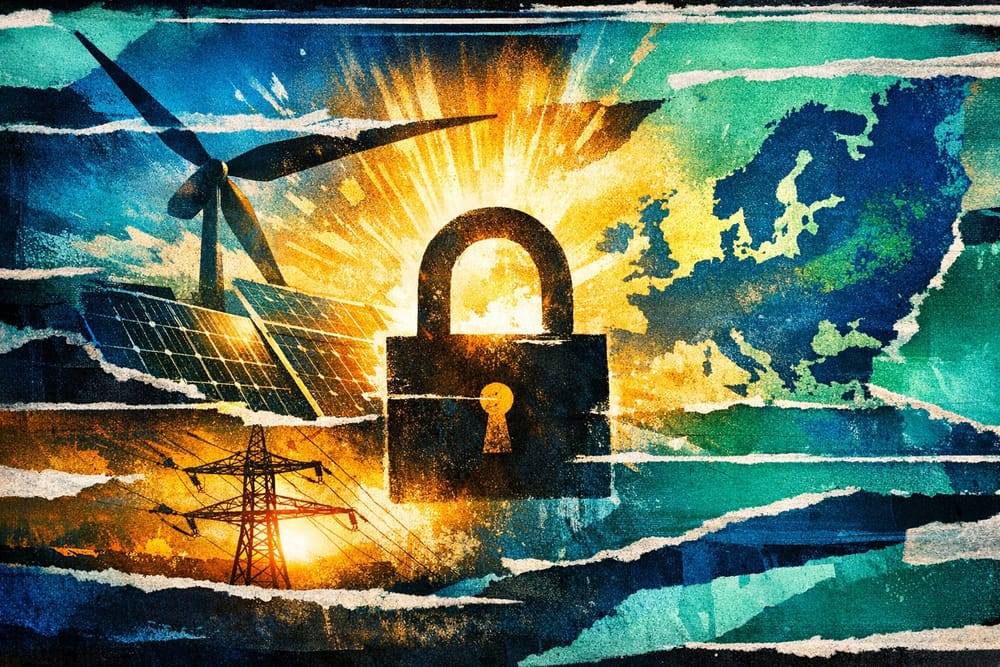
Queues exist in at least 16 EU countries for reasons including capacity, planning, transparency and application maturity. By mid-2026, the Commission reports, according to Ember, that approximately 120 GW and 1.5 million domestic installations risk delayed grid access by 2030. The queue grows each year due to insufficient transmission lines and cables, but also because in some national frameworks, first-come-first-served can reserve capacity, though this principle is not a binding European rule. Finland was considering a priority procedure taking progress into account, among other factors, but it was not yet applicable and excluded electricity production.
The Essentials
- By mid-2026, 120 GW of mature renewable projects and 1.5 million domestic installations risk remaining unconnected by 2030 in sixteen Member States (European Commission, European grids, 2026).
- The bottleneck results from network constraints and connection procedures, whose allocation rules may be a factor: the first-come-first-served principle allows speculative applications to occupy network capacity for years without construction.
- European guidelines indicate that maturity criteria can discourage speculation, but this effect cannot be attributed to a Finnish allocation mechanism already applied to renewables.
- Daniel Yergin observes that the global energy transition resembles addition more than substitution: renewables accumulate without always replacing fossil fuels. The European grid illustrates this mechanism: without rapid connection and sufficient network capacity, renewable deployment can be delayed and reduce their ability to replace fossil production.
- Reform of allocation rules, combined with physical investments, affects the probability that Europe achieves its climate goals.
Sixteen Countries, a Growing Queue
Grid connection queues are not a marginal phenomenon. In June 2026, the European Commission identifies bottlenecks in at least sixteen Member States. Network capacity sometimes exists physically, but is reserved by applications filed years earlier, a significant fraction of which will never result in actual construction.
The mechanism is straightforward. The “first-come-first-served” regime can favor immature or speculative applications when not accompanied by maturity criteria, milestones and financial guarantees. A developer can reserve capacity on multiple projects to complete one. The other four remain in the queue, blocking access for a competitor’s more advanced project. The Agency for the Cooperation of Energy Regulators (ACER) documents this phenomenon in its 2026 energy infrastructure monitoring report: in several countries, a significant portion of pending applications never reach the construction phase.
The concrete result: wind farms financed, authorized and ready to install their turbines wait several years for a connection point while phantom projects occupy the queue ahead of them. More than 1.5 million households could be affected by delays or prevention of rooftop solar connection. The queue is not abstract. It has financial cost for those waiting and climate cost for everyone.
The Finnish Reform and Its Scope
Finland modified its grid access rules by introducing maturity criteria at several stages of the process. An application must meet permit criteria and, depending on the project, certain land, environmental and technical requirements defined by Fingrid. A project failing to reach these milestones loses its position in the queue.
The Commission generally estimates that filtering non-progressing projects can free capacity. Network operators gain visibility into what will actually be connected, facilitating physical investment planning.
This model is not ex nihilo a Finnish invention. Spain, Portugal and the United Kingdom have experimented with variants of conditional connection contracts linked to milestones. Finnish criteria do not apply uniformly to all connections and certain mechanisms are specific to project categories. The Commission published its guidelines on December 19, 2025 and recommends general queue management principles, including maturity criteria, without citing the Finnish approach.
The Finnish reform also demonstrates something that debates on network investment tend to overlook: before building new cables, existing ones must be allocated efficiently. The 120 GW waiting in Europe are not all awaiting missing infrastructure. Some are waiting for a rule that changes.
Addition Before Substitution
Daniel Yergin, in an article published in Foreign Affairs with David R. Orszag and Atul Arya, argues that what governments call “energy transition” actually resembles “energy addition”: renewable capacity accumulates without substituting for fossil fuels, which continue to grow in absolute value at global scale.
Europe is the most advanced theater of transition. But the 120 GW stuck in queue illustrate precisely this mechanism of accumulation without substitution. A wind farm whose connection is delayed three years produces zero green electricity during this period. The gas or coal it would have displaced continues to burn. Installed capacity on paper and capacity that actually modifies the generation mix are two different figures.
This reading is not without tension with another family of analyses. Economists like Philippe Aghion, whose work on green growth examines how innovation policies accelerate technological substitution, would emphasize long-term dynamics more: once renewables become competitive, substitution structurally accelerates, independent of institutional friction at any given moment. The queue would then be a transitory obstacle, not an index of trajectory.
Mid-2026 data invites nuancing this confidence. Institutional frictions are not always transitory. When they crystallize in allocation rules no one reforms due to lack of political consensus, they can last a decade. The 2030 horizon set by the European Union for its climate goals leaves little margin for friction lasting that long.
The tension between the two readings is real, and available data do not resolve it. What they show, however, is that governance and network capacity are important determinants of deployment speed, alongside costs and technology competitiveness. On this point, Yergin and Aghion converge more than they diverge: both emphasize that technical progress does not automatically translate into energy results. It requires institutions to accompany it.
Electrical grids are exactly such an institution. And they are behind. Air conditioning is another example: as the journal’s analysis of generalized air conditioning documents, each new electrical use arrives on a network not designed for it. The renewable connection challenge fits within this broader systemic pressure.
Who Pays, Who Waits, Who Abandons
The queue has a social geography. Large-scale industrial projects have the financial resources to wait years for a connection: legal teams, balance sheets able to absorb delays, institutional relationships. Local cooperatives, SMEs investing in their own production or households that have installed solar panels do not have these resources.
The risk of procedural status quo is therefore reproducing, in network access, the inequalities that already exist in capital access. The figure concerns households potentially affected by rooftop solar connection constraints.
Geographic network pricing adds another layer. In regions where capacity is scarce, connection cost can represent a significant part of a medium-sized project’s budget. Without visibility into actual delays and costs, some project proponents abandon before even entering the queue. Queue statistics do not count projects never filed because network access conditions discouraged their proponents upstream.
Transparency on available capacity, recommended by the European Commission in its guidelines published December 19, 2025, is a prerequisite for an equitable queue. A project proponent who does not know how much capacity is actually available in their geographic zone cannot make a rational investment decision. This opacity mechanically benefits actors with means to navigate uncertainty.
What European Grid by 2040
The allocation rules question arises in a context of broader transformation. The European electrical system must adapt to multiple simultaneous demand increases: increased renewable production, transport electrification, electric heating and digital uses.
Two trajectories emerge, and they are not symmetric in their risks.
In the procedural status quo scenario, queues persist. ACER notes multi-year delays for monitored transmission projects, without establishing this generalization to connections in most Member States. Speculative projects continue occupying capacity without construction. Likely result: European 2030 goals are not met, fossils remain in the mix longer than expected, and better-capitalized actors more easily access available capacity. The IEA considers that physical network expansion must be accompanied by modernization, more efficient operation and regulatory reform.
In the maturity-reform scenario, several Member States adopt the Finnish approach or its equivalents. Flexible agreements and maturity milestones are tools recommended or already employed in several countries, but their generalization is not established. Capacity freed by eliminating speculative applications accelerates ready-project connection. Connection delays tend to decrease. This scenario assumes sufficient European coordination to prevent regulatory divergences between Member States creating new obstacles for cross-border projects.
Between the two, signals to track are few but clear: volume of gigawatts in queue by country, average connection time, and share of projects abandoning during procedure. These three indicators, if the European Commission publishes them systematically and comparably, will provide a precise picture of actual trajectory by 2027 or 2028.
Allocation rules reform is not the only lever. Physical investment in high-voltage lines, cross-border interconnections and transformation stations remains essential. RTE, France’s transmission network operator, evaluates in its Future Energies 2050 scenarios that network investment needs are on the order of several tens of billions of euros over the decade. ACER formulates similar estimates for the European whole.
But physical investment must be accompanied by efficient connection procedures to reduce queues. Cables overfilled with speculative applications do not accelerate transition. The presence of queues in 16 countries does not allow claiming that their national laws ignore all maturity criteria.
Remaining Levers for the Commission
The European Commission stated this diagnosis in its December 2025 guidelines, then provided further clarification in July 2026. It recommends that Member States adopt maturity criteria, publish transparent data on available capacity and introduce flexible connection contracts. These recommendations have no force of law.
The open question is that of timeline and convergence mechanism. The European Union has tools to accelerate reform adoption by Member States: directly applicable regulations, conditions linked to structural funds, infringement procedures for non-compliance with renewable energy directives. Queue management falls mainly under the electricity market framework, while the renewables directive mainly governs connection permit procedures and timelines.
Analysis of long-term climate issues shows that each year of delay in fossil substitution produces effects measured in decades. The connection queue is where the political will to decarbonize the European economy meets the rules governing infrastructure access.
At least 120 GW of planned renewable projects are at risk due to network capacity constraints. Physical capacity exists, at least in part. The reform that would free this capacity is documented, tested and available. The Commission identifies queues in at least 16 countries, without establishing that each refrains from applying a given reform.
Sources
- European Commission, European grids, 2026: https://energy.ec.europa.eu/topics/infrastructure/european-grids_en
- Daniel Yergin, David R. Orszag and Atul Arya, The Troubled Energy Transition: How to Find a Pragmatic Path Forward, Foreign Affairs: https://www.foreignaffairs.com/united-states/troubled-energy-transition-yergin-orszag-arya
- ACER, Energy Infrastructure Development Monitoring Report, 2026 (Agency for the Cooperation of Energy Regulators of the European Union)
- RTE, Future Energies 2050 (Electricity Transmission Network, France)
- IEA, World Energy Outlook (International Energy Agency)
- IRENA, system reports on renewable energy integration (International Renewable Energy Agency)