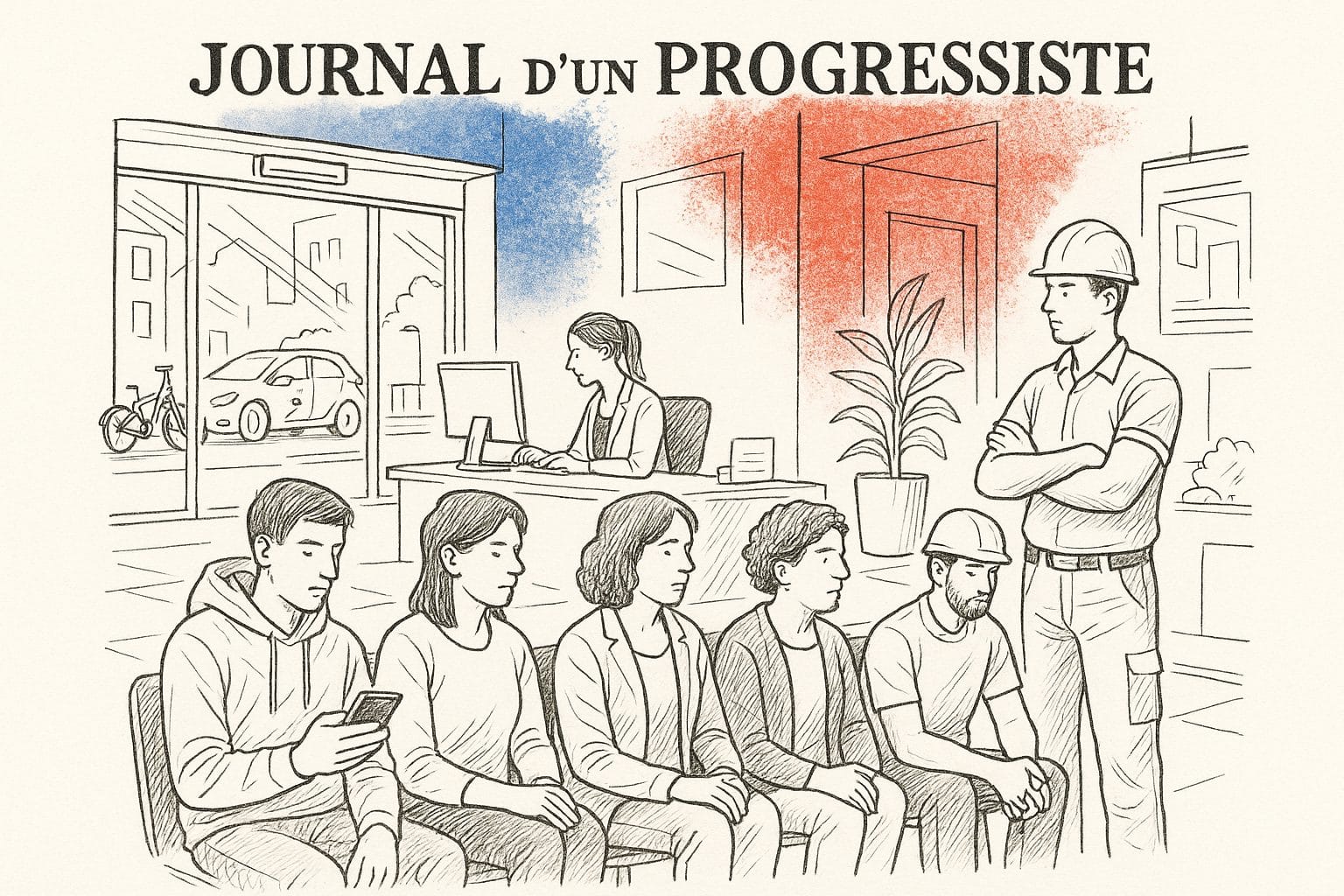
In ASEAN, the ILO does not yet observe widespread employment disruption linked to generative AI, while productivity gains are being reported in certain tasks. But this favorable window masks a widening fracture: women are more exposed to generative AI in many countries, but the actual distribution of gains is not established by this source. The question is no longer whether AI is reshaping work in the region, but whether the economies involved will act quickly enough for gains to be shared.
The essentials
- The ILO estimates that 22.9% of employment in ASEAN is potentially exposed, with marked concentration in finance, administration, and business services.
- MIT FutureTech reported worker assessments on task automation. The Yale Budget Lab observed no detectable disruption at the scale of the U.S. labor market in its data published in October 2025.
- In ASEAN, women are more than twice as likely as men to work in highly exposed occupations, mainly because of their concentration in administrative and professional roles.
- The arrival of autonomous agents could reduce the time available for training and tax policies to adapt.
- Singapore, Japan, and Australia are testing concrete responses; the rest of the region remains in waiting mode.
Productivity climbing, jobs holding, for now
MIT FutureTech reported worker assessments on task automation covering data analysis, report writing, customer request processing, and financial file management. AI can accelerate or automate certain tasks, but exposure does not allow us to claim that it systematically increases each worker’s productivity without replacing them.
The Yale Budget Lab tracked U.S. labor market indicators. The ILO indicated in July 2026 that it does not observe large-scale job losses in ASEAN, without establishing this claim for Asia-Pacific through August 2025. Job creation appears in certain areas, notably systems maintenance, quality control of AI outputs, commercial functions backed by increased productivity.
This picture is encouraging. It is also provisional. The current phase is one of augmentation: AI amplifies what workers already do. The next phase, that of autonomous agents capable of chaining multiple tasks without human supervision, changes the nature of the relationship. The available assessments cover the first phase; the second is only just beginning to roll out in HR and financial workflows at major firms in the region.
22% exposed, but exposure is not randomly distributed
The ILO has produced exposure estimates for ASEAN and AMRO has conducted a detailed study for Brunei, but employment-by-employment data for all of Asia-Pacific remains fragmented. Their aggregate figure, 22% of jobs exposed, masks a highly unequal distribution. The sectors most affected are finance, insurance, public administration, and business services. These are sectors with high density of repetitive and codifiable tasks: data entry, filing, routine analysis, standardized reporting.
Female presence varies greatly by sector and sub-region; it is notably majority in aggregated public services, care, and social services.
The correlation is no accident of timing. It reflects long-standing occupational segregation. Women have been directed, by the market and by social norms, toward functions precisely those that AI handles best. Administration, file management, support functions in finance: these professions were the first to be augmented by current tools, and will be among the first to be substitutable by autonomous agents of the next generation.
Women are overrepresented in occupations more exposed to AI.
This mechanism is documented in other labor markets. France pays twice the price for forced part-time work, a situation where the concentration of women in structurally devalued jobs results in a double penalty, in wages and social rights. In Asia-Pacific, the dynamic differs in its causes, but is comparable in its logic: productivity gains in feminized sectors benefit unequally firms and workers.
Singapore, Japan, Australia: three different bets
Three economies in the region have undertaken structured responses. Their approaches diverge, but they share a common diagnosis: the window for adaptation is short.
Singapore launched sectoral accelerated retraining programs via SkillsFuture. Singaporeans aged 40 and over have access to mid-career training support. The approach is deliberate and quantified.
Japan approaches the problem differently. Its main constraint is demographic: with a working-age population in decline, while the active population rose to 69.57 million in 2024, AI is presented as a necessity, not a threat. The Japanese government grants tax incentives for AI adoption, but without a general condition linking these subsidies to wage increases. It remains to be seen whether major Japanese companies, traditionally slow to adjust compensation, will follow the signal.
Australia chose the fiscal angle. The Productivity Commission’s report addresses notably data regulation and AI, without an identified recommendation on an expanded employer contribution to training funding. The debate is open, unions and employers are still negotiating. But the principle—taxing gains before they are consolidated by a few—is now part of public debate.
The rest of the region waits. Indonesia, the Philippines, Vietnam, Thailand: economies whose fiscal structure varies. The question of sharing gains between labor and capital arises in these countries with particular urgency, because automation could weaken the tax base if it reduces the wage bill.
The arrival of autonomous agents changes the calculation
Available sources address uses and effects still limited, primarily in the United States for Yale and in ASEAN for the ILO. The assistant drafts a first version, analyzes a spreadsheet, proposes a response. The worker validates, corrects, decides. The data observed so far show job growth in exposed professions, without allowing attribution of this employment preservation to a particular configuration.
Autonomous agents can chain actions independently, with controls, authorizations, or human interventions depending on context, and manage extended workflows. An agent deployed in an HR department can process a leave request, check entitlements, update the system, and notify the manager, without a human needing to intervene at each step. In finance, agents can generate regulatory reports, cross-reference data across systems, flag anomalies, and prepare decisions.
These deployments are beginning. Available sources do not allow direct measurement of hiring trends beginning in the region’s tech and financial hubs. Discreet signs of internal reorganization are observed: adjustment of job postings and increased mobility toward supervisory roles in some large firms. Aggregate statistics do not yet capture this.
This is precisely the moment economists call the “adaptation window.” When productivity rises but employment still holds, governments have a fiscal lever and an educational lever. The fiscal lever: capture a share of productivity gains to finance adjustment. The educational lever: retrain exposed workers before their positions disappear. These levers could become harder to use as substitution progresses.
ISEAS published AI governance analyses in 2026, but no assessment consulted corresponds to institutional capacity to respond to a defined employment transition window. The best-positioned economies, those combining an active vocational training system, robust tax administration, and political will to link productivity gains to wage policy, are also those that have begun to act: Singapore, Japan, Australia, South Korea. Exposure varies greatly within Southeast Asia and is not uniformly higher than in the advanced economies of the region, which must adapt their institutional tools.
2026-2030: two trajectories, one central trade-off
The period ahead is decisive, and two scenarios are plausible. Neither is a forecast; these are conditional directions.
In the first scenario, economies that act early on both levers, tax and training, could transform productivity gains into a collective good. Taxation of productivity gains could finance retraining. Workers in exposed functions acquire skills in supervision, auditing AI outputs, designing workflows. Wage gaps persist but do not widen further.
Agentic substitution arrives, but displaced workers have a safety net and a trajectory.
In the second scenario, political inertia prevails. Governments wait until the impact is statistically visible before acting—that is, after the window has closed. A significant portion of productivity gains could be captured by firms and their shareholders. The supply of entry-level jobs could decline; exposed workers remaining in position could see their bargaining power weaken.
Income inequality could widen, without sudden rupture or spectacular statistic, just a continuous drift that standard indicators capture with a delay.
What distinguishes the two trajectories is not technology. The deployment of autonomous agents progresses in both cases. What distinguishes them is the timing of public policy engagement. As substitution progresses, levers for redistribution through training and taxation risk losing effectiveness.
Three signals will reveal which trajectory is underway: the change in the share of entry-level positions in job postings published by tech and financial firms in the region, the pace of autonomous agent deployment in HR and finance workflows disclosed in large companies’ annual reports, and fiscal reforms affecting the labor-capital relationship in Southeast Asia. These signals will be readable before 2027, before aggregate employment statistics really shift.
Results from the most advanced economies
It would be inaccurate to present this window as merely theoretical. Concrete policies exist, and partial results are measurable.
SkillsFuture reports 520,000 individual enrollments in supported training in 2023; the figure of approximately 660,000 applies to 2021. Data on conversion to better-paid jobs following supervision or AI audit training are not available in the official sources consulted. SkillsFuture is administered as a public program and financed from government budget.
Japan has promoted both digital investments and wage policies, without an official rule consulted linking AI incentives to an obligation for companies of more than 300 employees to negotiate wages. This mechanism, conditional sharing of productivity gains, remains imperfect and poorly monitored, but it establishes a principle that other economies in the region have not yet formalized.
These examples do not resolve the question of women in the most exposed functions. Singapore’s retraining programs do not always include an explicitly gender dimension. Measures announced in 2025 support job redesign and training, but the results of this correction are too recent to evaluate seriously.
These experiments show that a coherent political response is feasible. A number of economies in the region are slow to act before employment statistics record the problem.
Sources
- MIT FutureTech 2026, AI Productivity and Labor: https://laweconcenter.org/wp-content/uploads/2026/02/AI-Productivity-and-Labor.pdf
- Yale Budget Lab, report on employment in Asia-Pacific, August 2025 (Yale Budget Lab, Yale University)
- ILO / AMRO, mapping of AI exposure in Asia-Pacific (International Labour Organization; ASEAN+3 Macroeconomic Research Office)
- ISEAS, institutional capacity assessments by country, 2026 (ISEAS–Yusof Ishak Institute, Singapore)
- Ministry of Manpower of Singapore, SkillsFuture data 2024 (Singapore Ministry of Manpower)